
Managing a barbering career means more than mastering the craft. It requires running a business, and with that comes an underutilized financial opportunity available to self-employed professionals: the ability to deduct business expenses from taxable income. For barbers operating as booth renters or independent contractors, the difference between a tax return prepared with and without legitimate deductions can amount to thousands of dollars per year.
This guide is designed to give working barbers a comprehensive understanding of the tax deductions available to them, what qualifies, what does not, and how to document everything properly. As with any tax-related matter, the specifics of your situation may vary based on your business structure, income level, and state tax laws. Always work with a licensed CPA or tax professional who understands service-based businesses and self-employment before filing.
All deductions referenced in this article are grounded in guidance from the IRS Publication 334: Tax Guide for Small Business, which is the primary reference document for sole proprietors and self-employed professionals in the United States.
Understanding Your Status Before Making Deductions
Employee vs. Independent Contractor
Your eligibility to deduct business expenses depends entirely on how you are classified for tax purposes. Barbers who receive a W-2 from a shop owner are considered employees and have significantly limited options for claiming business deductions under current federal tax law, particularly after the Tax Cuts and Jobs Act of 2017 eliminated the miscellaneous itemized deduction for unreimbursed employee expenses at the federal level.
Barbers who rent a booth or suite and operate independently are generally classified as self-employed independent contractors. They receive 1099-NEC forms from any platform that processed payments to them, or no form at all if clients pay directly in cash or by card. These individuals file a Schedule C (Profit or Loss from Business) alongside their Form 1040, and every legitimate write-off reduces their net profit, which in turn reduces their taxable income and their self-employment tax liability.

The IRS “Ordinary and Necessary” Standard
According to the IRS, a deductible business expense must be both “ordinary” and “necessary.” An ordinary expense is one that is common and accepted in your trade or profession. A necessary expense is one that is helpful and appropriate for your business. It does not need to be indispensable. Understanding this standard matters because it is the benchmark the IRS applies when reviewing deductions. The clippers you sharpen and replace regularly are ordinary and necessary. The luxury SUV you commute to work in is not a good tax deduction to take simply because you are self-employed.
Here are some examples of common expenses for barbers that make sense, fit the standard and can be written-off:
- Clippers, trimmers, and shears purchased to perform haircuts are ordinary because every working barber uses them, and necessary because the job cannot be done without them
- Barbicide, disinfectant sprays, nitrile gloves and sanitation supplies are necessary to meet state board hygiene requirements
- Booth rent paid to a shop owner
- A barber smock or professional apron bearing your shop’s branding
- A professional portfolio or social media account used to showcase your work and attract clientele
- Continuing education courses required for state license renewal
- Hair care products such as pomades, gels, and clays applied during client services
- A point-of-sale or appointment booking system to manage scheduling and collect payment
- Travel to a beauty supply distributor to purchase professional inventory
- Professional liability insurance to protect against claims arising from your services
Documentation: The Foundation of Every Deduction
No deduction is valid without records. The IRS expects taxpayers to maintain records sufficient to show the amount, date, place, and business purpose of every expense claimed. Receipts, bank statements, invoices, and mileage logs are all critical. A best practice is to maintain a dedicated business bank account and business credit card, which creates a clean, auditable paper trail that separates personal and professional spending from day one.
Booth Rent and Business Premises Expenses
Booth Rent
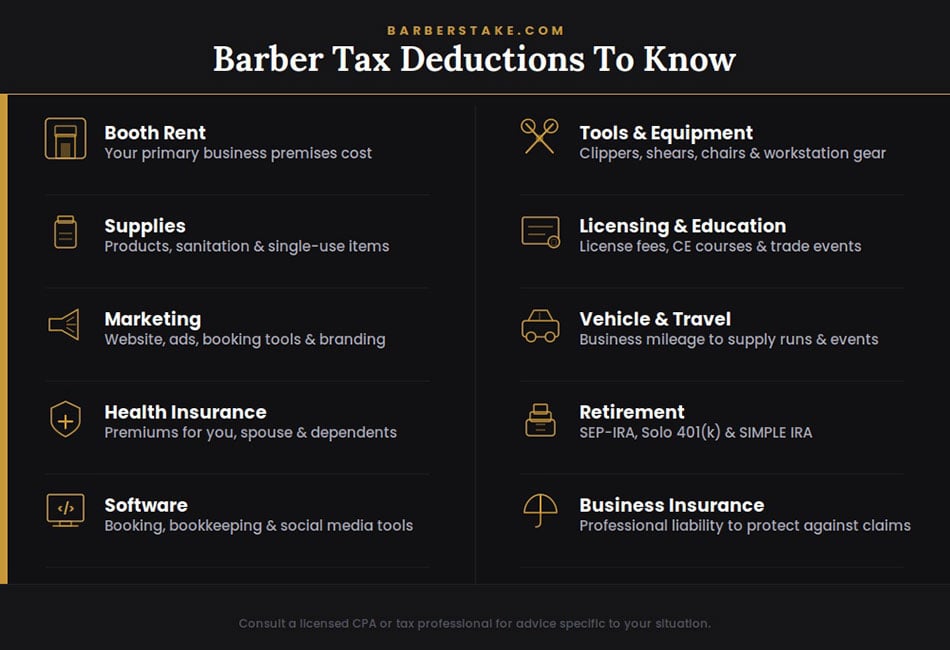
For most self-employed barbers, booth rent is the single largest business expense they pay, and it is fully deductible on Schedule C. Whether you pay weekly, bi-weekly, or monthly, keep every payment receipt or bank record. If your booth rental is documented through a formal lease agreement, retain a copy of that document as well.
Suite and Private Room Rental
Barbers who rent private suites through platforms or independent suite facilities operate slightly differently but with the same tax outcome: rent paid for the space where you conduct your business is a deductible write-off. Any separately billed charges for utilities, internet, or common area maintenance fees that are included in your lease arrangement or billed to you directly should also be expensed to the extent they are business-related.
Security Deposits
Security deposits paid to a landlord or booth rental facility are generally not immediately deductible because they are considered a refundable asset, not an expense. However, if a deposit is applied to rent in arrears, used to cover damage you caused, or is otherwise forfeited, that portion may become eligible in the year it is applied or forfeited. Consult a tax professional if you have a deposit situation that is more complex.
Tools and Equipment

Clippers, Trimmers, and Cutting Tools
Every piece of equipment you purchase to perform barbering services is a deductible business expense, including clippers, trimmers, detailers, shears, straight razors, and replacement blades, as well as all accessories including guards, combs, picks, and brushes. Keep your receipts from any professional supply store, whether physical or online.
Section 179 Expensing vs. Depreciation
Barbers have two primary ways to deduct expenses for higher-cost equipment purchases. The first is standard depreciation, where the cost of the asset is deducted incrementally over its useful life as determined by IRS asset class schedules. The second is Section 179 of the Internal Revenue Code, which allows qualifying businesses to deduct the full purchase price of qualifying equipment in the year it was placed in service, up to an annual limit set by the IRS.
For a barber purchasing a high-end clipper set or a hydraulic chair, Section 179 can provide a meaningful upfront deduction rather than spreading it over several years. Bonus depreciation rules may also apply, depending on the year of purchase.
Workstation Equipment and Furnishings
Barbers who own their space or who have purchased equipment for their booth or suite, such as chairs, mirrors, lighting, and tool storage, can deduct these costs as well. These are capital expenses that may be deducted through Section 179 or depreciated over their useful lives, depending on the amount and your tax strategy.
Repairs and Maintenance
Routine maintenance on your tools, including clipper blade sharpening services, blade replacement, and minor repair costs, is fully deductible as an ordinary and necessary business expense in the year the expense is incurred.
Supplies and Consumables
Barbers go through a significant volume of consumable products and single-use supplies in the course of normal operations. All of the following qualify as business write-off when purchased for professional use:
- Shaving creams, gels, and foams
- Hair care products including pomades, clays, waxes, sprays, and conditioners used on clients
- Barbicide and other disinfectants and sanitizing solutions
- Neck strips, draping capes, and barber towels
- Disposable blades and razors
- Gloves and other personal protective equipment
- Sanitation supplies including paper towels, tissues, and surface wipes
- Aftershave lotions and talcum powders used during services
Retain purchase receipts from your distributor, supply house, or retail supplier. If you purchase supplies through an online account, download and archive your order history at the end of each year.
Licensing, Certifications, and Professional Dues
State Barber License Fees
Your state barber or cosmetology license is a legal requirement to practice your profession, making renewal fees a legitimate deduction on your taxes. This applies to both the initial license and any renewal fees paid during the year. Business operating license fees required by your city or county are also write-offs.
Professional Association Dues
Membership dues paid to professional organizations related to your work, such as industry barber associations, may be deductible. Personal, social, or recreational club memberships generally do not qualify.
Background Check Fees
If your state requires background checks as part of the licensing or re-licensing process, those fees are considered an ordinary and necessary cost of maintaining your professional standing and are deductible.
Education and Professional Development
Continuing Education Required for License Renewal
Most states require barbers to complete a set number of continuing education hours before they can renew their professional license. Fees paid for these qualifying courses are deductible. According to IRS Publication 970, education expenses are deductible when the education maintains or improves skills required in your current job or is required by law or your employer to keep your current job, title, or rate of pay. Education that qualifies you for a new trade or business, however, does not qualify under this standard.
Advanced Skills Training
Workshops, seminars, and training classes focused on advanced cutting, fading, straight razor shaving, or other barbering techniques that improve your existing professional skills are legitimate deductible expenses. This includes both in-person and online training platforms.
Industry Events and Trade Shows
Registration fees for industry conventions, trade shows, and professional conferences related to barbering are write-offs. Related travel and lodging expenses may also qualify under the rules for business travel, discussed in more detail below.
Books, Manuals, and Learning Materials
Books, instructional videos, and professional publications that support your development as a barber or as a business owner are allowable when they are directly related to your professional practice.
Marketing and Advertising
Digital Presence
A common barber business expense is the full cost of building and maintaining a professional online presence, including website design fees, hosting fees, and domain registration. Social media advertising costs on platforms such as Meta, Instagram, and TikTok for the purpose of attracting clients are fully deductible as advertising expenses.
Print and Branded Materials
Business cards, flyers, banners, and any other printed promotional materials representing your barbering business should be written-off on your taxes. Branded merchandise such as custom aprons or shop apparel intended as promotional tools may also qualify, depending on how they are used.
Photography and Content Creation
Professional photography or videography hired specifically to create content showcasing your work for business promotion is a legitimate advertising expense. Equipment purchased specifically for content creation for your business may also qualify, though the deductibility and method of deduction will depend on the extent to which it is used for business versus personal purposes.
Booking Platforms and Client Management Software
Subscription fees for online appointment scheduling platforms, client management systems, and loyalty program software that you use to operate your barbering business are business expenses to remember to list as deductions.
Work Clothing and Uniforms
What Qualifies
The IRS allows a deduction for work clothing when two conditions are met: the clothing must be required as a condition of employment, and it must not be suitable for everyday wear. Branded barber aprons and smocks that bear your business name or logo and are worn exclusively in your professional capacity generally meet this standard. The cost of cleaning and maintaining qualifying work attire is also a deductible expenditure.
What Does Not Qualify
General street clothing and casual attire, even if you purchase it primarily for work, does not qualify as a deductible uniform expense. The IRS takes the position that if the clothing can reasonably be worn outside of work, it is a personal expense regardless of the context in which you typically use it. For a thorough overview of clothing deduction rules, refer to IRS Publication 463.
Phone and Internet
Cell Phone
If you use your personal cell phone for business purposes, including booking clients, communicating with suppliers, managing social media accounts, and operating apps related to your business, you can deduct the business-use portion of your phone bill. The IRS requires that you calculate the percentage of time the phone is used for business versus personal use and apply that percentage to your total monthly expense.
Home Internet
Similarly, if you use your home internet for business-related tasks, you may deduct the business-use percentage of your monthly internet bill. Maintaining clear records of how and how often you use your connection for business activity will support your deduction in the event of a review.
Software and Digital Subscriptions
The cost of software and digital subscriptions used in the operation of your barbering business is deductible. Common examples include:
- Appointment booking and scheduling apps
- Point-of-sale systems and payment processing software
- Accounting and bookkeeping software
- Social media management tools used for business promotion
- Cloud storage and file management services used for business files
- Streaming music services used in your work environment, provided you are subscribed to a licensed commercial plan
Personal subscriptions shared between business and personal use should be prorated based on actual business use.
Vehicle and Transportation Expenses
Deductible Business Driving
If you use your personal vehicle for business-related driving, you can deduct those miles. Qualifying business-related trips include driving to purchase supplies, traveling between multiple work locations in the same day, and driving to educational events, trade shows, or meetings with vendors and business contacts.
However, your daily commute from home to a single, regular place of business is not deductible. The IRS does not consider commuting a business expense. You can find detailed guidance on this distinction in IRS Publication 463.
Standard Mileage Rate vs. Actual Expense Method
The IRS provides two methods for deducting vehicle expenses. The standard mileage rate allows you to deduct a fixed rate per mile driven for business, which the IRS adjusts annually. You can find the current rate at IRS Standard Mileage Rates. The actual expense method requires you to track all vehicle-related costs, including gas, insurance, repairs, and depreciation, and then deduct the portion attributable to business use based on the percentage of total miles driven for business.
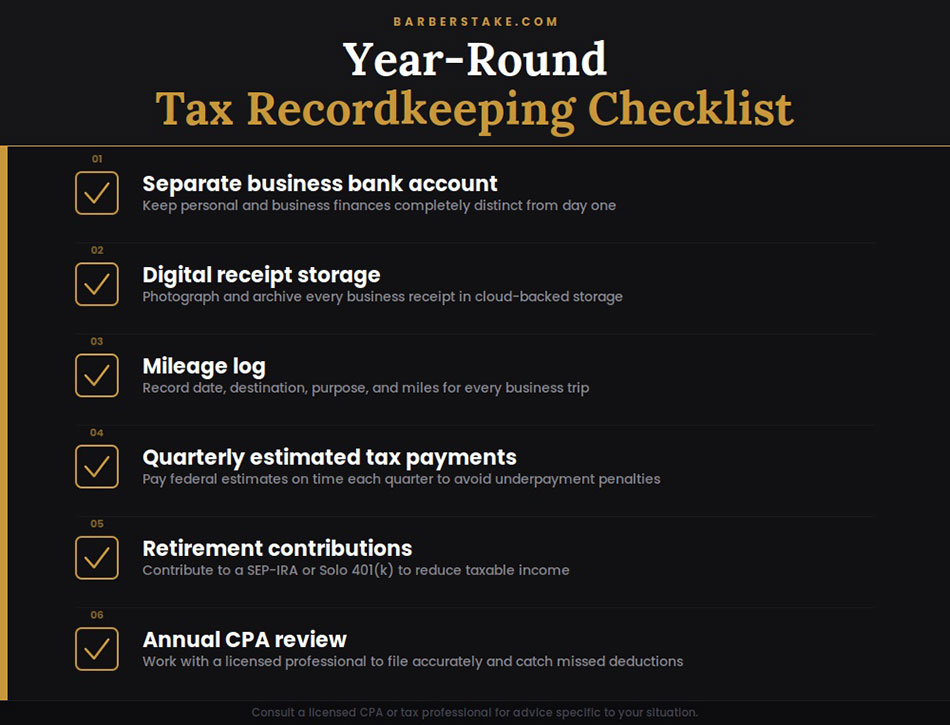
In either case, a contemporaneous mileage log recording the date, destination, purpose, and miles driven for each business trip is essential. Smartphone mileage tracking apps can simplify this process considerably.
Health Insurance Premiums
The Self-Employed Health Insurance Deduction
One of the most impactful deductions available to self-employed barbers is the ability to deduct health insurance premiums paid for themselves, their spouse, and their dependents. This is an above-the-line deduction, meaning it reduces your adjusted gross income (AGI) without requiring you to itemize deductions on Schedule A.
To qualify, you must not be eligible to participate in an employer-sponsored health plan through a spouse or other employer, and your deduction cannot exceed your net self-employment income for the year. Dental and vision premiums paid for qualifying individuals are also included. IRS Form 7206 is used to calculate this deduction, and the result flows to Schedule 1 of Form 1040.
Retirement Contributions
Contributing to a tax-advantaged retirement account is one of the most powerful financial moves available to a self-employed barber. Contributions reduce your taxable income now, while building long-term wealth for the future. Three primary options exist for sole proprietors:
SEP-IRA
A Simplified Employee Pension (SEP-IRA) allows self-employed individuals to contribute up to 25% of their net self-employment income, up to the annual IRS limit. Contribution limits are published annually by the IRS and can be found at IRS SEP Plan FAQs. Contributions are fully deductible and the account is straightforward to establish through most major financial institutions.
Solo 401(k)
A Solo 401(k), also known as an individual 401(k), allows a self-employed individual to make contributions both as the employee and as the employer, which can result in higher total annual contributions compared to a SEP-IRA at certain income levels. The IRS publishes contribution limits and guidance at IRS One-Participant 401(k) Plans.
SIMPLE IRA
A SIMPLE IRA is another option, though it is more commonly used by small businesses with employees. Self-employed individuals without employees can establish a SIMPLE IRA, but the SEP-IRA and Solo 401(k) often offer more flexibility and higher contribution limits for those operating solo.
Business Insurance Premiums
Insurance premiums paid to protect your business and professional activities are fully deductible expenses. Relevant policies for barbers include:
- General liability insurance: Protects against claims of bodily injury or property damage occurring in connection with your services.
- Professional liability insurance: Sometimes called malpractice or errors and omissions insurance, this covers claims related to professional services rendered.
- Property insurance: Covers the tools, equipment, and physical assets of your business against loss or damage.
- Business interruption insurance: Replaces lost income if your business is forced to close temporarily due to a covered event.
Shop owners with employees should also consider workers’ compensation insurance, which is typically required by law in most states and is a deductible business expense.
Home Office Deduction
Who May Qualify
Many barbers do not qualify for a home office deduction because their primary place of work is their booth or suite. However, if you regularly and exclusively use a specific area of your home for business administrative tasks, such as bookkeeping, client scheduling, content creation, or managing your business finances, you may qualify.
The IRS requires that the space be used regularly and exclusively for business. A guest bedroom where you occasionally sit at a desk to review invoices does not qualify. A dedicated room or clearly defined space used solely for business operations may. Detailed requirements are available in IRS Publication 587: Business Use of Your Home.
Simplified vs. Actual Expense Method
The simplified method allows you to deduct $5 per square foot of your qualifying home office space, up to a maximum of 300 square feet, for a maximum annual deduction of $1,500. The actual expense method allows you to deduct a proportional share of your actual home expenses, including mortgage interest or rent, utilities, homeowners or renters insurance, and repairs, based on the percentage of your home’s total square footage that the office occupies. The method that produces the larger deduction depends on your specific home costs and office size.
Bank Fees and Payment Processing Costs
The cost of doing business financially is fully deductible. This includes:
- Monthly maintenance fees for a dedicated business bank account
- Credit card processing fees charged by payment platforms such as Square, Stripe, or PayPal
- Merchant service fees
- Interest paid on business loans or lines of credit used exclusively for business purposes
Personal account fees and interest on personal debt are not proper deductions, even if you used borrowed funds for business-related spending in the past. Keeping business and personal finances completely separated makes documenting these deductions straightforward.
Business Meals
The IRS currently allows a deduction of 50% of the cost of qualifying business meals. A qualifying business meal is one where a business owner, employee, or contractor is present, and there is a clear, documented business purpose, such as meeting with a vendor, discussing a collaboration with another barber, or meeting with a business advisor.
The IRS requires documentation of the business purpose, the names of all attendees, the location, and the date. Meals consumed alone while working or meals purchased for personal enjoyment do not qualify. Entertainment expenses, such as taking clients to sporting events or concerts, are generally not deductible under current law as enacted by the Tax Cuts and Jobs Act. For the most current guidance, refer to IRS Publication 463.
The Self-Employment Tax Deduction
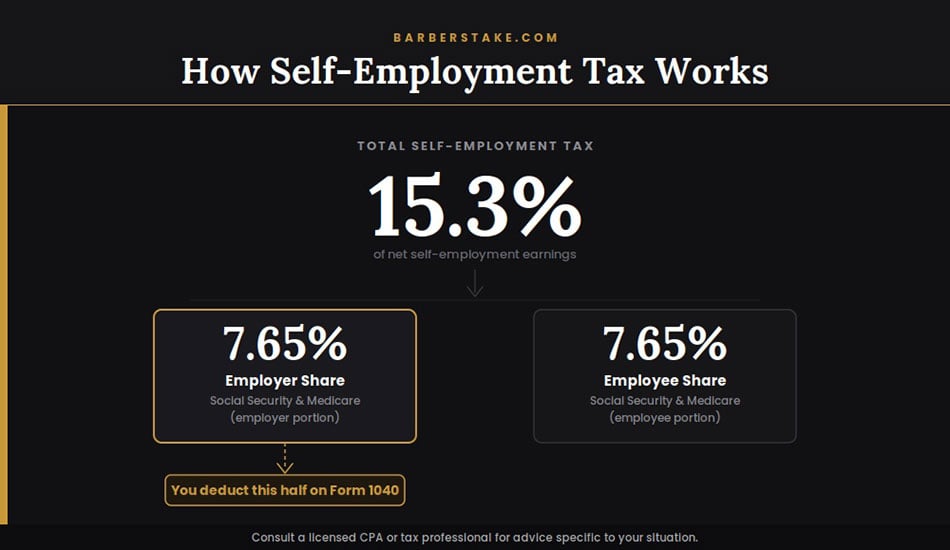
Self-employed barbers are responsible for paying both the employer and employee share of Social Security and Medicare taxes, collectively referred to as self-employment (SE) tax. As of the current rate structure, SE tax is assessed at 15.3% of net self-employment earnings up to the Social Security wage base, and 2.9% on earnings above that threshold, with a Medicare surtax applicable at higher income levels.
While the total SE tax burden is significant, the IRS allows self-employed individuals to deduct one-half of their SE tax liability as an above-the-line deduction on Form 1040. This deduction does not require itemizing and reduces your adjusted gross income directly. The deduction is calculated on Schedule SE and flows to your 1040 as an income adjustment.
The Qualified Business Income (QBI) Deduction
Under Section 199A of the Internal Revenue Code, eligible self-employed individuals and certain pass-through business entities may deduct up to 20% of their qualified business income (QBI) from their taxable income. For a self-employed barber earning net profit through a sole proprietorship, this deduction can be substantial.
The deduction is subject to income thresholds and phase-out rules that the IRS adjusts for inflation annually. The IRS provides a comprehensive overview of the deduction at IRS Qualified Business Income Deduction. Because the calculation can be complex depending on your total income and filing status, this is a deduction best reviewed with a qualified tax professional to ensure it is claimed correctly and maximized within your situation.
Recordkeeping Best Practices
Separate Your Finances
Opening a dedicated business bank account and using a business credit card for all business purchases is the single most effective recordkeeping habit you can develop. It eliminates the need to sort through personal transactions when preparing your Schedule C and provides a clean, defensible record if your return is ever reviewed.
Digital Receipt Management
Store digital copies of all receipts. Several apps are designed specifically to capture, organize, and categorize business receipts throughout the year, reducing the year-end scramble that leads to missed deductions. Back up your records to cloud storage to ensure they are preserved even if a device is lost or damaged.
How Long to Keep Records
The IRS generally recommends keeping business tax records for at least three years from the date you file the return to which they relate, as this is the standard period for a routine audit. Records relating to property, assets, and depreciation should typically be kept for longer, as they may be relevant in future years. The IRS provides detailed recordkeeping guidance in How Long Should I Keep Records?.
Quarterly Estimated Taxes
Self-employed individuals who expect to owe at least $1,000 in federal tax for the year are generally required to make quarterly estimated tax payments to the IRS. These payments cover both income tax and self-employment tax, and failing to make them on time can result in underpayment penalties. The IRS publishes due dates and payment instructions at IRS Estimated Taxes.
Common Tax Mistakes Barbers Make
Mixing Personal and Business Expenses
Paying for personal items with a business card, or vice versa, creates accounting confusion that can lead to either missed deductions or erroneous claims. Keep the two entirely separate from day one.
Failing to Track Cash Income
All income, including cash tips and cash payments, must be reported as gross income on Schedule C. Omitting cash income from your return creates a discrepancy between your reported income and the lifestyle indicators the IRS may observe, and can trigger serious compliance issues.
Missing the Self-Employed Health Insurance Deduction
This deduction is claimed on Schedule 1 of Form 1040, not on Schedule C, and many self-employed individuals miss it entirely when filing without professional guidance. It is one of the most valuable above-the-line deductions available and should not be overlooked.
Over-Deducting Vehicle Expenses Without a Mileage Log
Vehicle deductions are one of the most audited areas of a self-employed individual’s return. Without a contemporaneous mileage log, the deduction is difficult to substantiate. Claiming vehicle expenses without adequate records exposes you to potential disallowance and penalties in the event of a review.
Ignoring Quarterly Estimated Tax Payments
Many first-time self-employed barbers are accustomed to having taxes withheld automatically through a W-2. When operating independently, that automatic withholding disappears, and the responsibility to pay taxes throughout the year falls entirely on the individual. Underestimating or ignoring quarterly payments leads to a large bill at year-end, along with underpayment penalties that are entirely avoidable with proper planning.
Final Thoughts
Self-employment as a barber carries real financial advantages, and the tax code is one of them. When you operate your chair as a business rather than simply as a job, you gain access to a broad range of legitimate deductions that reduce the amount of income subject to both income tax and self-employment tax. Over the course of a career, the cumulative impact of consistently claiming every allowable deduction and making informed retirement contributions can be significant.
None of this requires complexity, but it does require intentionality. Track your expenses throughout the year, keep your business and personal finances separated, set aside funds for quarterly estimated tax payments, and work with a tax professional who understands the trades. The barbers who treat their finances with the same precision they bring to a clean fade are the ones who retain the most of what they earn.
This article is provided for general informational purposes only and does not constitute legal or tax advice. Tax laws are subject to change, and individual circumstances vary significantly. Consult a licensed CPA or tax professional for advice specific to your situation.
