A loyal client is the most valuable asset a professional barber can build, turning a men’s haircut into hundreds of dollars in annual spending and potentially thousands over the course of a long-term relationship. Barbering naturally creates recurring demand because hair grows, fades soften, beards lose their shape and most men who care about maintaining a short to medium-length hairstyle need to return regularly. A successful barber with a loyal client base can build a predictable stream of recurring revenue that many service businesses simply can’t.
The economics become surprisingly powerful when you stop looking at the price of a haircut and start looking at the value of the client sitting in the chair. A $35, $42 or $50 haircut may not seem significant as a single transaction, but a regular who visits every three to four weeks can easily generate $600 to more than $1,200 in annual spending, depending on the market, service preferences and appointment frequency.
In this guide, I’ll break down the value of a regular barber client in low-, mid- and high-cost markets, comparing haircut-only customers with clients who also receive beard services. We’ll look at the economics of one appointment, annual spending and the potential value of a client relationship over one, three, five and ten years.
I’ll also discuss what these numbers mean behind the chair and share the practical steps I would focus on if I wanted to build a more loyal, valuable and sustainable clientele.
Barber To Barber: One Appointment Is Not One Client
When you’re working through a full day behind the chair, it’s natural to think about the appointment directly in front of you. You finish the haircut, clean the station, check the schedule and bring in the next client. In that moment, a $40 haircut can feel like exactly that: a $40 transaction.
But that’s not really how a successful barbering business works. If the same client comes back every three or four weeks, you’ve potentially started a recurring relationship that can last for years. The value isn’t just in today’s haircut. It’s in becoming the person he trusts to maintain his appearance month after month.
As a barber, I think that’s an important distinction because we don’t normally talk to each other in terms like “customer lifetime value.” We know it in a more practical way.
The Economics of Client Loyalty
There’s a difference between the guy whose hair you cut once and the client who sits down, gives you almost no instructions and already knows you’re going to get his haircut right.
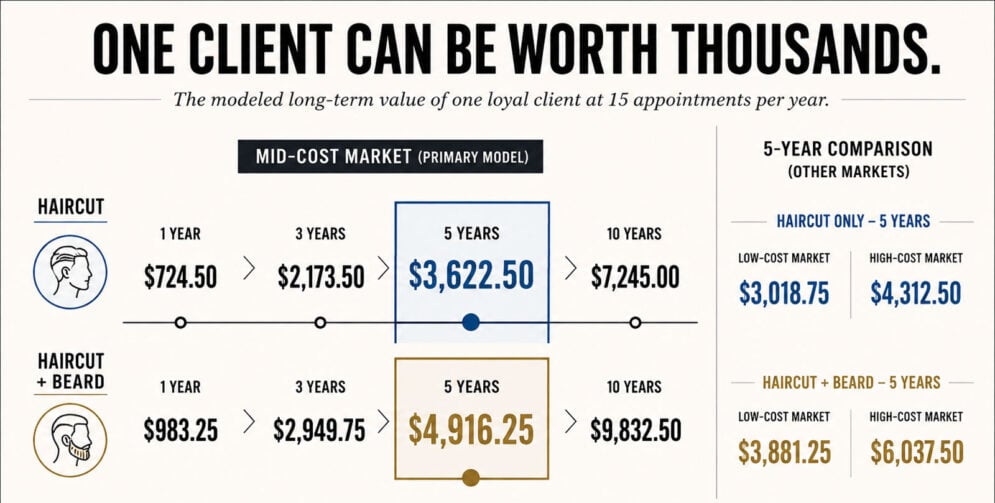
That trust has a real financial value. A mid-market client paying $42 for a haircut and tipping 15% spends about $48 per appointment. If he comes in 15 times a year, that relationship generates roughly $725 annually. Maintain it for five years and his spending exceeds $3,600, even if you never raise your price.
Add regular beard work and the value climbs further. The takeaway isn’t that every client should be viewed as a dollar sign or that barbers need to squeeze more money out of every appointment. It’s that keeping a good client is worth considerably more than the price printed next to the service on your booking page.
How We Calculated the Value of a Barber Client
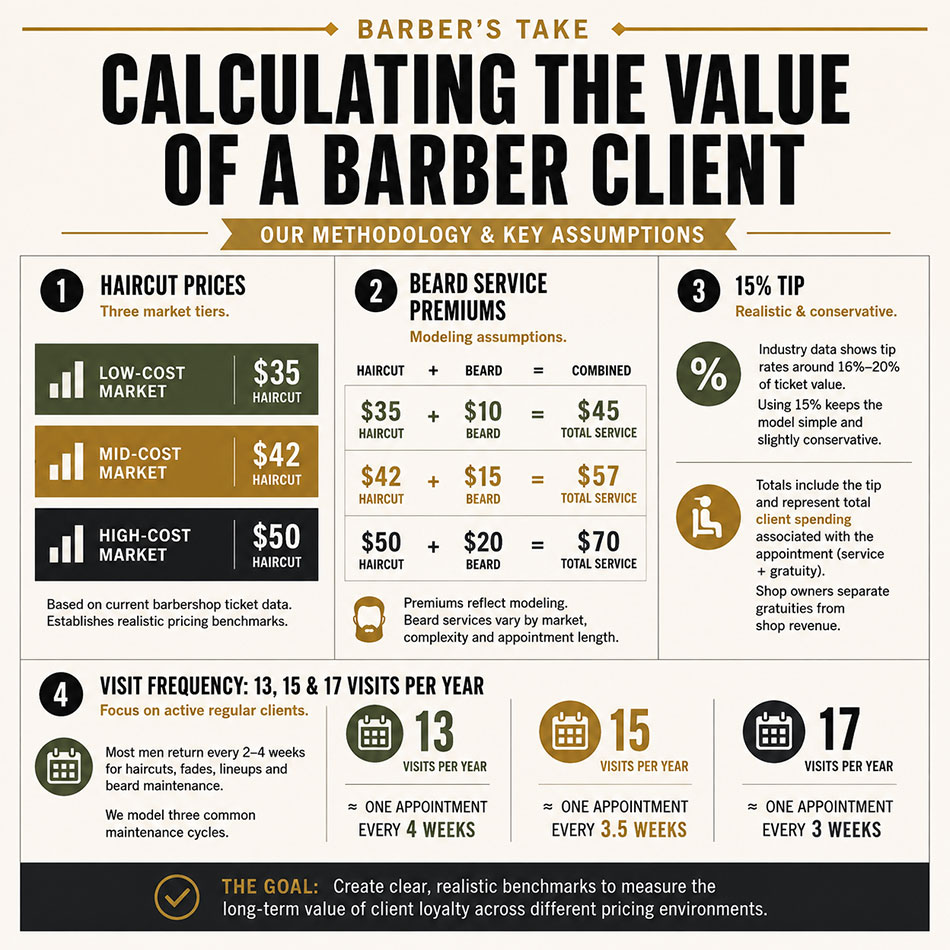
There isn’t one haircut price or service mix that accurately represents every barber in America, so we created three simplified market models. The goal isn’t to claim that every barber in a particular city should charge these exact amounts. The figures give us realistic, easy-to-understand benchmarks for comparing the economics of client loyalty across different pricing environments.
Haircut Prices
- Low-cost market: $35 haircut
- Mid-cost market: $42 haircut
- High-cost market: $50 haircut
These assumptions are broadly consistent with current barbershop ticket data. Zenoti’s 2026 industry benchmarks put the median barbershop ticket around $34, the 75th percentile around $39 and the top 10% around $48. Our figures aren’t intended to duplicate those benchmarks exactly because an average ticket and an individual haircut price are not the same measurement. They simply establish reasonable market tiers for the model.
Beard Service Premiums
For clients who receive a beard service with their haircut, we add $10 in the low-cost market, $15 in the mid-cost market and $20 in the high-cost market. That creates combined service prices of $45, $57 and $70.
- Low-cost market: $35 haircut + $10 beard service = $45
- Mid-cost market: $42 haircut + $15 beard service = $57
- High-cost market: $50 haircut + $20 beard service = $70
These premiums are modeling assumptions rather than claimed national averages. Beard work varies considerably based on the service itself, the barber’s market, appointment length and whether the service involves basic trimming, detailed shaping, razor work, hot towels or other elements.
Why We Used A 15% Tip
We calculate gratuity at 15%. Zenoti’s recent barber-specific benchmark data places tip rates around 16% to 20% of ticket value, so using 15% gives us a simple and slightly conservative assumption rather than automatically assuming every customer tips 20%.
There is an accounting distinction worth mentioning without making this analysis unnecessarily complicated. The service price is revenue generated by the haircut or beard service, while a gratuity generally goes to the barber. Because this guide is written primarily for the professional behind the chair, our totals include the tip and represent total client spending associated with the appointment. A shop owner analyzing business revenue would separate gratuities from shop revenue.
Why We Modeled 13, 15 and 17 Visits Per Year
This case study focuses on an active regular client, not every person who gets a haircut during the year. Most traditional barbering revolves around short to medium-length men’s hairstyles, and those cuts generally need relatively frequent maintenance to keep their intended shape. Fades, lineups, beard work and other precision services can require even more regular attention.
Zenoti describes frequent barbershop visitors as clients who commonly return every three to four weeks, while its research also notes that many men with fades, beard maintenance and shape-ups return every two to four weeks. Based on that behavior, we modeled three simple schedules:
- 13 visits per year: approximately one appointment every four weeks
- 15 visits per year: approximately one appointment every 3.5 weeks
- 17 visits per year: approximately one appointment every three weeks
We use 15 appointments as our central example while showing the 13- and 17-visit scenarios to illustrate how frequency changes client value.
What Is A Barber Visit Worth?
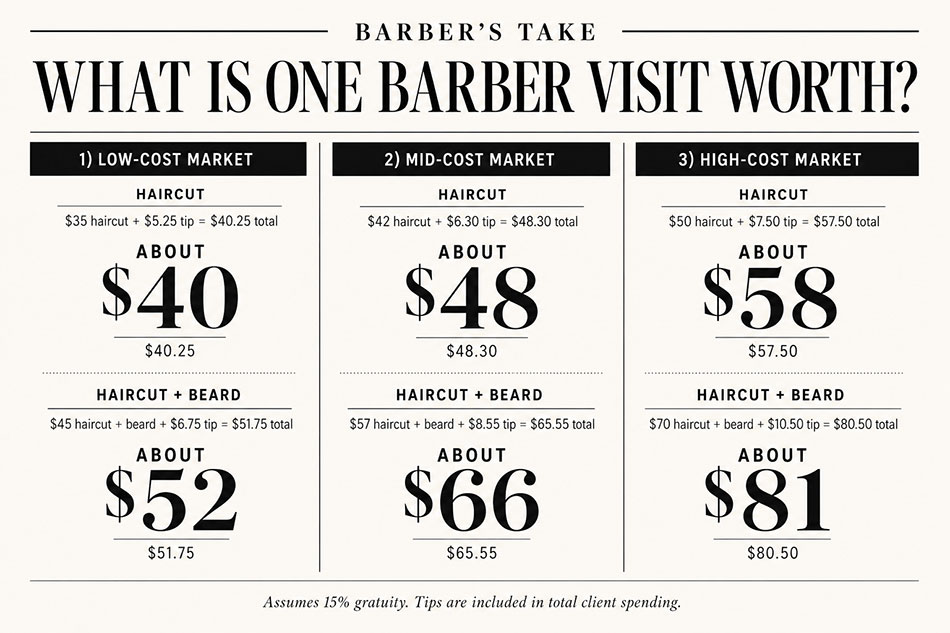
Before looking at years of loyalty, start with a single appointment. The differences between markets are relatively modest when viewed one haircut at a time, but those differences compound once the client becomes a regular.
| Client Spend | Low-Cost Market | Mid-Cost Market | High-Cost Market |
|---|---|---|---|
| Haircut price | $35.00 | $42.00 | $50.00 |
| 15% tip | $5.25 | $6.30 | $7.50 |
| Total men’s haircut visit | $40.25 | $48.30 | $57.50 |
| Men’s haircut + beard price | $45.00 | $57.00 | $70.00 |
| 15% tip | $6.75 | $8.55 | $10.50 |
| Total haircut + beard visit | $51.75 | $65.55 | $80.50 |
For a haircut-only appointment, that’s about $40 in a low-cost market, $48 in a mid-cost market and $58 in a high-cost market. A haircut with beard service increases total client spending to approximately $52, $66 and $81, respectively.
None of these amounts look extraordinary on their own. Frequency is where the economics become much more interesting.
What Is A Regular Barber Client Worth Annually?
A recurring service business behaves differently from a business that has to sell a completely new product every time it wants another transaction. The client’s hair continues to grow, and a man who values a consistent, well-maintained appearance has a built-in reason to return.
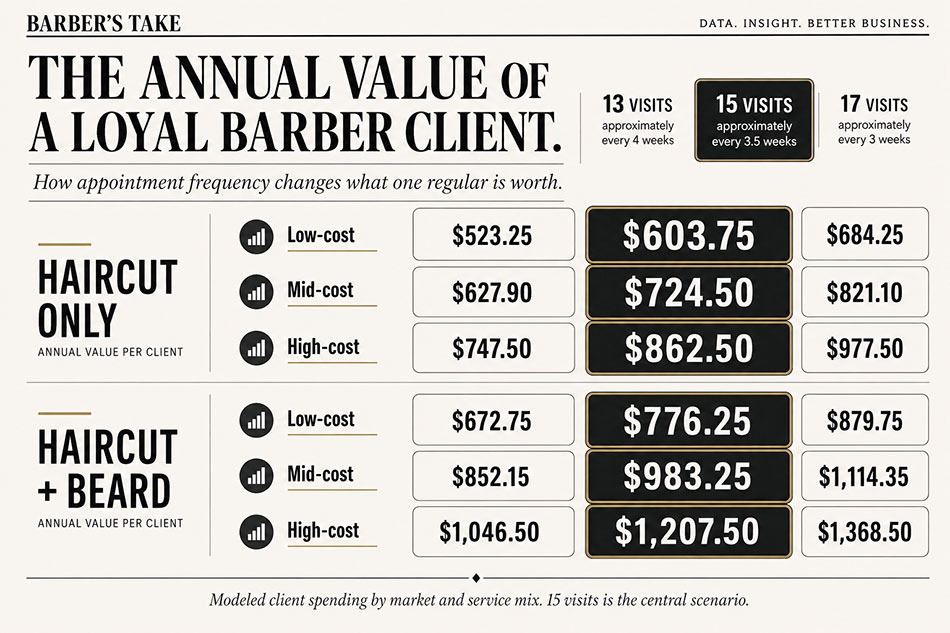
Using our three appointment frequencies, the annual value of one regular looks like this:
| Service and Market | 13 Visits | 15 Visits | 17 Visits |
|---|---|---|---|
| Haircut: Low-cost | $523.25 | $603.75 | $684.25 |
| Haircut: Mid-cost | $627.90 | $724.50 | $821.10 |
| Haircut: High-cost | $747.50 | $862.50 | $977.50 |
| Haircut + beard: Low-cost | $672.75 | $776.25 | $879.75 |
| Haircut + beard: Mid-cost | $852.15 | $983.25 | $1,114.35 |
| Haircut + beard: High-cost | $1,046.50 | $1,207.50 | $1,368.50 |
At our central frequency of 15 visits per year, a haircut-only regular generates approximately $604 annually in a low-cost market, $725 in a mid-cost market and $863 in a high-cost market. A client who receives the modeled haircut-and-beard service every visit increases those figures to approximately $776, $983 and $1,208.
That means one established regular can represent roughly $600 to more than $1,200 in annual spending before considering product purchases, other grooming services, future price increases or referrals.
Why Visit Frequency Matters More Than Most Barbers Realize
Pricing gets all the attention in barber-business conversations. Going from a $35 haircut to a $40 haircut can materially improve earnings across hundreds or thousands of annual appointments. But price isn’t the only variable that determines what a client is worth and how much a barber will make in a year.
Consider the mid-market client in our model. His haircut costs $42, and with a 15% gratuity he spends $48.30 per appointment. At 13 appointments per year, he represents about $628 in annual spending. At 15 visits, he reaches roughly $725. At 17 visits, he exceeds $821.
The haircut price never changed. The difference came entirely from how consistently the client maintained his schedule.
This is also why losing a good regular costs more than the appointment that disappears from today’s calendar. If a $42 client who normally comes 15 times per year leaves permanently, you aren’t necessarily losing the $42 haircut appointment. You’re potentially losing the next 15 haircuts this year and every appointment that would have followed in the years ahead.
The Second Appointment Might Matter More Than the First
Approximately 48% of barbershop clients made one appointment and never returned, according to Squire’s report. That makes the transition from first-time customer to repeat client one of the most important moments in the customer relationship.
A first-time client can reach your chair for dozens of reasons. He found you on Google, saw one of your haircuts on Instagram, received a recommendation, needed a last-minute appointment or couldn’t get in with his regular barber. Getting him through the door proves that your marketing, reputation or availability worked.
The second appointment means something different. When he voluntarily chooses your chair again, you’re starting to establish preference and trust.
From a business standpoint, I’ve come to think the second appointment can be more important than the first. The first visit gets someone into your chair. The second starts turning him into your client.
Using our mid-market model, the financial difference is substantial. A one-time haircut generates about $48 in client spending. A regular customer maintaining a 15-visit annual schedule generates approximately $725 in earnings for a professional barber. Over five years, that same behavior adds up to more than $3,600.
That’s why a barber who constantly acquires new clients but fails to retain them is building a very different business from the barber whose calendar is filled with people who have already decided to come back.
The Economics of Premium Add-On Services
Beard services clearly increase client value in our model. At 15 appointments annually, adding the beard premium increases yearly client spending by about $173 in a low-cost market, $259 in a mid-cost market and $345 in a high-cost market.
That additional revenue matters, but the practical economics are more nuanced than simply telling every barber to upsell every client.
A Bigger Ticket Is Not Automatically a Better Appointment
Chair time matters. If a $15 beard service takes another ten minutes and you have the available capacity, the additional service can be attractive. If it turns a 30-minute haircut into a 60-minute appointment during a fully booked Saturday, the higher ticket may come at the expense of another service you could have performed during the same time.
I prefer to think about the question in terms of value per chair hour. You don’t need an elaborate spreadsheet to make that useful. Ask how much additional time the service requires, whether the client genuinely values it and what that time would otherwise be used for.
The economics will also change based on your business model. A self-employed barber keeping most of the service revenue looks at an extra $15 differently than an employee, commission barber, booth renter or shop owner. The purpose of this analysis isn’t to reconcile every compensation structure. It’s to show how service mix affects the economic value of the underlying client relationship.
Don’t Sell a Beard Service to Someone Who Doesn’t Need It
The best additional services don’t feel like sales tactics. They improve the finished result. If cleaning the beard, balancing its shape or properly blending the sideburn into the haircut is going to make the client look noticeably better, that’s a legitimate professional recommendation.
Clients can usually tell the difference between useful advice and an attempt to inflate the ticket. The long-term relationship is more valuable than forcing another $10 or $20 into today’s appointment, so I would never sacrifice trust for a short-term add-on.
Additional Services Can Make the Barber Harder to Replace
There’s also a relationship benefit that doesn’t fit neatly into a table. Once you’ve cut someone’s hair repeatedly, you learn his growth patterns, preferred length, trouble spots and styling habits. If you also maintain his beard, you begin learning how he likes the cheek line, where he wants weight left around the chin, how aggressively he wants the neckline cleaned and how the beard should transition into the haircut.
That accumulated knowledge makes the experience easier for the client. He doesn’t have to explain everything again, and you’re increasingly able to anticipate the result he wants. Over time, that familiarity can become a meaningful competitive advantage.
How Much Is a Barber Client Worth Over His Lifetime?
The term customer lifetime value sounds precise, but using it responsibly requires knowing how long the average relationship actually lasts. That’s where current barber-industry research becomes less useful.
I reviewed the major barber-specific sources available from Squire and Zenoti and could not find a sufficiently reliable industry statistic establishing that the average client remains with one barber for a specific number of years. The available research gives us useful information about repeat visits, rebooking, frequency, retention and one-and-done behavior, but not a defensible average relationship length such as five, seven or ten years.
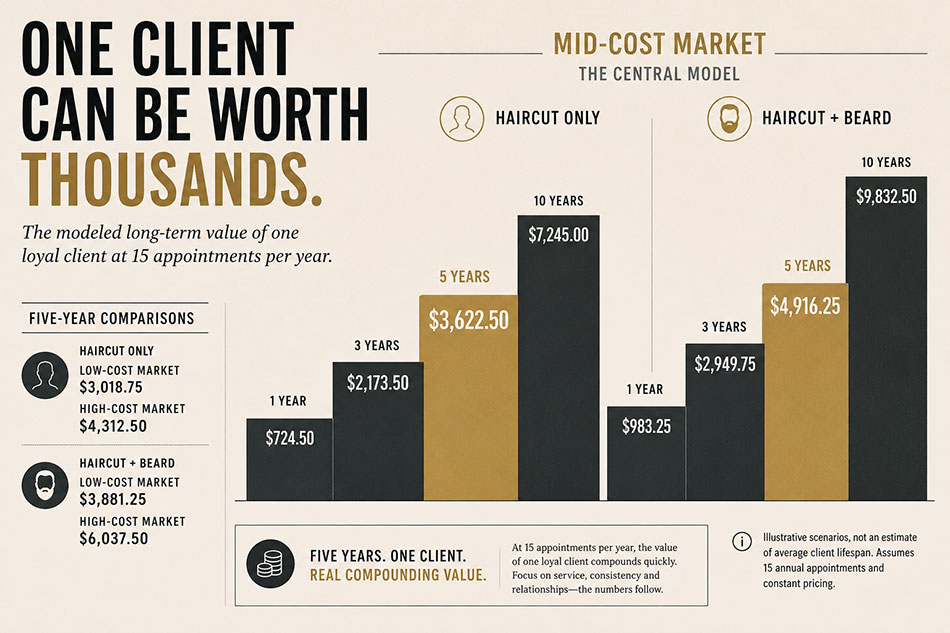
Rather than inventing a number and calling it an industry average, Barber’s Take modeled four transparent scenarios: one year, three years, five years and ten years. Each assumes 15 appointments annually, the same service at each visit and no changes in pricing. In practice, most barbers will raise their prices over time to account for higher operating costs and inflation, which makes these long-term estimates intentionally conservative.
Disclaimer: I also chose not to build an inflation adjustment into the model. Doing so would introduce another assumption into what is meant to be a straightforward comparison, and I personally believe commonly cited government inflation figures often understate the increases in real-world costs that small businesses and consumers actually experience. Keeping prices constant makes the methodology easier to understand while avoiding a false sense of precision.
Long-Term Value of a Barber Client
| Client Type | 1 Year | 3 Years | 5 Years | 10 Years |
|---|---|---|---|---|
| Low-cost: Haircut | $604 | $1,811 | $3,019 | $6,038 |
| Mid-cost: Haircut | $725 | $2,174 | $3,623 | $7,245 |
| High-cost: Haircut | $863 | $2,588 | $4,313 | $8,625 |
| Low-cost: Haircut + beard | $776 | $2,329 | $3,881 | $7,763 |
| Mid-cost: Haircut + beard | $983 | $2,950 | $4,916 | $9,833 |
| High-cost: Haircut + beard | $1,208 | $3,623 | $6,038 | $12,075 |
The five-year figures are particularly useful because they illustrate the compounding value of loyalty without assuming an unusually long relationship. A mid-market haircut client reaches approximately $3,623 over five years. Add the $15 beard service in our model and that rises to about $4,916.
In a high-cost market, the five-year values are approximately $4,313 for the haircut-only client and $6,038 for the haircut-and-beard client.
The ten-year figures are even more striking, but they should be interpreted correctly. We are not claiming that the average client stays with his barber for ten years. We’re showing what the relationship becomes worth if he does.
The model is also intentionally simple. It assumes no inflation, no future haircut price increases, no product purchases and no additional services. A barber who raises prices over time would generate more nominal revenue from a client who remained loyal throughout the period.
One Loyal Client Is More Valuable Than One Expensive Haircut
There are two ways to think about a full appointment book. The first is transactional: how much money did I make today? The second asks a longer-term question: how many of the people I cut today are likely to still be sitting in my chair next year?
Both matter. Barbering is a business, bills are due now and today’s revenue cannot be ignored. But long-term stability comes from reducing how much of tomorrow’s book needs to be rebuilt from scratch.
That matters even more in the current environment. Zenoti reported that new guest visits to barbershops declined 17% in 2025, while visits from existing guests increased 2%. Barbershop membership sales also increased 20%, reflecting the industry’s growing focus on recurring customer relationships and predictable visit patterns.
You always need new clients entering the top of the funnel. People move away, change jobs, change hairstyles, experience financial changes and stop visiting for reasons you can’t control. But constantly replacing preventable churn is expensive, exhausting and unnecessary.
A loyal clientele gives the barber a base to build from.
Retention Is a Barber’s Real Competitive Advantage
Most clients have options. In a populated market, a man can search his phone and find dozens of barbers within a reasonable distance. Some will charge less than you. Some will have better social media. Some will be closer to his home or office, and someone else will probably have an opening when your schedule is full.
Your advantage is the relationship you’ve already earned.
Once a client knows that you understand his hair, remember his preferences, respect his time and consistently deliver the result he expects, switching barbers creates uncertainty. He has to explain the haircut again and take the risk that someone else interprets it differently.
That trust isn’t just a soft customer-service concept. It’s part of the economic moat around your book.
How Can a Barber Make $100,000 a Year?
Making $100,000 a year as a barber can sound like a difficult milestone until you break the goal down by appointments, pricing and the number of regular clients needed to support it. Using the same assumptions from our client-value model, six figures becomes less about chasing an enormous number of customers and more about building a dependable book of clients who return consistently.
There is one important distinction before getting into the numbers. For this example, $100,000 represents annual client spending attributed to the barber’s chair, including our modeled 15% gratuity. It is not the same as taking home $100,000 after taxes, booth rent, commissions, card-processing fees, supplies and other business expenses. A self-employed barber, booth renter and commissioned barber can all generate the same amount from clients while personally keeping very different amounts.
What $100,000 Looks Like With Haircuts Alone
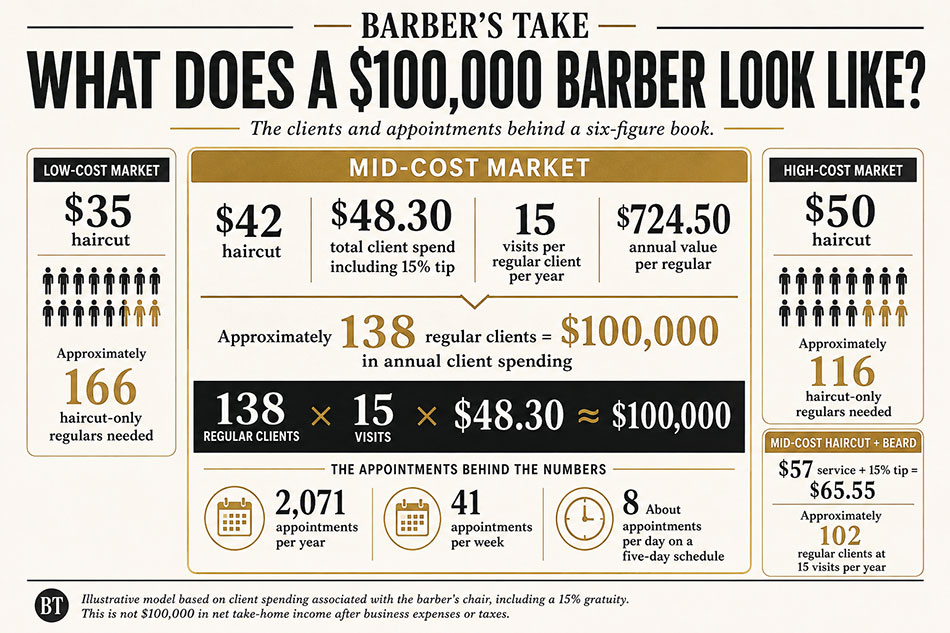
In our low-cost market, a $35 haircut with a 15% tip represents about $40.25 per appointment. To generate $100,000 at that spending level, a barber would need approximately 2,485 appointments per year.
Our mid-market barber charges $42, bringing total client spending to about $48.30 per visit. Reaching $100,000 requires approximately 2,071 appointments annually. At a $50 haircut in our high-cost market, total spending reaches about $57.50 per visit, reducing the requirement to approximately 1,740 appointments per year.
Assuming the barber works 50 weeks per year, the workload looks like this:
| Haircut Market | Total Per Visit | Visits Per Year | Visits Per Week | Visits Per 5-Day Workday |
|---|---|---|---|---|
| Low-cost | $40.25 | ~2,485 | ~50 | ~10 |
| Mid-cost | $48.30 | ~2,071 | ~41 | ~8 |
| High-cost | $57.50 | ~1,740 | ~35 | ~7 |
For the mid-market barber, that means roughly eight to nine haircuts per day across a five-day week. That is a busy schedule, but it also illustrates why price, efficiency and retention matter so much. The barber does not necessarily need hundreds of new people coming through the door every month. He needs enough good clients to keep those appointment slots consistently occupied.
How Many Regular Clients Does a Six-Figure Barber Need?
The client-count calculation may be even more useful. Earlier, we modeled an active regular at 15 appointments per year, or approximately one appointment every 3.5 weeks. At that frequency, one haircut-only client is worth approximately $604 annually in a low-cost market, $725 in a mid-cost market and $863 in a high-cost market.
To generate approximately $100,000 in annual client spending, the barber would therefore need a book of roughly:
- 166 regular haircut clients in a low-cost market
- 138 regular haircut clients in a mid-cost market
- 116 regular haircut clients in a high-cost market
That’s a different way to think about building a six-figure barbering business. Instead of asking, “How do I make $100,000?”, the more useful question may be:
How do I build and keep 120 to 165 good regular clients?
That is a much more actionable problem. A barber can break it down into client acquisition, second appointments, retention, scheduling capacity and the amount of business already sitting in the chair.
What I Would Focus On Behind the Chair
If I wanted to increase the long-term value of my clientele, I wouldn’t begin with clever upsells or a complicated loyalty system. I would start with the basic things that make a good client want to come back every three or four weeks. Most of them sound simple, but consistently executing them across hundreds of appointments is what separates a barber with customers from a barber with a real book of business.
Win the Second Appointment
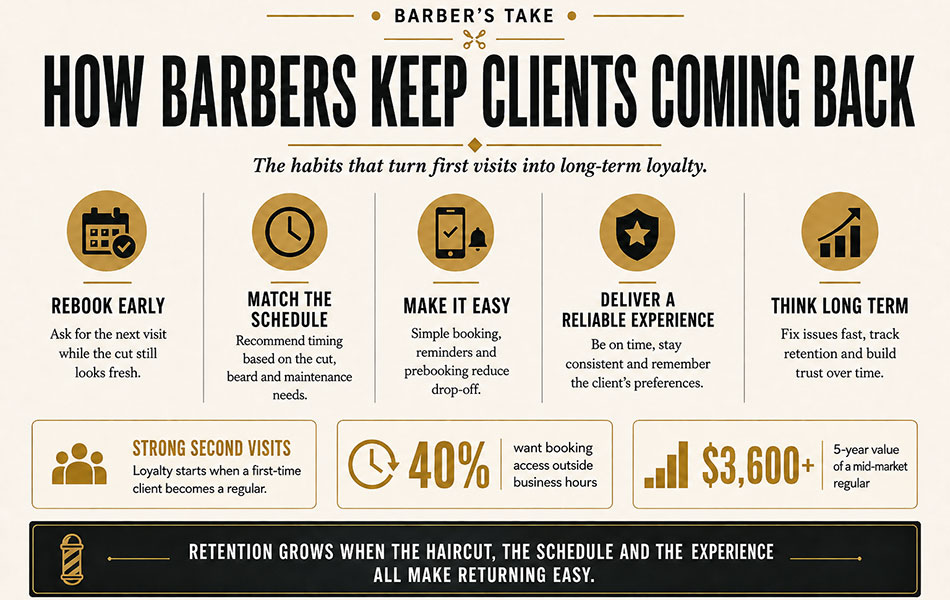
Squire’s finding that approximately 48% of clients make only one appointment makes the second booking an obvious place to focus. A new client may have found you through Instagram, Google, a recommendation or simple convenience. If he comes back, you’re beginning to establish preference.
The easiest time to discuss the next appointment is while the result is still fresh. Don’t pressure the client or turn checkout into a sales presentation. Give him useful maintenance guidance based on the haircut you just performed.
A simple version might be: “This should stay sharp for about three to four weeks. Want to grab the same time next month?”
If he says no, leave it alone. If he says yes, you’ve removed the need for him to remember to book later and you’ve protected a future spot on your schedule.
Learn the Client’s Actual Maintenance Cycle
Not every haircut belongs on the same schedule. A skin fade or sharp lineup may visibly lose its finish before a longer scissor cut. A client maintaining a detailed beard may want more frequent appointments than someone wearing a softer, grown-out style.
Zenoti notes that fades, beard maintenance and shape-ups are among the services that can bring men back every two to four weeks. Use that as context, not a quota. The goal is to recommend the schedule that genuinely fits the client’s haircut and expectations.
Tell him what to expect. If the fade will begin softening around week three, explain that. If his haircut will still look excellent after four or five weeks, tell him that too. Honest maintenance advice builds credibility because the recommendation is connected to the work rather than your desire to fill another appointment.
Make Booking Almost Frictionless
Convenience matters because a client who intends to return can still drift away if booking becomes annoying. Zenoti has reported that 40% of barbershop regulars say they always need the ability to book outside normal business hours, which makes a strong case for giving clients access to scheduling even when you’re not answering the phone.
A working system doesn’t have to be complicated. Keep your booking link easy to find, make service names clear, use accurate appointment lengths and enable automated confirmation or reminder messages when your platform supports them.
For regulars with predictable schedules, encourage prebooking. The less effort required to stay on schedule, the easier it becomes for the client to remain part of your book.
Respect the Client’s Time
A technically excellent barber can still lose clients by chronically running late. Men often fit haircuts between work, family commitments, meetings, dates and other obligations. A 1:00 appointment that routinely begins at 1:25 changes the real cost of doing business with you.
No barber runs perfectly on schedule every day. Difficult cuts take longer than expected, clients arrive late and unexpected problems happen. The goal is not perfection. It’s making punctuality part of the service rather than treating the client’s time as unlimited.
Build realistic appointment lengths into the calendar, leave breathing room where you need it and communicate when you are meaningfully behind. A ten-second message can prevent twenty minutes of frustration.
Remember the Details That Matter
You don’t need to remember every personal detail a client has ever shared. You should remember the information that affects the service he’s paying you to perform.
Know whether the previous fade was low or mid, how much length he likes left through the crown, how his cowlick behaves, whether he’s growing the top out and whether he prefers the neckline natural or sharply tapered. If his beard is part of the service, remember the length, shape and transition he prefers.
Use notes in your booking system if necessary. The goal is to make the next visit feel like a continuation of the relationship rather than another consultation from zero.
Be Consistent Enough That the Client Can Relax
A great haircut once is not the same thing as a reliably great haircut. Long-term clients stay because they trust the outcome.
That doesn’t mean every appointment should be mechanically identical. Hair grows differently, styles evolve and clients change their minds. Consistency means the client trusts your judgment and knows you’re paying attention.
Ask whether anything bothered him about the last cut. Check whether the length worked. If you’re changing something, explain why. These small habits reduce miscommunication and show the client that you’re thinking beyond the current thirty or forty-five minutes.
Fix Legitimate Mistakes Like the Relationship Is Worth Thousands
The long-term math changes the way a barber should think about service recovery. If a good client has a legitimate issue, don’t evaluate the situation only against today’s $42 haircut.
A mid-market client in our model can generate more than $3,600 over five years. If you can preserve that relationship by spending another fifteen minutes correcting something you genuinely got wrong, the economics are easy to understand.
Invite him back, make the correction, avoid making him uncomfortable for mentioning it and learn from what happened. You don’t have to accept unreasonable demands, but protecting a valuable relationship when you’ve made a real mistake is good service and good business.
Recommend Additional Services Only When They Improve the Result
Beard services can increase annual client value considerably, but don’t turn that knowledge into an excuse to sell something unnecessary. The best add-on should have an obvious reason to exist.
If shaping the beard will improve the overall look, explain what you would change. If blending the sideburn properly into the beard will make the fade look more complete, point it out. If the client doesn’t need the service, don’t manufacture a problem.
A useful test is simple: would I recommend this if I weren’t being paid extra for it? If the answer is yes, you’re probably advising the client rather than selling him.
Track Your Own Retention Instead of Guessing
Industry benchmarks are useful for context, but your own numbers are more important. You don’t need sophisticated business intelligence software to start understanding them.
At the end of each month, look at how many first-time clients you served and how many returned for another appointment. Track how many of your clients have visited at least three times, how many prebook before leaving and how many previously consistent clients have disappeared from the schedule.
One especially useful metric is your second-visit rate. Take the number of new clients who returned within the normal maintenance window for their haircut and divide it by the number of first-time clients you served. Monitor the direction over several months rather than obsessing over one short period.
If you attracted 30 new clients last month and almost none returned, attracting another 30 may not be the first problem to solve. Find out why the first group didn’t stick.
Reach Out to Lapsed Regulars Once
A client disappearing from the schedule doesn’t always mean you’ve lost him because of the service. He may have moved, changed jobs, grown his hair, had a financial issue or simply gotten out of his routine.
If someone who was previously consistent hasn’t visited in an unusually long time, one professional message can be worthwhile. Keep it normal and low pressure:
“Hey Mike, haven’t seen you in a while. Hope everything’s good. If you’re due for a cut, here’s my booking link.”
Send it once. Don’t chase him. The point is to remove friction and remind him that the relationship is still there, not make him feel guilty for disappearing.
Build Around the Clients You Actually Want
Revenue matters, but not every high-frequency customer is automatically a great client. Someone who comes every three weeks but consistently arrives twenty minutes late, disrespects your policies and makes the rest of your schedule run behind can cost more than the raw appointment value suggests.
As your book becomes more established, think about the type of clientele you want to build around. The best long-term clients value your work, respect your time, communicate clearly and fit the type of service experience you want to provide.
A healthy book isn’t simply full. It’s sustainable.
Think in Years, Not Individual Appointments
This is the larger lesson behind all the math. If you approach every appointment purely as a transaction, you’ll naturally optimize for today’s ticket. When you think in years, the incentives change.
You spend the extra minute getting the blend right. You don’t rush the consultation. You remember how the client likes the back. You tell him when he doesn’t need the more expensive service. You fix legitimate mistakes, respect his appointment time and make booking the next visit easy.
Those decisions may seem small when viewed one haircut at a time. Across a relationship that lasts for years, they compound just like the revenue does.
A $42 Haircut Isn’t Really a $42 Relationship
A $42 haircut is one transaction. A loyal $42 haircut client is something entirely different.
At 15 appointments per year and a modeled 15% gratuity, our mid-market client represents approximately $725 in annual spending. Keep that relationship for three years and it reaches roughly $2,174. Five years takes it beyond $3,600, and ten years would represent approximately $7,245 if the service price and frequency remained unchanged.
Add the modeled $15 beard service and the same client approaches $1,000 per year, nearly $5,000 over five years and almost $10,000 over ten years.
Not every client will stay that long. Some won’t make it past the first appointment, which is exactly why retention matters.
The lesson isn’t to look at the guy in your chair and calculate how much money you can extract from him. It’s to understand what the relationship is worth and then behave accordingly. Do excellent work, stay consistent, respect his time, give honest advice, make it easy to return and build the kind of trust that makes changing barbers feel unnecessary.
If you can do that across an entire book of clients, the money tends to take care of itself.
Sources and Methodology
The haircut prices, beard-service premiums, 15% gratuity and long-term scenarios used in this article are Barber’s Take modeling assumptions intended to illustrate the economics of an active regular client. They should not be interpreted as universal national averages.