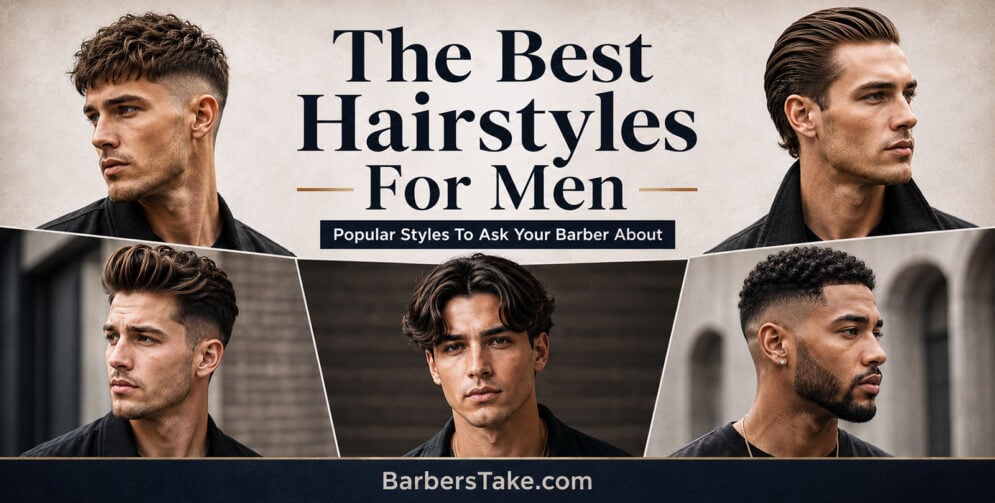
The best men’s hairstyles are about creating a balance between structure, texture and complementary aesthetics, and less about chasing trends. A good cut should work with your hair type, flatter your face shape and features, fit your styling routine and suit your lifestyle without making your mornings more complicated.
In 2026, the strongest looks are the ones that feel intentional, wearable and personal, like you thought about your style without overthinking it. These give you confidence without forcing your hair into something it was never meant to hold.
In the past, I’ve noticed that most guys settle on the same cut, not because they’ve thought carefully about the alternatives, but because it’s the one they know by name and can comfortably ask for. This list exists to change that and expand the conversation. It covers everything from the classic styles that anchor every credible barbershop menu to the newer ones gaining traction that your barber is likely already cutting daily, even if you haven’t asked yet.
In this guide, I’ll show you the most popular haircuts for men to get in 2026, breaking down the ones that are trending in barbershops, who they work well for and how to ask your barber for the version that fits your face and hair. Whether you want something sharp and professional, relaxed and low-maintenance or bold enough to stand out, these styles will give you a practical starting point before your next appointment.
The 40 Best Haircuts For Men in 2026
1. Textured French Crop: The Most Requested Cut in the Modern Barbershop
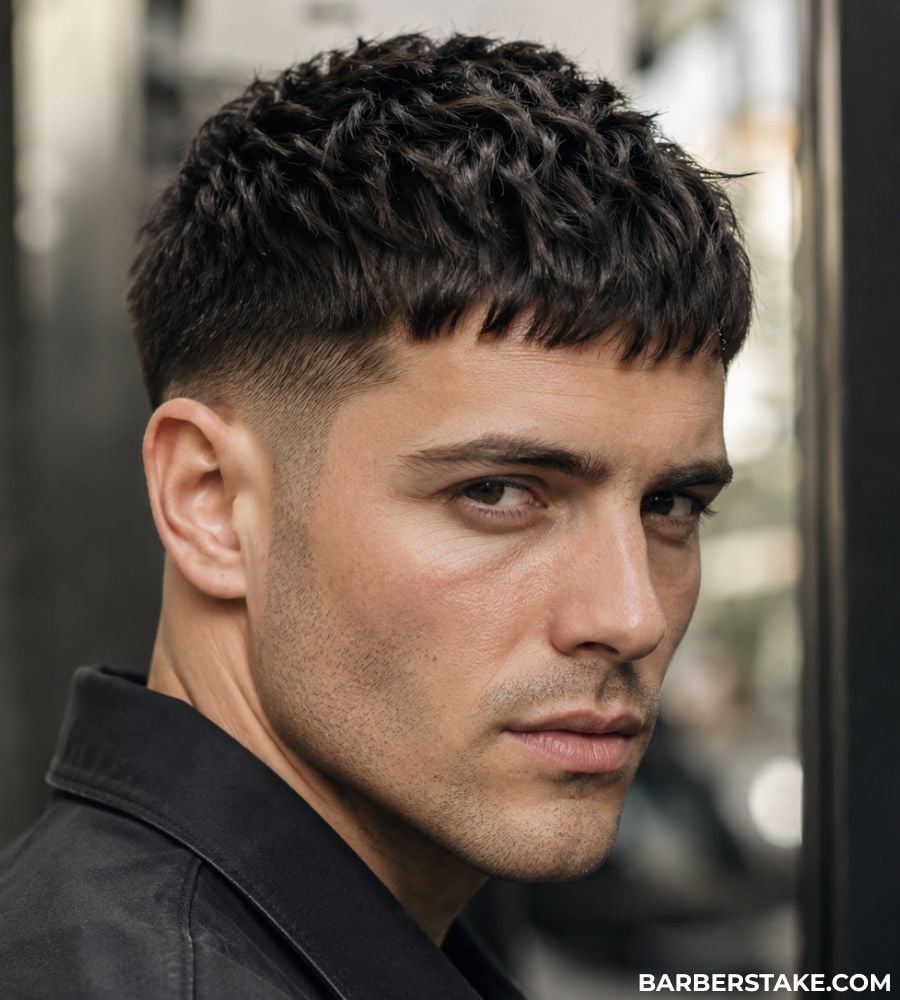
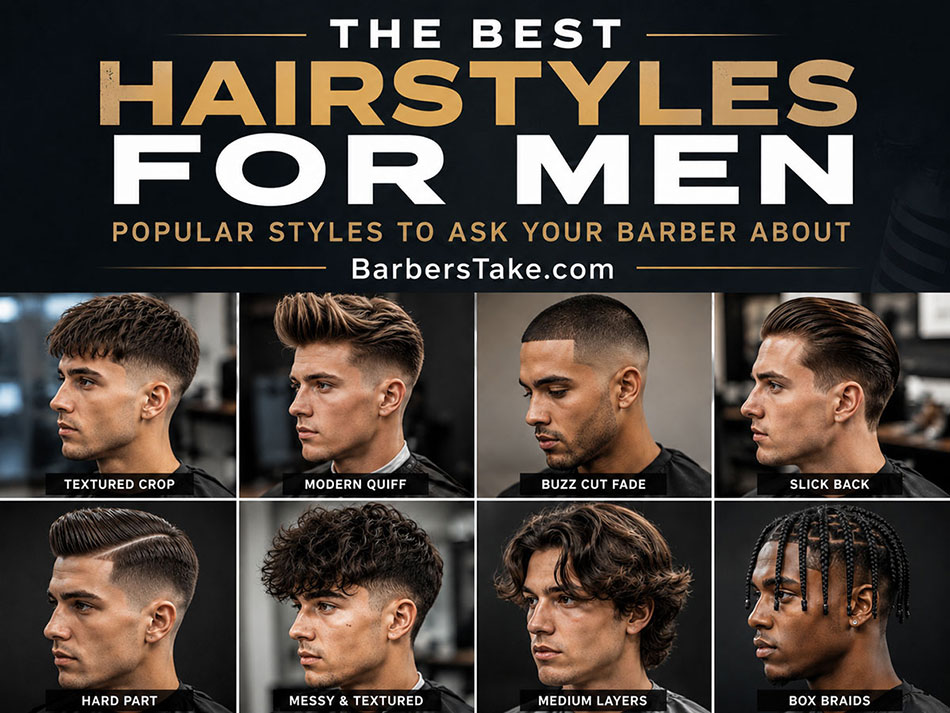
The textured crop features short, choppy layers on top with a forward-falling fringe, faded or tapered sides, and a deliberately tactile finish that suggests effort without broadcasting it. The fringe sits across the forehead, not blunt enough to be an Edgar, not long enough to sweep like a quiff, just enough to define the front of the cut and give it character.
This cut has dominated barbershop request lists across every age bracket for the better part of five years, and it has earned that position honestly. It’s fast to style, adaptable to an unusually wide range of face shapes, and sits comfortably at the intersection of casual and professional. The textured crop is, in the current landscape, what the crew cut was in the 1950s, the default answer when someone asks for something that just works.


Who it suits: Straight and wavy hair take to it best. Fine or thinning hair benefits significantly from the textured top, which creates the illusion of density, while the forward fringe discreetly covers a receding temple. Not ideal for very curly or coily hair without modification to the fringe and layering technique.
How to ask for it: “I’d like a textured crop, choppy layers on top, a forward fringe sitting across the forehead, and a mid skin fade on the sides. Keep the top at around an inch and a half.”
Styling and maintenance: Matte clay or paste on damp hair, finger-styled forward. A blow dryer is optional unless additional volume is the goal. Trim every three weeks to keep the fringe line and fade sharp.
2. Modern Mullet: Business in the Front, Confident Enough Not to Explain the Back
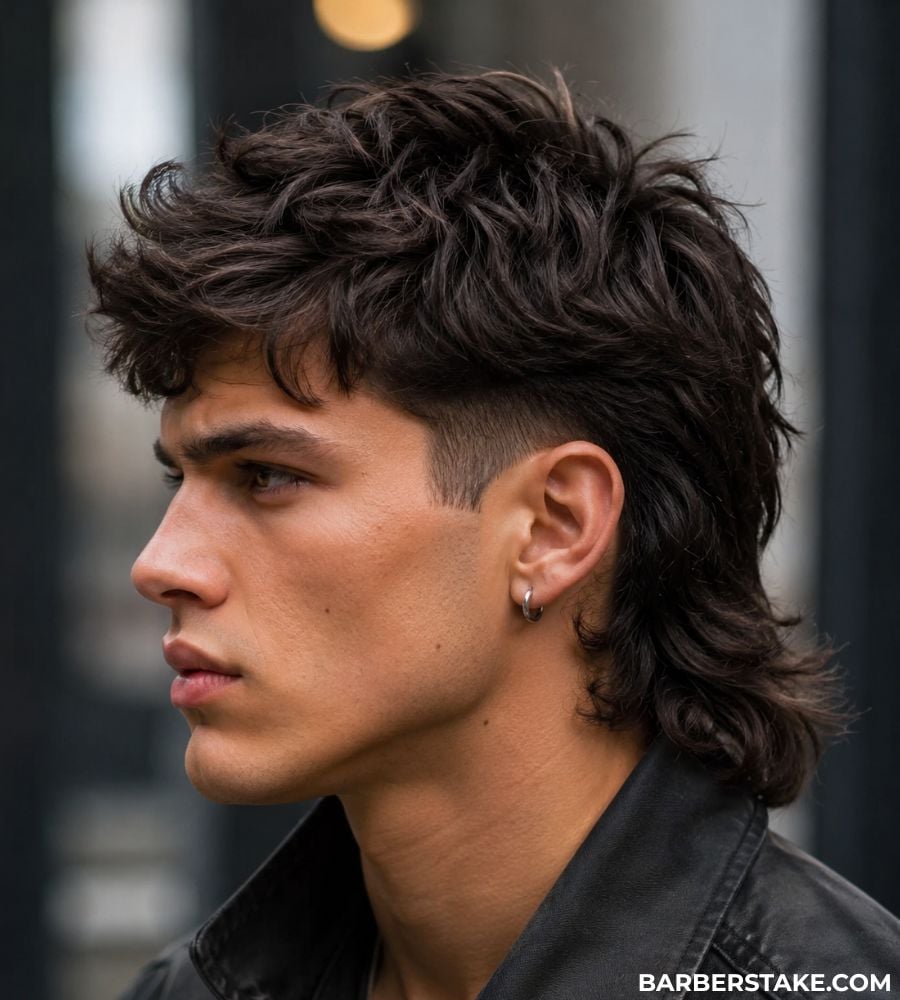
The modern mullet is a trendy haircut that retains the fundamental structure of its predecessor, shorter at the front and sides, longer in the back, but replaces the hard transition with a textured, layered finish and a fade or taper on the sides that reads contemporary rather than archival. The result is a cut with genuine attitude that somehow works in more contexts than the original managed in its entire cultural lifespan.
The mullet’s revival is a well-documented comeback story. It has moved from ironic to genuinely fashionable, appearing on professional football pitches, fashion runways, and the feeds of several million people who would have sworn they’d never consider it. Love it or not, at this point, it deserves a serious entry on any comprehensive list.


Who it suits: Oval and oblong face shapes benefit from the back length, which adds proportion. Thick or wavy hair creates the most compelling silhouette. Fine hair may struggle to deliver the volume that makes the cut work at the back. Not the easiest cut for very conservative professional environments, though the taper fade variation softens the overall impression significantly.
How to ask for it: “I’d like a modern mullet, textured and layered on top, faded on the sides, and kept longer in the back. I want movement and a contemporary finish, not a retro look.”
Styling and maintenance: Blow dry with a diffuser for volume, finger-style with a light matte clay. Let the back section move freely, minimal product there. Trim every four to six weeks.
3. Flow: The Only Haircut You Can Justify Not Styling
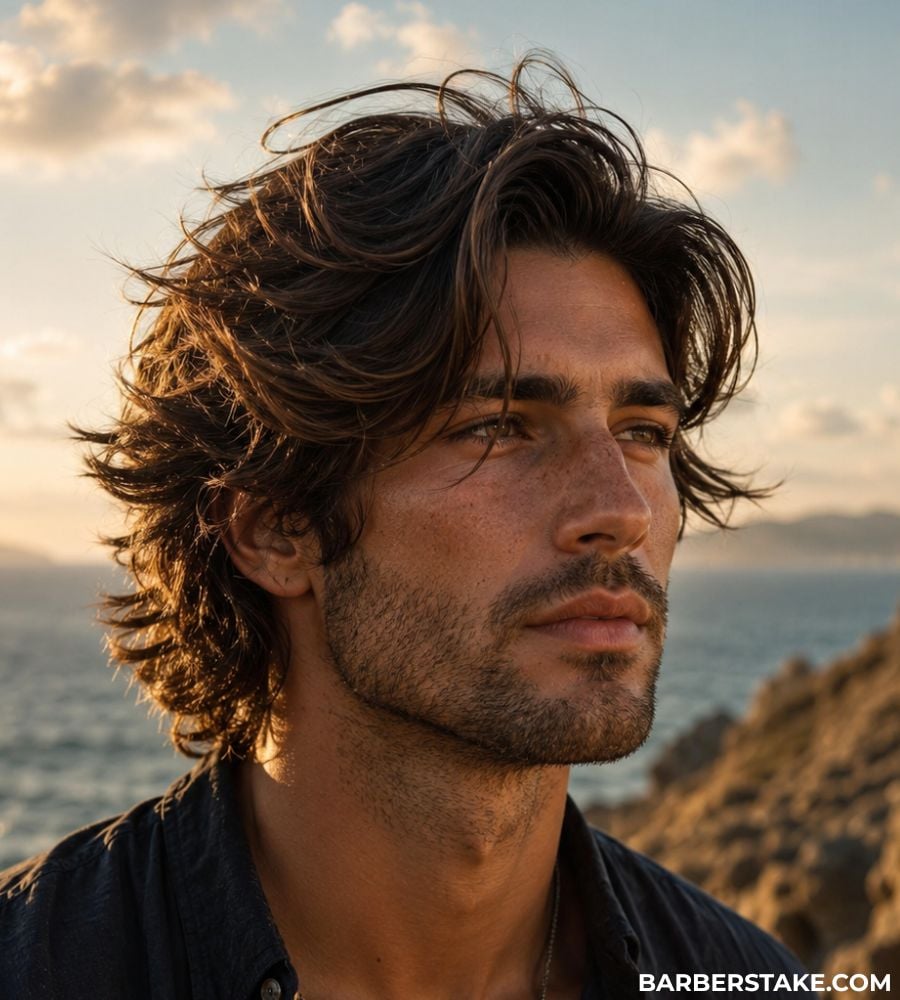
The flow is a medium-to-long natural hairstyle defined by loose, relaxed movement, hair that passes the ears, tucks behind them when convenient, and communicates general ease with the natural world. Layers are optional but helpful and styling is minimal by design. It’s the haircut equivalent of not trying, which, as any barber will confirm, requires a specific kind of upkeep to maintain correctly.
The textured, medium flow is growing steadily beyond its traditional surfboard and skateboard demographic into broader mainstream appeal. Its nonchalance is its primary selling point, and that’s been enough to sustain it across multiple trend cycles.


Who it suits: Works on straight, wavy, and loosely curly hair. Wavy hair is arguably the sweet spot, the natural movement adds texture without any effort. Not ideal for men who need to present as polished in formal professional settings, though it navigates creative and casual environments with ease.
How to ask for it: “I’d like my hair grown into a bro flow, add layers to prevent it sitting flat, tidy the ends without removing length, and I want genuine movement.”
Styling and maintenance: Sea salt spray on damp hair, air dry. A light leave-in conditioner for drier or wavier hair types. The entire routine should take under two minutes. Every eight to ten weeks.
4. Broccoli Cut: Gen Z Named It, the Barbershop Kept It
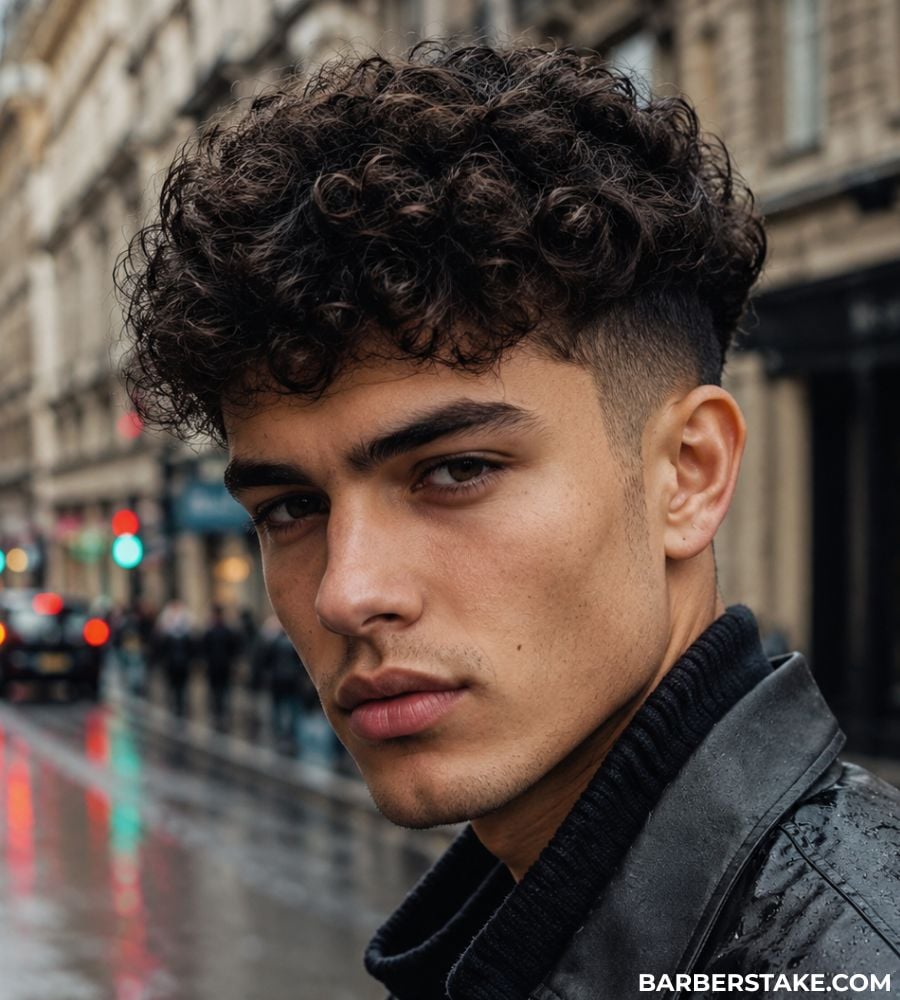
The broccoli cut pairs a tight high fade or skin fade on the sides with a full, rounded volume of curly or tightly textured hair on top, creating a silhouette that, yes, accurately resembles its namesake. Also referred to as the wet mop, zoomer perm, or bird’s nest depending on who you ask, it’s the cut that went viral on TikTok and then actually stayed in barbershops, which is a more difficult trick than it sounds.
This unapologetically confident cut is reserved for men with naturally curly or wavy hair who want maximum contrast and expressive volume. It doesn’t ask for permission. It knows what it is.


Who it suits: Curly or wavy hair is essential, the cut is defined entirely by the natural texture on top. Fine or straight hair won’t achieve the intended shape without chemical assistance. Works well on round and oval faces, where the vertical volume adds pleasing proportion.
How to ask for it: “I’d like a broccoli cut, a high skin fade on the sides with my natural curls left full and rounded on top. I want the volume to stand out against the clean sides.”
Styling and maintenance: Curl cream applied to soaking-wet hair, scrunched upward, then air dried or diffused. The shape comes from the curl pattern, not product hold. Every two to three weeks for the fade and use a daily curl moisture routine for the top.
5. Curtains: The 1990s Were Right About This One
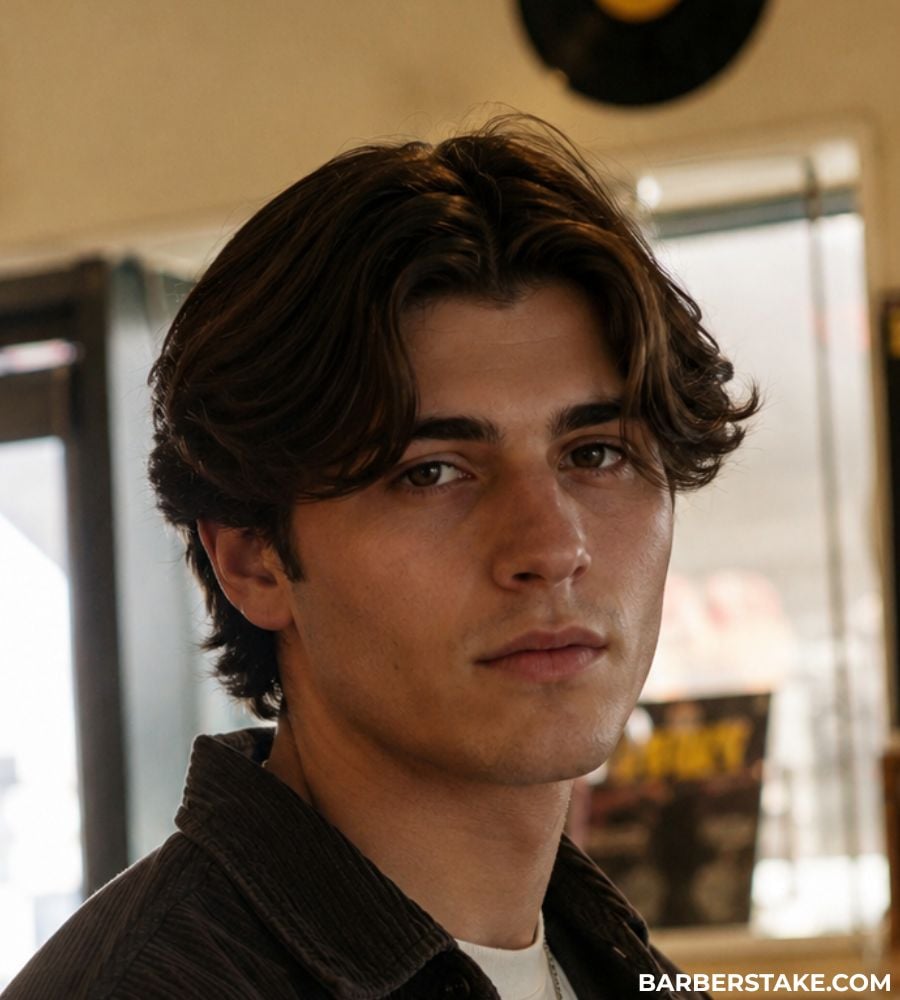
Curtains, sometimes called curtain bangs or simply the middle part, split the hair evenly down the center with a soft parting, allowing it to fall symmetrically to either side of the face in layered frames. The classic version grazes the cheekbones while longer variations fall toward the jaw. The effect is soft, symmetrical, and distinctly unhurried.
Few men’s trends have accelerated as sharply as this one in recent years. Driven by social media and a broader cultural appetite for 1990s-referencing aesthetics, the curtains haircut is the most pinned, saved, and screenshot-shared men’s look on every major platform, and unlike some viral styles, it translates directly into sustained barbershop demand.


Who it suits: Works particularly well on oblong and oval face shapes, where the symmetrical framing adds width and softens length. Also flattering on square faces, where the soft center part breaks up hard angles. Requires at least three to four inches on top to split and fall properly. Natural wave or slight texture enhances the movement significantly.
How to ask for it: “I’d like curtains, a soft center part with the hair falling to either side. Keep the front around cheekbone length with layered ends. I’m also happy to add a low fade or taper on the sides if that suits.”
Styling and maintenance: Sea salt spray or a lightweight cream on damp hair, rough dry with a blow dryer while parting with the fingers, then let it set naturally. Avoid heavy product, the appeal is the soft, unforced quality. Every six to eight weeks.
6. Side Part: The Haircut That Comes With a Handshake
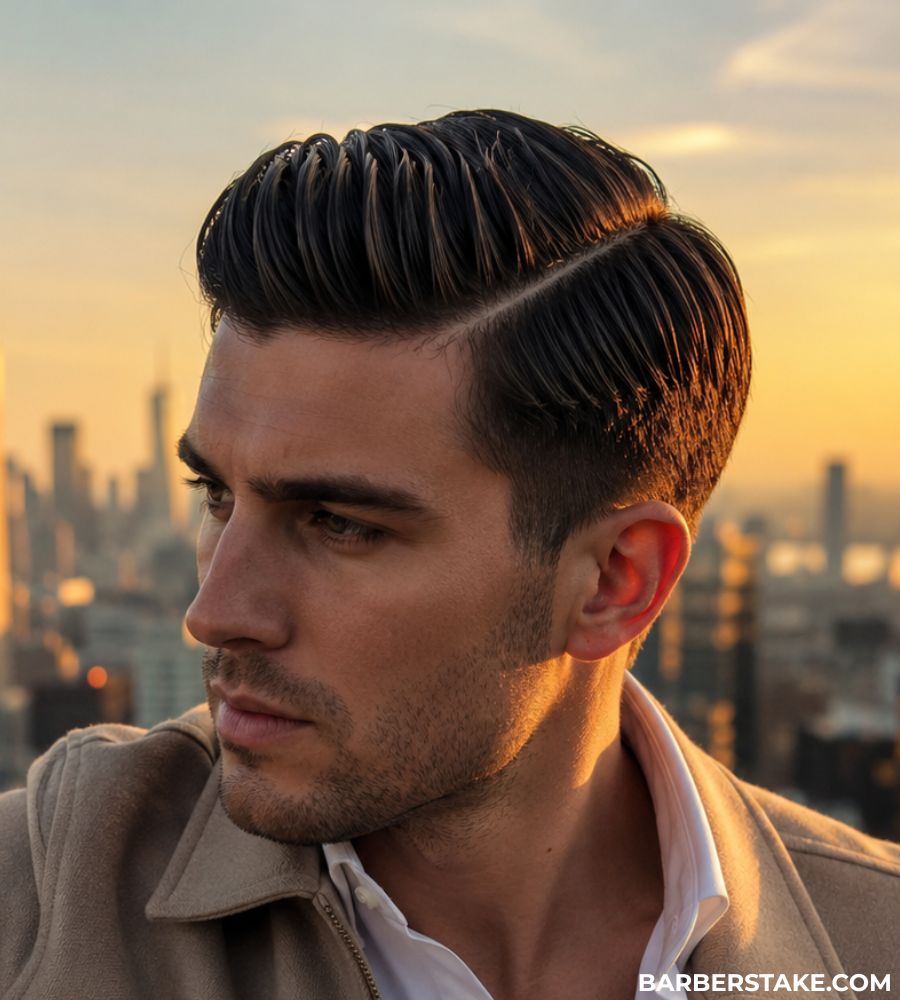
The side part divides the hair from a defined point above one temple, sweeping the bulk of the top section across in one direction. It can be kept natural and relaxed or sharpened into a hard part via a shaved line. A fade or taper on the sides brings the technical contrast that updates the silhouette without dismantling the essential structure underneath.
As close to a universal professional haircut as the barbershop produces. It communicates intention without ostentation, adapts effortlessly from a Tuesday morning meeting to a Saturday evening, and ages well in both directions, men in their 20s and 50s wear it with equal credibility.


Who it suits: Effective on most face shapes. Particularly useful on round faces, where the asymmetry of the part introduces angularity. Fine hair benefits from the directional sweep, which creates a convincing sense of density. Works on straight and wavy hair with minimal effort.
How to ask for it: “I’d like a side part with a mid fade, natural part or shaved hard part, I’m open to your recommendation based on my hairline. Keep the top around two inches, swept to one side.”
Styling and maintenance: Pomade or medium-hold cream combed through damp hair. Blow dry while combing to set the sweep direction. Every two to three weeks.
7. Crew Cut: A Classic, Masculine Look
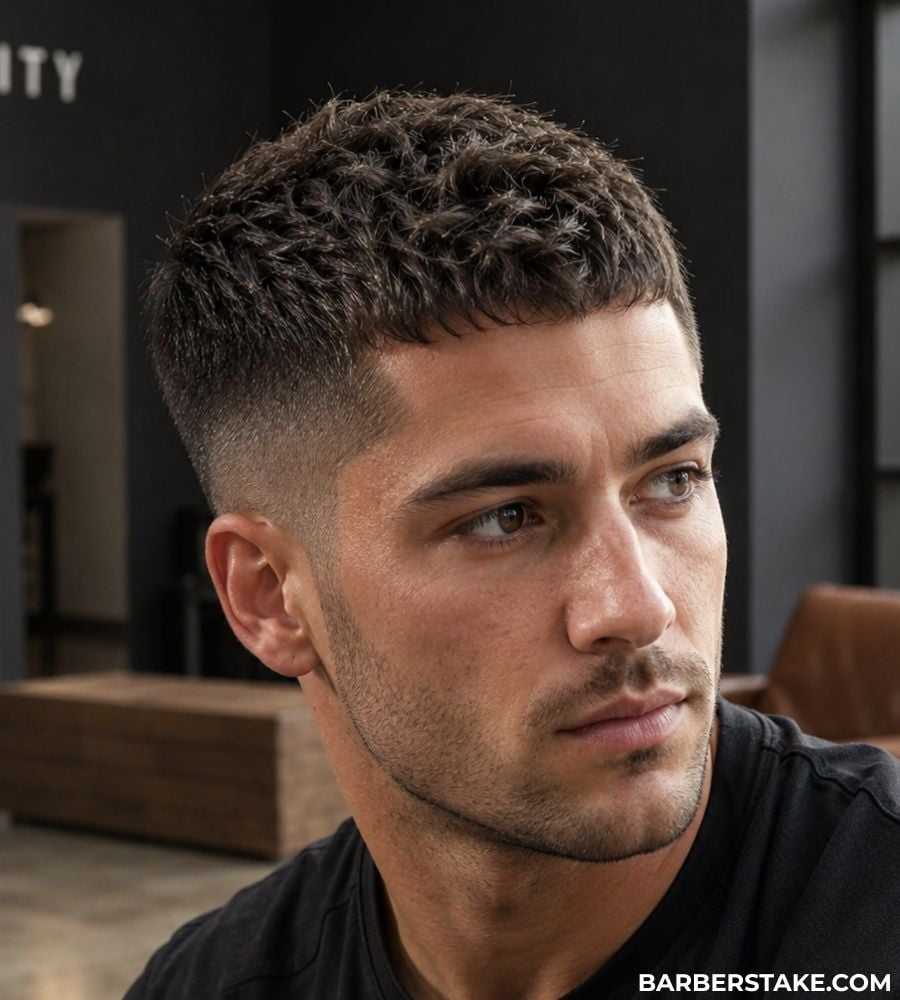
The crew cut keeps the hair on top short, typically one to two inches, slightly longer at the front than at the crown, and blends or fades the sides down proportionally. It’s orderly, deliberate, and completely devoid of pretension. It doesn’t chase trends because it predates most of them.
Few haircuts have survived this many generational shifts without needing a rebrand. The crew cut persists in barbershops not because it’s fashionable in the moment, but because it consistently delivers, sharp enough to read professional, low-effort enough to not be a daily negotiation.


Who it suits: Works across all face shapes. Oval and square faces carry it particularly well. It behaves naturally on straight and wavy hair, but for thick or curly hair, a textured variation handles the additional volume more comfortably.
How to ask for it: “I’d like a crew cut, about an inch and a half on top, slightly longer at the front with a natural taper toward the crown, and a fade on the sides.” If you want the classic military-close version, specify a grade one or two all over with a tight taper.
Styling and maintenance: A small amount of matte clay or pomade worked through damp hair, blow dried upward for subtle lift if needed. Trim every three to four weeks.
8. Modern Quiff: Confident and Measured
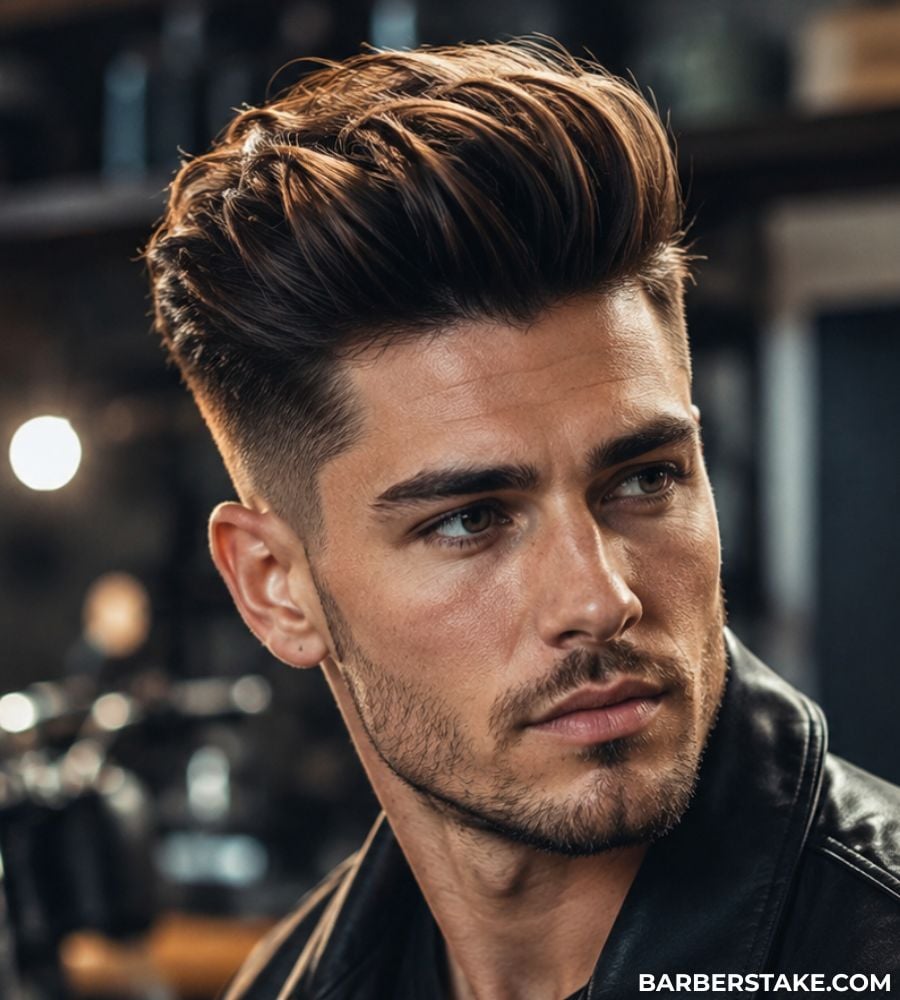
The quiff is a timeless hairstyle that lifts and sweeps the hair at the front of the head upward and slightly back, creating a visible peak above the hairline. It’s less structured than a pompadour, less swept, less elevated, but shares the signature front volume and the same fundamental appeal: height and intention at the front, clean contrast at the sides.
This cut occupies a well-positioned middle ground. It makes a considered statement without demanding full commitment to a dramatic look. It works in a creative office, at a dinner reservation, and at the kind of casual Friday where “smart casual” is doing a lot of interpretive work. It’s the kind of haircut that quietly does the heavy lifting for you.


Who it suits: Particularly flattering on round faces, where the added height elongates the face and adds definition. Works better on straight and wavy hair, and thick hair produces the most dramatic results. Finer locks can achieve a quiff with the right volumizing product.
How to ask for it: “I’d like a quiff, lifted at the front with movement, faded sides, and around two to two and a half inches on top. Not a full pompadour, just a forward-swept, upward lift at the front.”
Styling and maintenance: Volumizing mousse on damp hair, blow dry the front section upward with a round brush, then finish with matte paste or medium-hold cream. Every two to three weeks.
9. Blowout Taper: The Cut an Entire Generation Agreed On
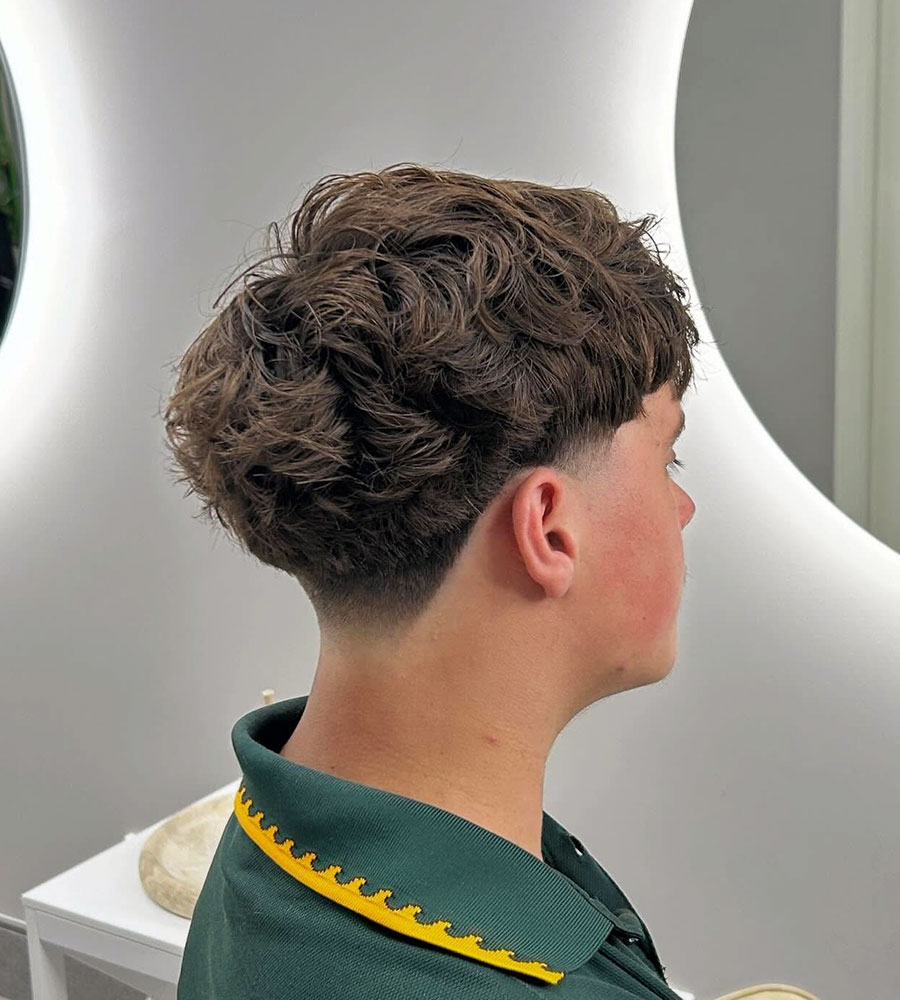
The blowout taper builds volume upward and outward from the front of the head, the hair blow-dried into a full, textured, slightly windswept shape, and pairs it with a low taper that cleans the neckline and the area around the ears without climbing the sides. The contrast is the point: maximum expression on top, minimal interference below. The modern version has shed the stiff, gelled aggression of its 2000s Jersey predecessor in favor of a softer, fluffier finish that looks more like good genetics than good product.
Few cuts have moved from social media request to daily barbershop reality this completely. The low taper blowout has been the defining young men’s cut of the past few years, and it has held that position long enough to earn a permanent entry rather than a trend footnote. Barbers in every shop in the country are cutting several of these a day, usually for clients who show the same three reference photos.


Who it suits: It’s perfect for straight and wavy hair with medium to higher fullness. Here, the volume is the aesthetic, and fine hair will need a texturizing styling clay and a committed blow-dry routine to deliver it. Round faces benefit significantly from the added height. Requires at least two and a half to three inches on top. The low taper keeps it wearable in most workplaces, though the silhouette reads youthful by design.
How to ask for it: “I’d like a low taper blowout, keep the top around three inches with texture cut in so it holds volume, taper low at the neckline and around the ears, and leave enough weight up front for the blown-out shape.”
Styling and maintenance: A blow dryer is non-negotiable here. Sea salt spray or volumizing mousse on damp hair, then blow dry upward and slightly forward, lifting at the roots with your fingers or a vent brush. Finish with texture powder or a light matte clay for hold without collapse. Every two to three weeks to keep the taper clean.
10. Slick Back: The Haircut That Means Business in Any Room
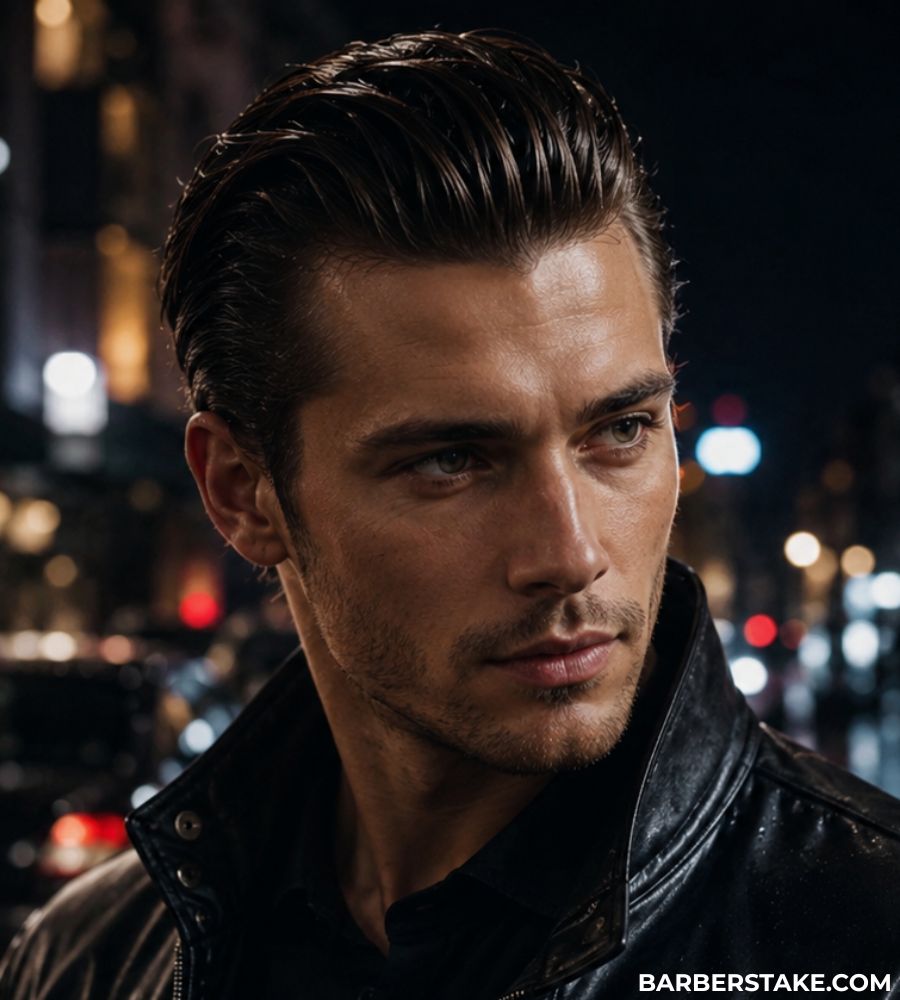
The slick back directs all hair from the forehead straight toward the nape, creating a smooth, controlled surface that showcases the hair’s natural weight and shine. A fade or undercut on the sides removes bulk and frames the top. The finish ranges from high-gloss wet look (gel) to a refined, matte contemporary finish (pomade or cream) depending on the occasion and the preference.
It combines effort and effortlessness in a proportion that very few other cuts achieve. Looks intentional. Never suggests you spent too long in front of the mirror. The slick back is equally comfortable in a boardroom, at dinner, and the kind of places where neither applies.


Who it suits: Straight or wavy hair with enough length to stay back, minimum three to four inches on top. Works best on oblong, oval, and square face shapes. Round faces can struggle with the flat sides-and-back that a slick back produces. A fade creates needed contrast in those cases.
How to ask for it: “I’d like a slick back with a mid fade, skin finish on the sides. Keep the top long enough to comb back, at least three inches at the front.”
Styling and maintenance: Medium-hold pomade or styling cream through damp hair, swept back with a fine-toothed comb. Gel for a high-shine wet look on special occasions. Use matte cream for the everyday version. Trim every three to four weeks.
11. Comb Over Fade: The Classic That Got a Proper Upgrade
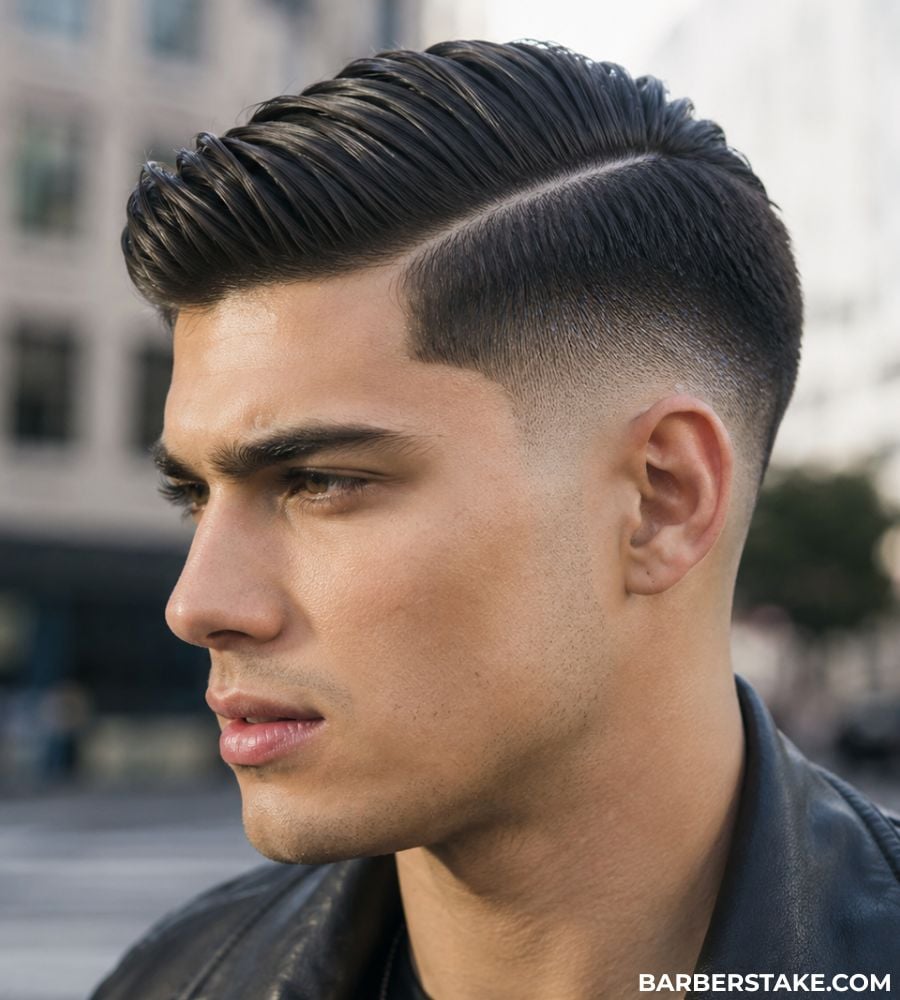
The comb over sweeps the hair laterally across the top from a side part, natural or shaved, while a fade on the sides brings the modern contrast that separates this from its dated predecessor. The result is a cut that communicates precision without effort, and reads sharply from across a conference table.
It is the navy suit of barbering. Appropriate everywhere, easily elevated, impossible to genuinely get wrong if the barber knows what they’re doing. Men who’ve worn this for twenty years won’t be changing anytime soon, and the men discovering it for the first time are wondering why it took them this long.


Who it suits: It works well with almost all face shapes. The part and top volume adjust naturally to add width, height, or definition where needed. Perfect for straight and wavy hair, and generally manageable on thick hair with a medium to high hold clay, pomade or paste.
How to ask for it: “I’d like a comb over fade, a natural side part with the hair swept across, and a mid skin fade on the sides. Keep the top around two inches, enough for a clean sweep.”
Styling and maintenance: Medium-hold pomade or styling cream through damp hair, combed in the direction of the part. A fine-toothed comb produces a sharper, more formal result; wider-toothed gives a softer sweep. Every two to three weeks.
12. Textured Fringe: Length, Layers, and a Fringe Worth Growing Out For
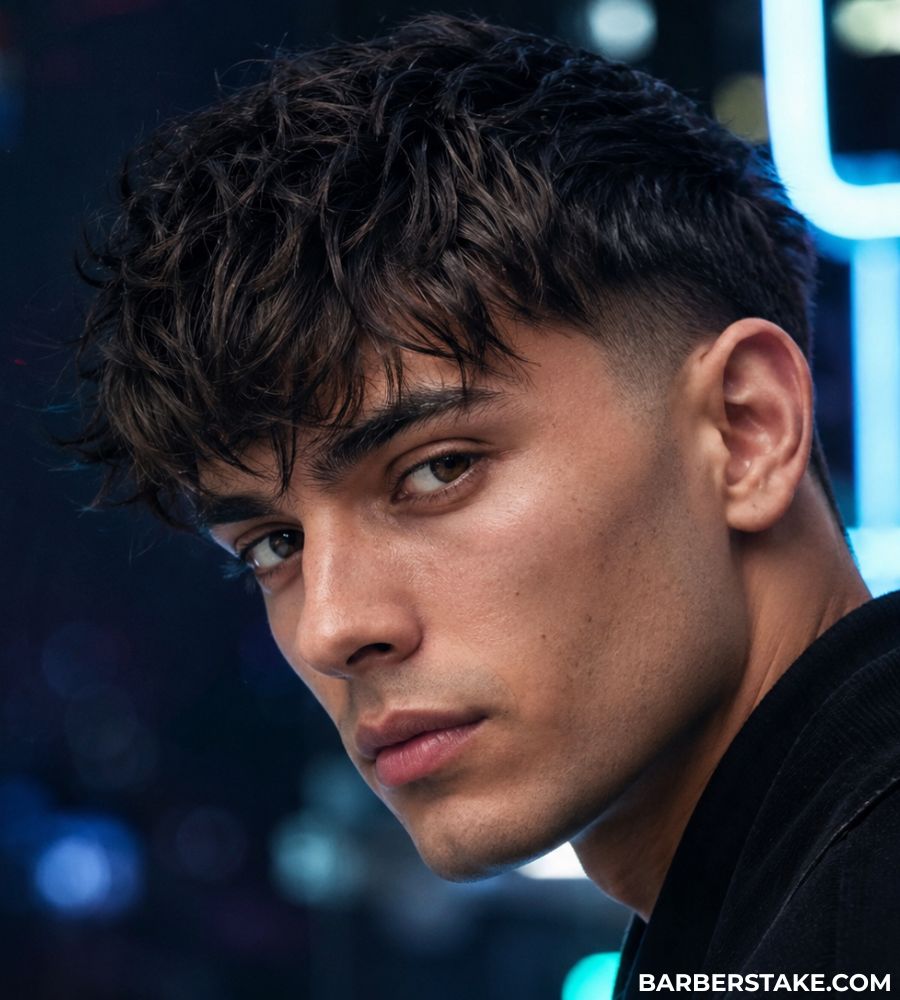
The textured fringe keeps the hair at a medium length on top with choppy, layered texture built into a longer fringe that sweeps casually across the forehead, typically reaching the brows or just above them. It can fall forward, be pulled to one side, or pushed across with a light product for a more intentional sweep. The sides are faded or tapered to keep the look sharp and prevent the overall shape from going shapeless. The fringe itself is the focal point, and the layering is what gives it movement rather than weight.
Where the textured crop sits short and forward with a defined line, the textured fringe leans longer and softer, with more visible flow and less structural precision. That distinction matters. The textured fringe frames the face rather than defining the forehead, and the sweeping, layered quality softens angular features in a way that shorter fringe cuts simply don’t. It’s a cut that rewards a little extra length on top and looks progressively better as it grows in.


Who it suits: Particularly effective on men with square or angular facial features, where the soft, sweeping fringe introduces contrast without competing with the jaw. Oval faces carry it well in any variation. Works best on straight and wavy hair, where the layers create visible separation and movement. Very thick hair may need some internal weight removed to stop the fringe sitting heavy across the forehead.
How to ask for it: “I’d like a textured fringe: longer than a crop, with choppy layers through the fringe so it has movement rather than a blunt line. Keep it long enough to sweep across the forehead and add a mid fade on the sides.”
Styling and maintenance: Apply a texturizing cream or hair powder to damp hair, then rough dry with a blow dryer and a round brush to build movement and lift through the fringe. Finger-style the fringe forward or to one side depending on your preference. Avoid heavy pomade, which will flatten the texture the cut relies on. Every three to four weeks to maintain the fringe length and fade.
13. Undercut: The Most Versatile Structure in Men’s Barbering
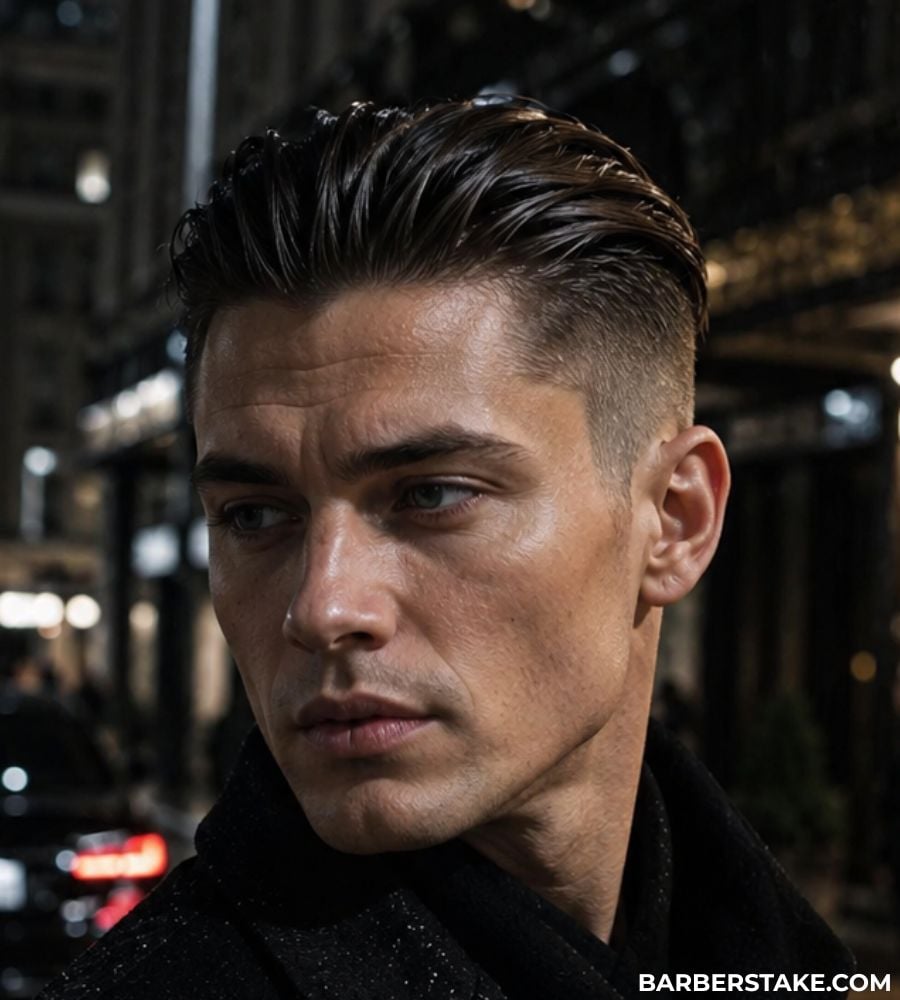
The undercut clips the sides and back to a short, uniform length with no tapering or gradual blending, creating a sharp, graphic transition between the longer top and the clipped sides. The disconnect is the whole point. It’s a deliberate gap rather than a transition, and the top becomes, effectively, a blank canvas for whatever style the wearer prefers.
Slick it back, style it forward, spike it upward, gather it into a bun, the undercut supports all of it without requiring a new haircut. That adaptability is why it’s stayed relevant across multiple shifts in men’s grooming culture since its first major wave of popularity in the 2010s.


Who it suits: Well-defined features carry the strong contrast most effectively, particularly defined jawlines and prominent cheekbones. Rounder or softer face shapes can find that the disconnection widens the midface in an unflattering way, in which case a blended fade may serve better. Works across all hair types.
How to ask for it: “I’d like a disconnected undercut, no fading, just a clean, sharp transition from the longer top to short sides. Take the sides to around a grade two or three.”
Styling and maintenance: Entirely determined by the top style. Pomade and comb for a slick back, matte clay for textured styling, smoothing cream for a man bun. Every three to four weeks.
14. Edgar Cut: Sharp Edges, Zero Apologies
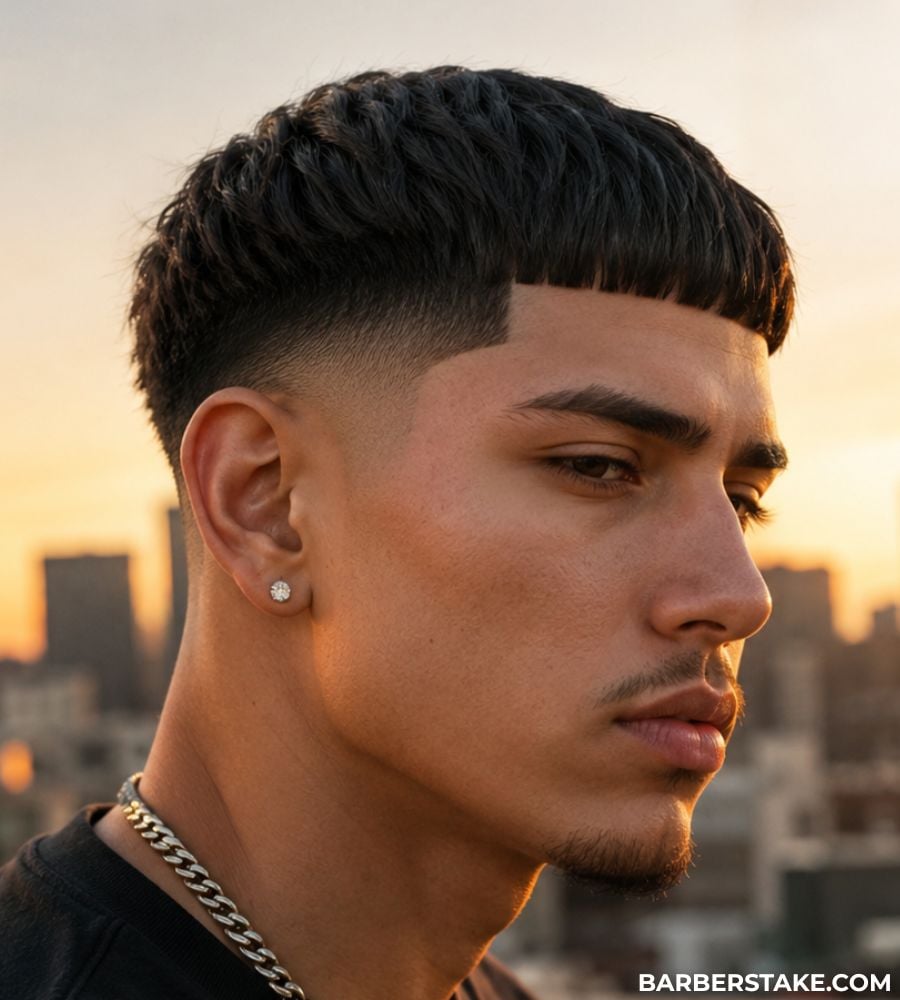
The Edgar cut pairs a blunt, precisely horizontal line across the forehead, the fringe cut straight rather than tapered, textured, or swept, with a skin fade or tight taper on the sides. The contrast between the clean forehead line and the stripped sides is the whole conversation.
Also known as the Takuache cut, the Edgar has deep roots in Mexican-American youth culture and carries that identity proudly. It has since crossed into broader mainstream request territory, appearing in barbershops across demographic lines, not because it softened, but because its graphic confidence proved contagious. This is not a subtle cut. That’s entirely the point.


Who it suits: Strong, angular facial features, particularly square and diamond face shapes with defined foreheads. If you have a very high forehead, the horizontal line can emphasize it unless you ask for a longer fringe. Hair should be straight or wavy with enough density for the blunt line to read cleanly.
How to ask for it: “I’d like an Edgar cut, a straight, horizontal scissor cut across the forehead at about an inch, with a high skin fade on the sides. The forehead line needs to be clean and level.”
Styling and maintenance: The cut holds its structure without product, which is part of its appeal. Matte clay or sea salt spray for texture if desired. Every two weeks to keep the forehead line precise.
15. Wolf Cut: The trending Rockstar Look
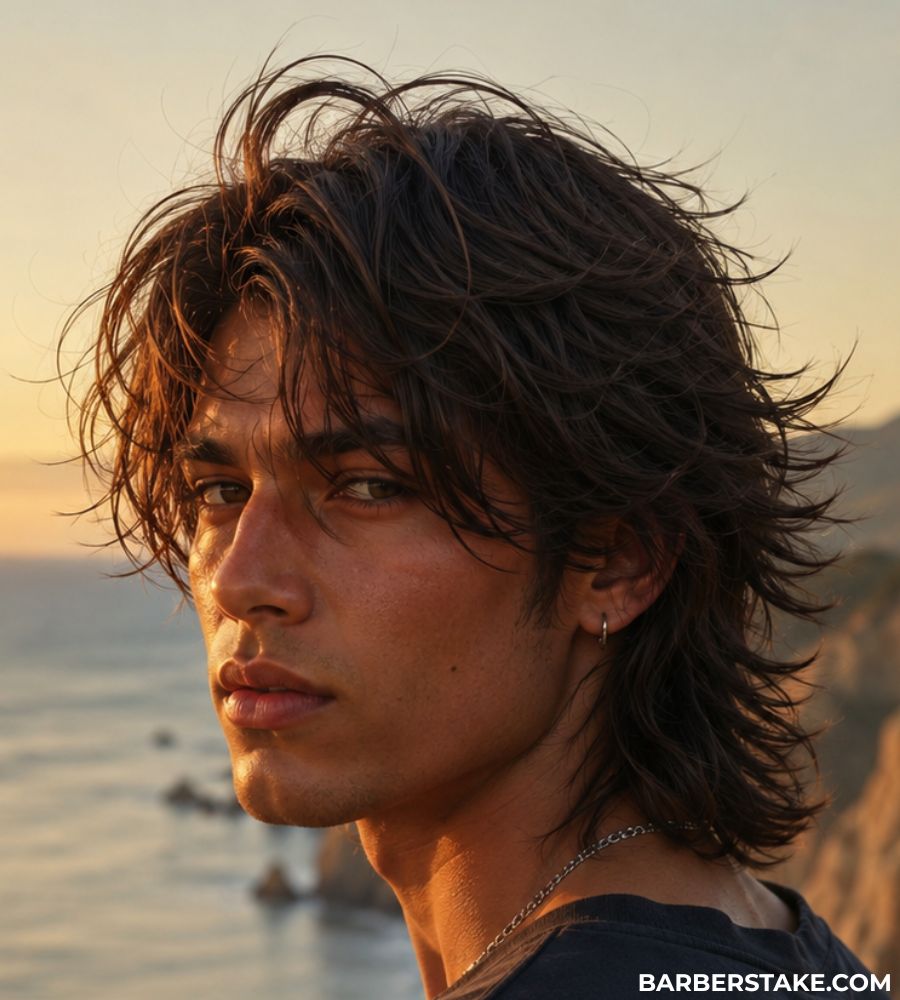
The wolf cut combines the heavy, choppy layering of a shag with the longer back and deliberately messy texture of a mullet, topped with a curtain-style fringe at the front. The silhouette is voluminous, feathery, and loaded with movement, intentionally undone in a way that requires a surprisingly specific brief to achieve properly.
It became a social media phenomenon and has maintained real-world staying power by appealing to a broad cross-section of men who want the volume and expression of longer hair without the formality of structured long styles. It looks effortless. It is not effortless. This is fine.


Who it suits: Works best on straight and wavy hair where the layers create visible separation and movement. Very curly or coily hair requires additional technique from the barber to achieve the intended shape rather than a formless mass. Oval and oblong face shapes wear the volume most naturally.
How to ask for it: “I’d like a wolf cut, heavy layers through the crown and top, a curtain fringe at the front, length kept in the back. Think shag meets mullet, but with a more current finish.”
Styling and maintenance: Diffuse on low heat with a texturizing spray, then finish with a light matte clay or leave-in product for separation. Avoid heavy products that collapse the layers. Every six to eight weeks.
16. The Brush Back: Volume and Direction
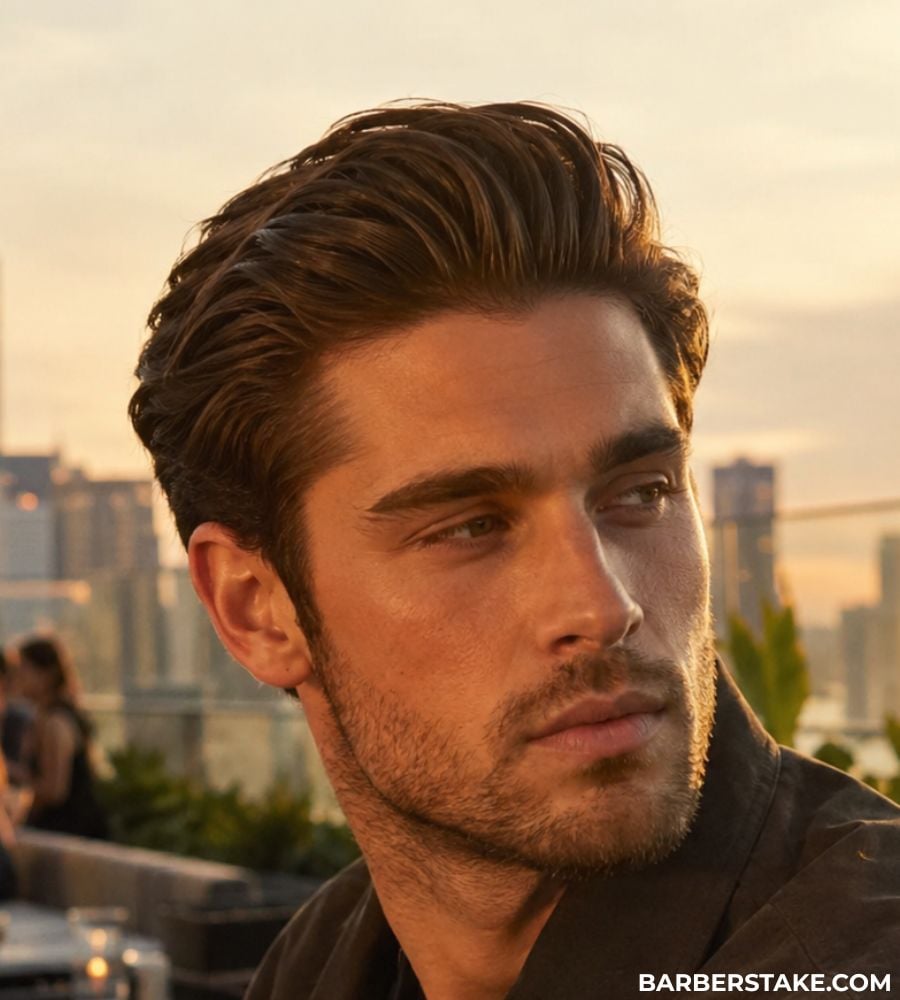
The brush back directs the hair away from the forehead and swept toward the crown and nape, creating a clean, open-faced silhouette with natural volume and front-to-back movement. The length on top sits between two and four inches depending on how much lift and flow you want, and the sides are tapered or faded to keep the proportions balanced. It’s the kind of cut that makes your forehead look like a deliberate feature rather than something that just happened.
The brush back sits in a useful space between the precision of a comb over and the looseness of a slick back. It carries structure without rigidity, and the volume created by the round brush and blow dryer gives it a fullness that most shorter cuts can’t replicate. It also happens to be a more forgiving cut to maintain at home, since the styling technique does most of the shaping work rather than the scissor line alone.


Who it suits: Works well on most face shapes. Round faces benefit from the height and backward direction, which adds length. Square and oval faces carry the volume naturally. Straight and wavy hair respond best to the round brush technique; thick hair produces the most impressive results. Fine hair can work with the right volumizing product but may need a shorter overall length to hold the lift.
How to ask for it: “I’d like a brush back. Keep the top around two to three inches with enough length to sweep back and create volume. Add a mid fade or high taper on the sides, and I want the top to have some movement rather than lying flat.”
Styling and maintenance: Apply volumizing mousse or a lightweight cream to damp hair, then blow dry using a round brush, directing the hair back from the forehead. Work in sections to build lift at the roots. Finish with a medium-hold pomade or matte paste to set the shape without flattening the volume. Every two to three weeks to keep the fade or taper sharp.
17. Pompadour Fade: Architecture for the Front of Your Head
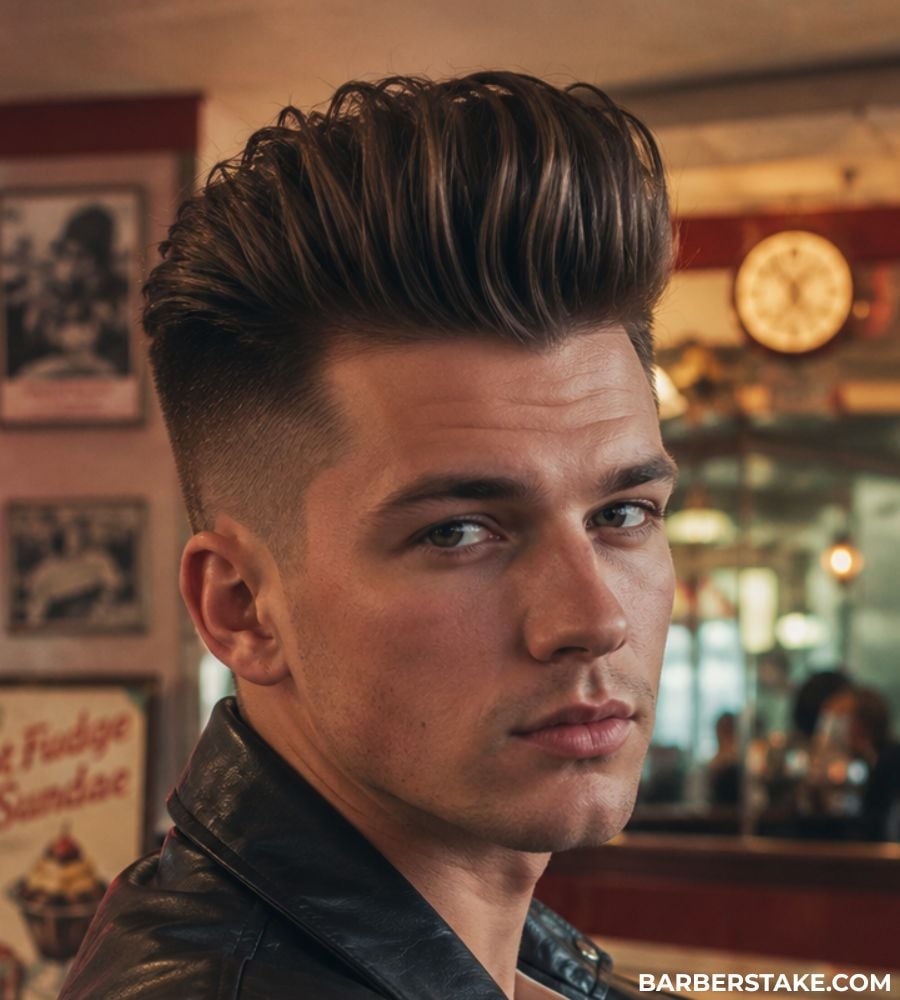
The pompadour concentrates length and volume at the front of the head, sweeping the hair upward and backward in a structured, elevated wave behind the hairline. A fade on the sides keeps the silhouette proportional and the overall impression current rather than costume. It’s an architecturally ambitious style that won’t look theatrical in everyday life.
Rooted in 1950s Greaser culture, Elvis wore it best, Johnny Cash wore it boldly, the pompadour was reshaped in the 1980s, quietly modernized across the 2000s, and has sat comfortably in mainstream barbering ever since. Its staying power comes from something simple: when it suits a face, it suits it completely.


Who it suits: Strong jawlines and oval or oblong faces benefit most from the height. Not recommended for men with very fine or low-density hair at the front, the pomp needs mass to deliver its signature lift. Works on straight and wavy hair, but thick hair excels here and produces the most dramatic results.
How to ask for it: “I’d like a pompadour with a mid or high fade on the sides. Keep the front long enough for height, at least two to two and a half inches. Clean skin finish on the sides.”
Styling and maintenance: Volumizing mousse on damp hair, blow dry the front upward and backward with a round brush, then secure with a medium-hold pomade for shine or matte paste for a textured finish. Every two to three weeks for maintenance.
18. Faux Hawk: All the Presence Minus the Morning Commitment
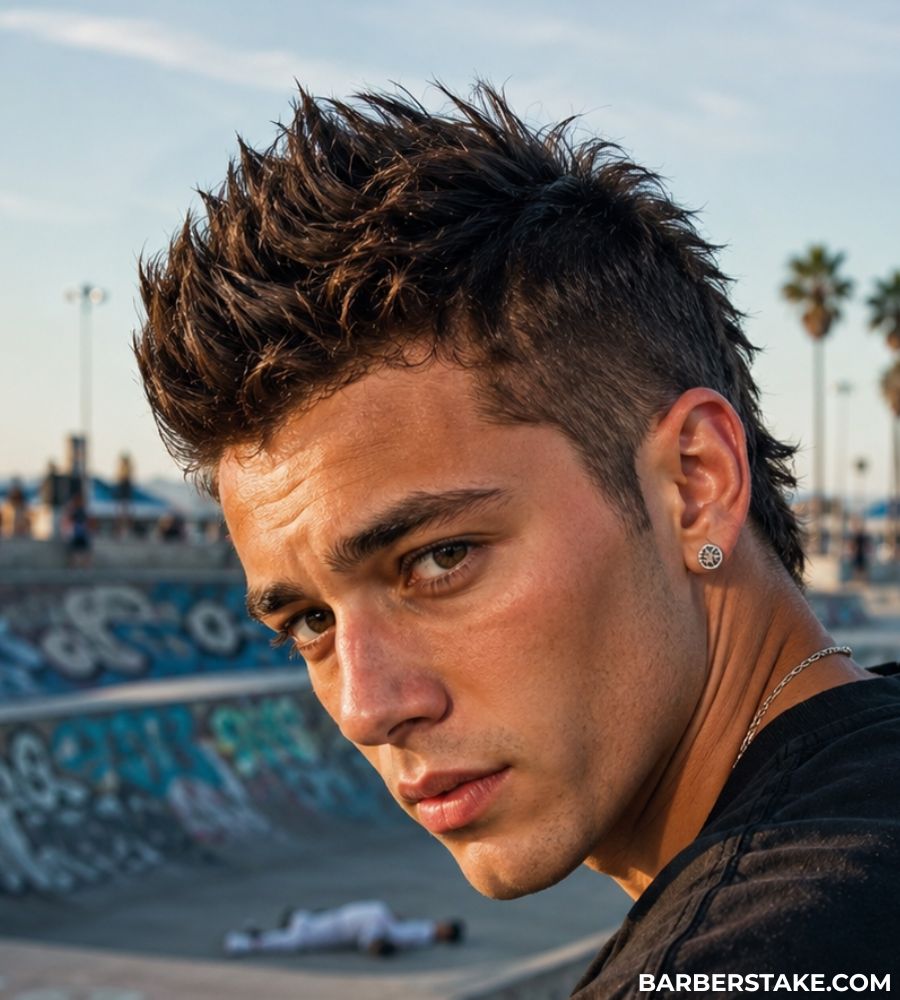
The faux hawk concentrates volume and length down the center of the head, from the hairline to the crown, styled upward into a contained ridge. Unlike a full mohawk, the sides are faded or tapered rather than shaved bare, making the transition gradual and the overall look substantially more wearable across different environments. The central strip remains the focal point and the fade frames rather than eliminates.
The faux hawk found the sweet spot between bold and functional and has occupied it for over a decade. It gives men a defined, expressive silhouette without requiring a full lifestyle rebrand. That’s a useful quality in a haircut.


Who it suits: Strong, defined features carry it most effectively. Works across all hair types, though thick hair delivers the most dramatic central ridge. Oval and oblong face shapes benefit most from the added crown height.
How to ask for it: “I’d like a faux hawk, tapered or faded sides with the top left long enough down the center to style upward into a ridge. Keep the central section around two inches.”
Styling and maintenance: Strong-hold matte paste or gel on damp hair. Lift the center section with fingers while blow-drying upward to set the height. Let the sides stay clean and unproducted for contrast. Every two to three weeks.
19. Two Block Cut: K-Pop’s Most Influential Export
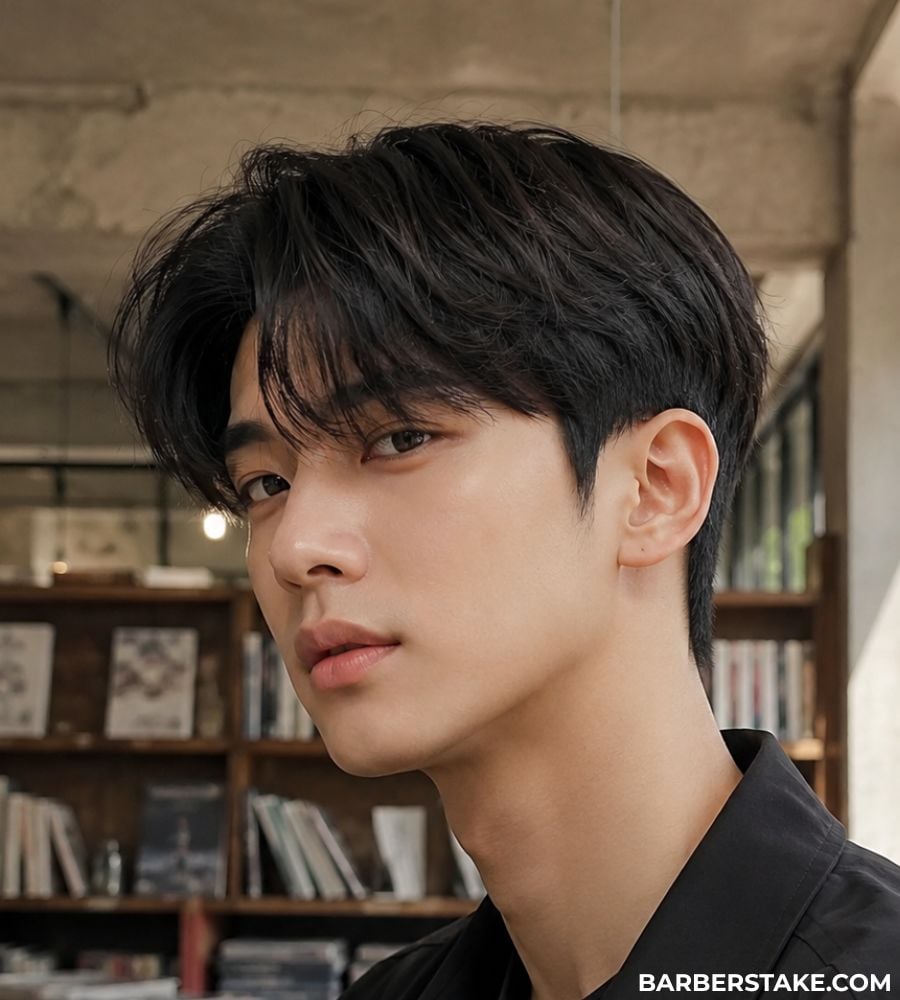
The two block haircut (originating in Korean barbering) keeps the hair significantly longer on top, left to flow with natural texture and movement, while the sides and back are clipped or faded to a considerably shorter length, producing a graphic, two-tiered visual contrast. It’s not a subtle transition. The gap between the lengths is the entire aesthetic.
The two block cut is a clear example of global cultural exchange shaping Western men’s haircut trends in real time. Driven initially by K-pop and Korean celebrity culture, it has since crossed well beyond its origin community into mainstream barbershops across Europe, North America, and Australia. Its sharp structure has proved genuinely adaptable across different hair types and personal aesthetics.


Who it suits: Works best on straight and wavy hair. Oval and oblong face shapes wear it comfortably; the dramatic side contrast can widen rounder faces, which is worth factoring in. Sufficient density on top is important, fine hair may struggle to deliver the textured volume the cut needs to read clearly.
How to ask for it: “I’d like a two block, long and textured on top, much shorter on the sides and back with a clean, defined transition between the two lengths.”
Styling and maintenance: Lightweight styling cream or soft clay on the top section, finger-styled for natural movement. Avoid heavy product, the natural flow is the point. Every three to four weeks.
20. Caesar Cut: Julius Had No Idea What He Was Starting
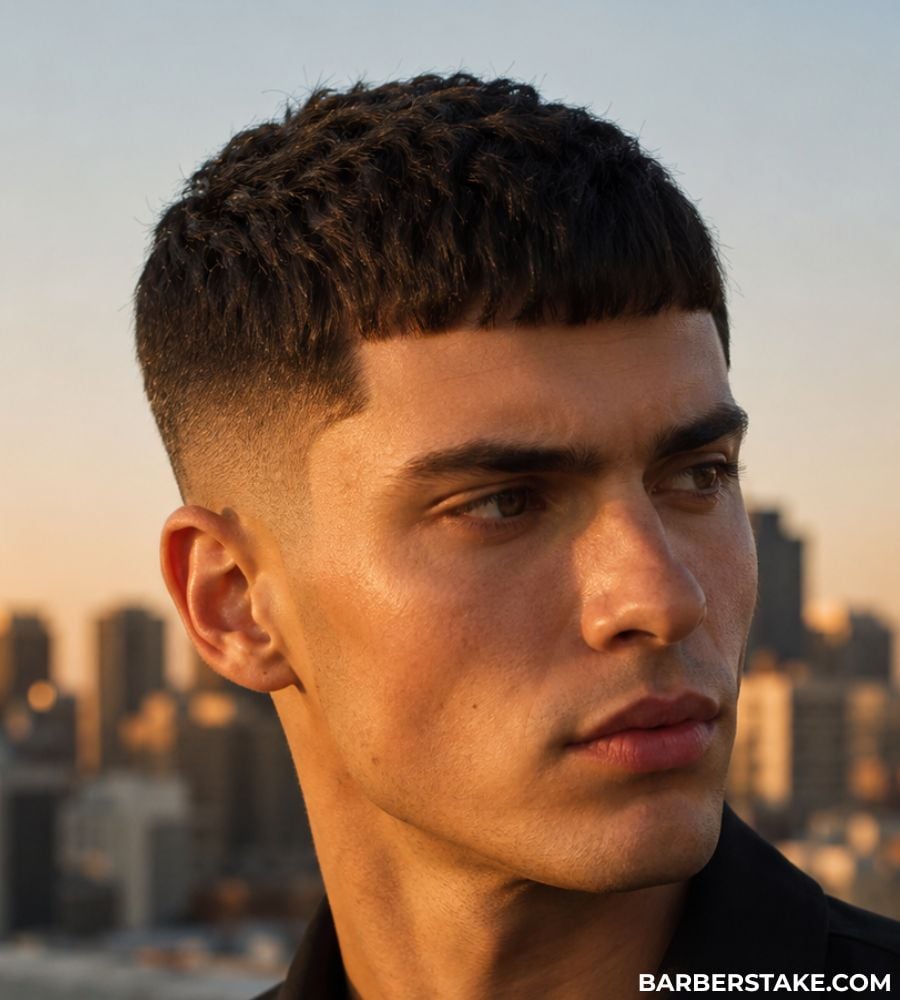
The Caesar keeps hair at a uniform, short length on top, typically between half an inch and two inches, with a straight fringe brushed forward across the forehead. The sides can remain even with the top in the classical version, or tapered and faded for a contemporary update. What makes it distinctive is the horizontal fringe: clean, intentional, and doing considerably more work than it appears to.
The Caesar’s quiet functionality is part of its longevity. The forward fringe creates a clean visual break across the forehead and, of particular relevance to a significant portion of the men who request it, provides effective, unobtrusive coverage for an uneven hairline or early temple recession. It handles this task without drawing any attention to it whatsoever, which is exactly the kind of discretion men appreciate.


Who it suits: Works across all face shapes. Particularly practical for men with thinning hairlines or high foreheads. Straight, wavy, and curly hair all carry it well, curly variations produce a naturally textured top that pairs beautifully with the signature fringe.
How to ask for it: “I’d like a Caesar cut, uniform short length on top with a straight fringe brushed forward, and a mid fade on the sides.”
Styling and maintenance: A small amount of matte clay worked into damp hair, finger-styled forward. For a sharper fringe line, blow dry forward with a vent brush. Every two to three weeks.
21. Man Bun: The Most Patience-Required Entry
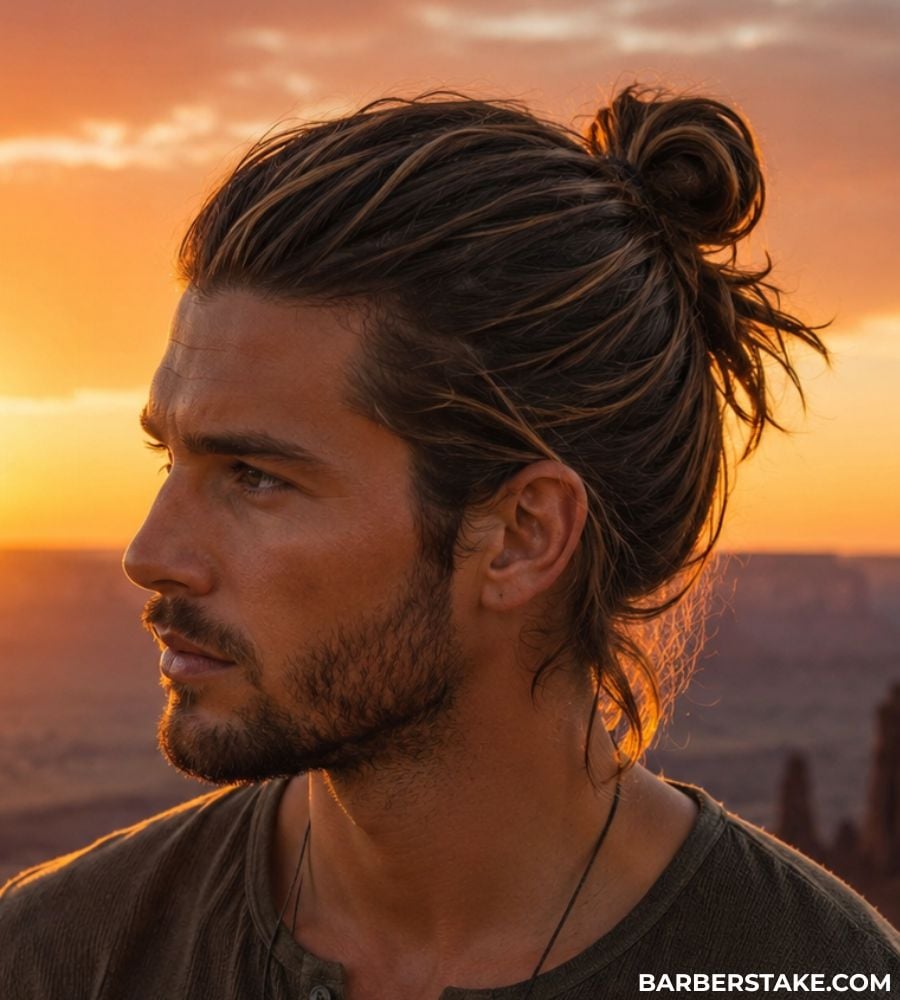
The man bun gathers medium-to-long hair and secures it at the back of the head or at the crown with an elastic, forming a compact, deliberate knot. The sides can be left at full length or reduced with a taper or fade for a cleaner overall impression. It’s simultaneously functional for active men and underrated in most professional environments with relaxed dress codes.
Its cultural lifespan has outlasted several rounds of backlash, which is more than most trends can say. Men grow into it, discover it suits them, and quietly stay. The combination of a well-maintained man bun and a groomed beard is a consistently effective pairing.


Who it suits: Requires at least four to six inches of hair on top to tie properly. Works across all hair types. Round faces benefit from a higher bun at the crown, which elongates; oblong faces suit a lower bun at the nape. The beard combination adds the weight and structure at the jaw that a tied-up haircut can otherwise remove.
How to ask for it: “I’m growing out for a man bun, I’d like the sides tapered or faded to keep things clean, and the top trimmed for shape without taking any significant length off.”
Styling and maintenance: Smoothing cream or hair oil on damp hair before tying. Soft fabric ties prevent breakage. Every six to eight weeks for shape; sides trimmed more frequently if faded.
21. Shag Cut: The 1970s Had One Excellent Idea, and This Was It
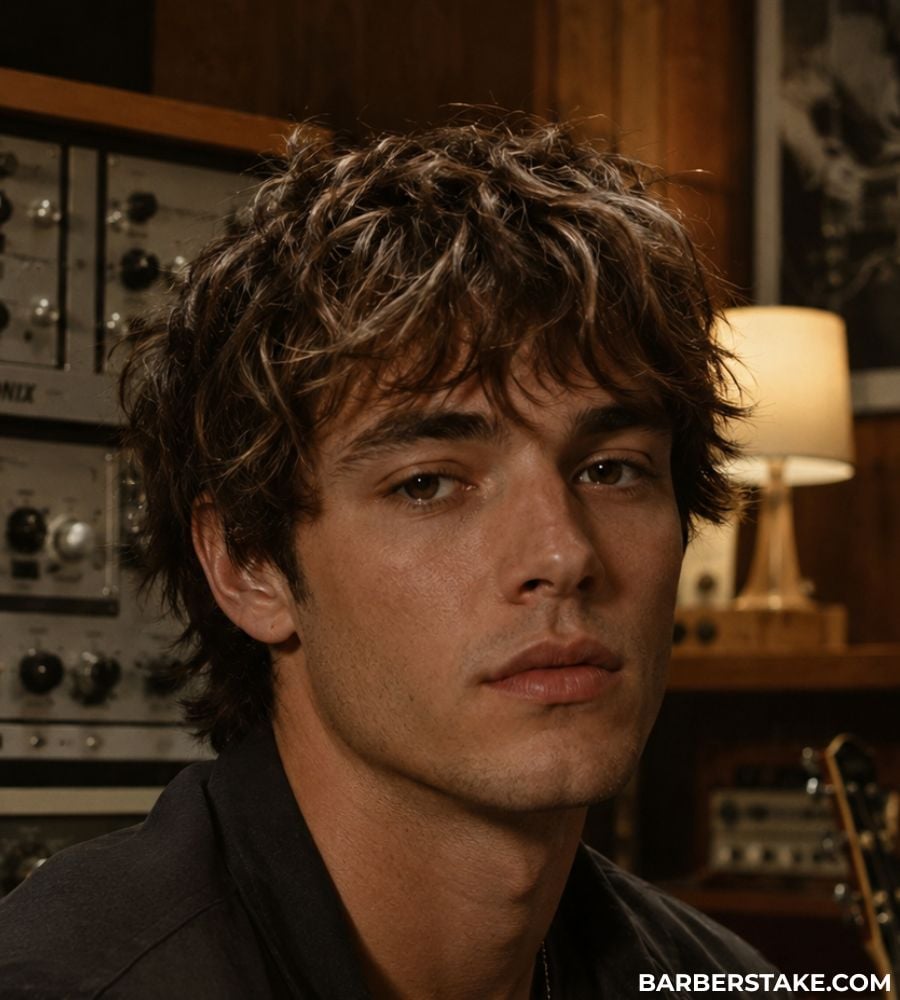
The shag is a medium-to-long layered cut defined by heavy, choppy layers from roots to ends, a textured fringe, and razor-cut or point-cut tips that create an airier, less structured silhouette. It’s the haircut most honestly described as controlled chaos, and it looks significantly better than that description suggests.
The shag has been on a slow, steady ascent for the better part of six years and has gained particular traction among men who want the expression of longer hair without the weight that usually accompanies it. The layers remove bulk while preserving length, a useful trade-off.


Who it suits: Sings on straight and wavy hair where the layers create visible separation and movement. Oval and oblong face shapes are the most natural fit, though the layering angles can be adjusted to add or remove width for other shapes. Works less naturally on very coily or Afro-textured hair without significant technique adjustment.
How to ask for it: “I’d like a shag, heavy layers through the crown and ends, a textured fringe, and feathered tips. Keep the overall length medium to long, and I want genuine movement.”
Styling and maintenance: Diffuse on low heat with a texturizing spray, then a light matte clay for separation. The cut looks best when left slightly undone, over-styling defeats its purpose. Every eight to ten weeks.
22. Drop Fade: The Curved Cut with Personality
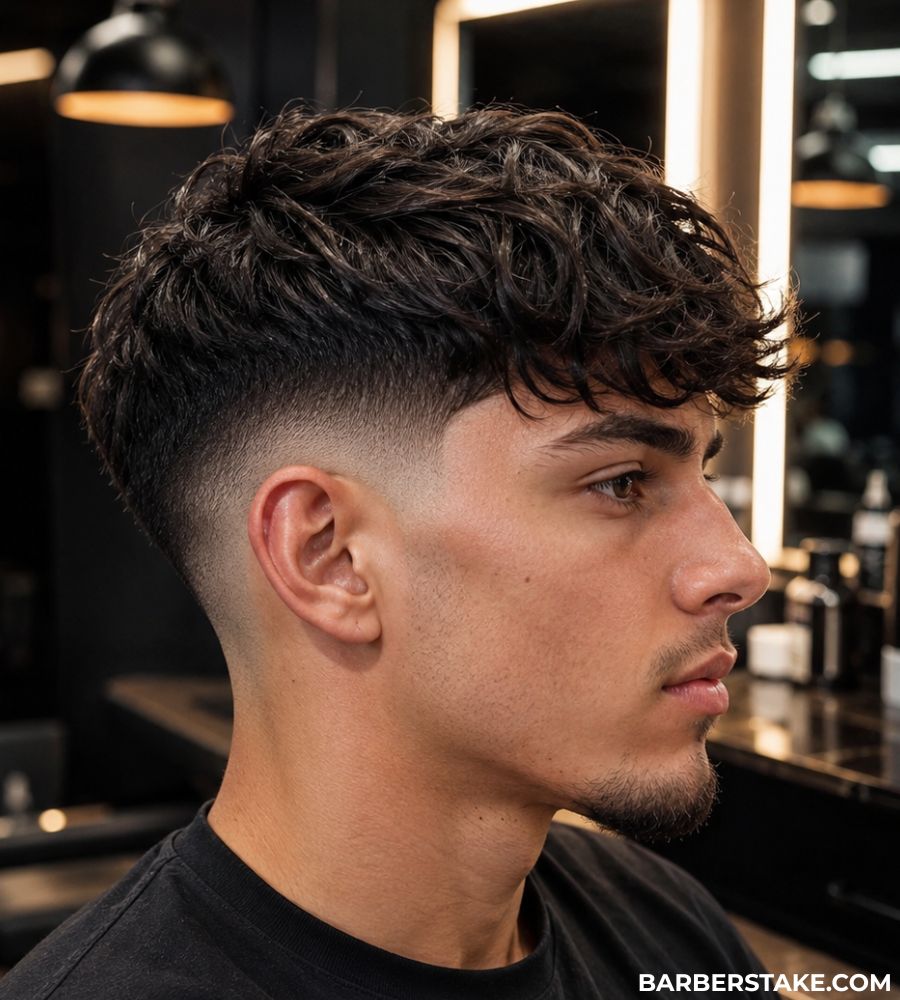
The drop fade curves downward behind the ear rather than following a straight horizontal line, creating a rounded arc that drops toward the nape. The effect is a more dynamic, three-dimensional finish at the back of the head, subtly different in construction, noticeably different in how a haircut reads up close.
It’s a technical detail rather than a standalone hairstyle, but it’s requested by name in barbershops for a reason. Men who know what a drop fade is tend to know they want one, and the barbers who execute it well know the difference too.


Who it suits: Particularly effective with styles that benefit from defined back-of-head framing: crops, pompadours, mohawks, natural curls. Adds a three-dimensional quality to any cut it accompanies. Works on all hair types.
How to ask for it: “I’d like a drop fade, the taper should arc down behind the ear rather than running horizontally. Pair it with [your top style].”
Styling and maintenance: Determined by the top style. Every two weeks to keep the arc defined.
23. High Top Fade: A 1990s Architectural Icon
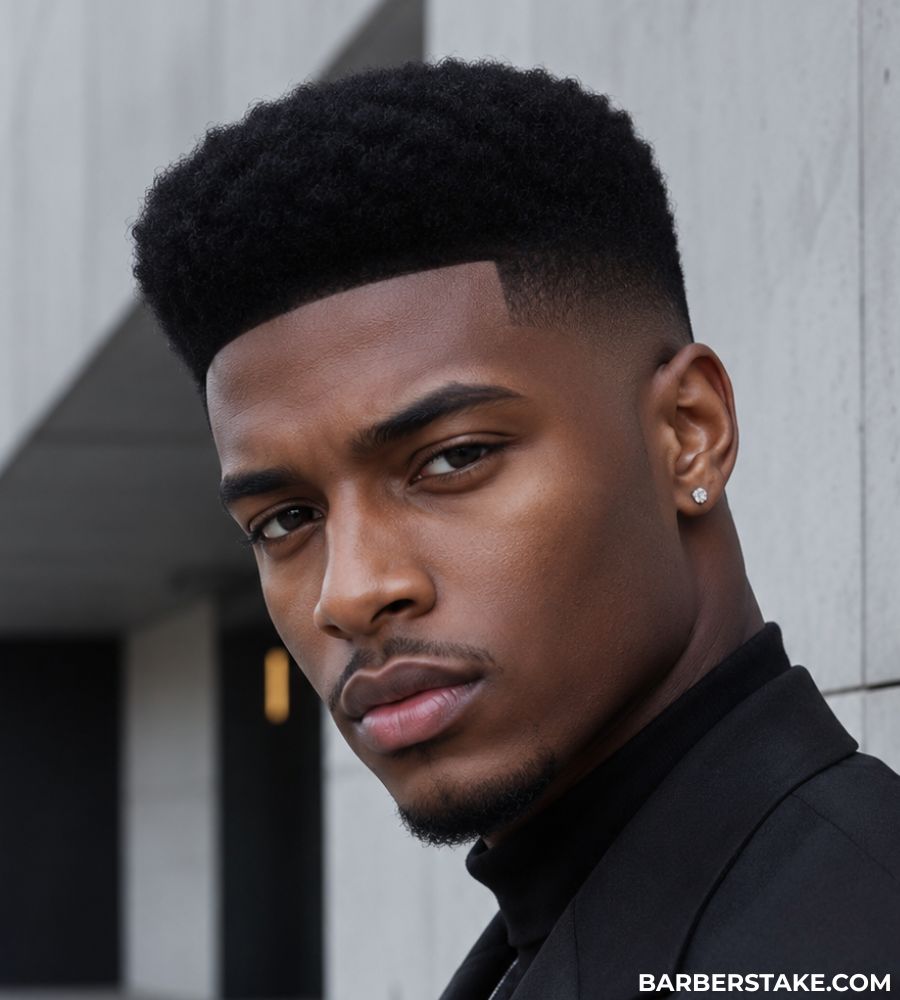
The high top fade trims the hair on the crown into a level, flat-top platform using clipper-over-comb technique, while the sides and back fade tightly to the skin. The silhouette is unmistakable: square, vertical, and unapologetically bold.
This cut carries significant cultural weight in Black barbering history, it defined a visual era in American culture and is now experiencing a thoughtful revival, fueled partly by nostalgia and partly by a broader appreciation for expressive, structural hairstyles that don’t pretend to be something quieter than they are.


Who it suits: Requires naturally coily, tightly curly, or Afro-textured hair to achieve the flat-top platform. Oval and square faces carry the proportions most naturally. The vertical height can help elongate rounder faces when paired with tight sides.
How to ask for it: “I’d like a high top fade, keep the top flat and level at the crown, and take the sides down to a skin fade. The top platform should be about an inch and a half to two inches high.”
Styling and maintenance: Curl moisturizer or light styling cream to maintain the shape. Regular picking keeps the flat-top platform defined between cuts. Every one to two weeks.
24. Natural Afro with Fade: Volume and Contrast
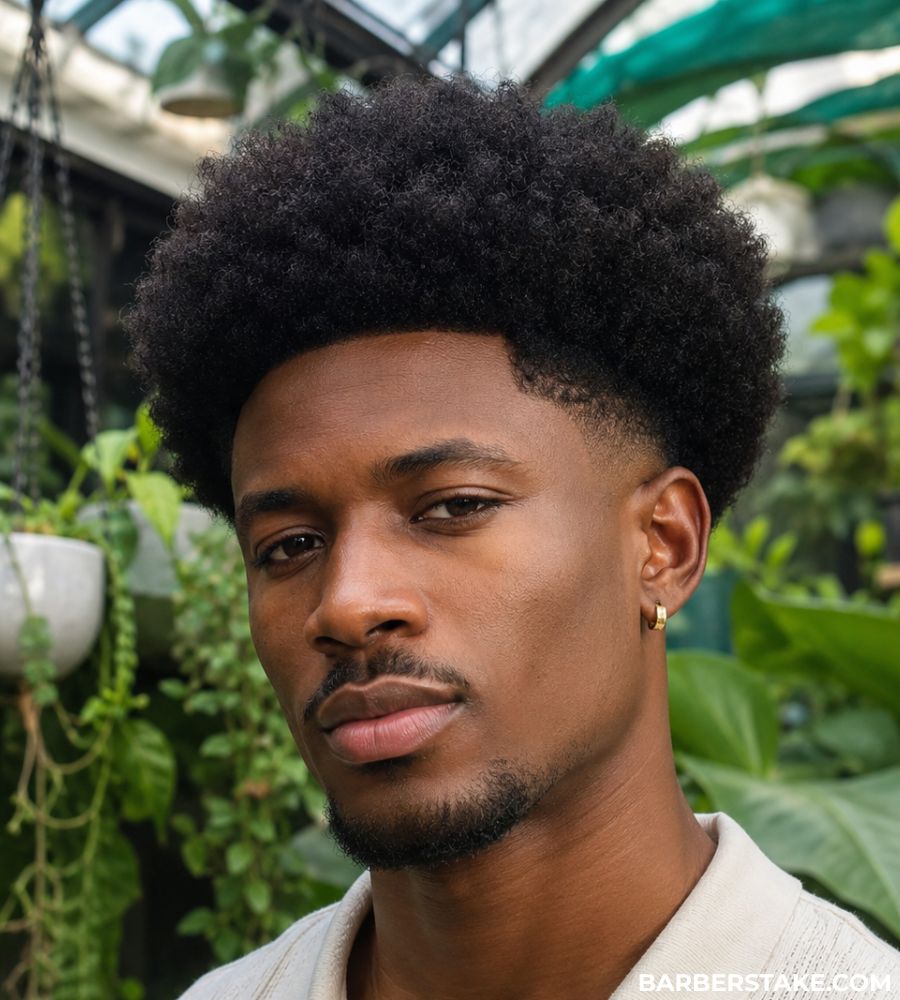
A full natural afro, maintained with regular picking and a consistent moisture routine to hold its rounded, voluminous shape, paired with a fade or taper at the sides and back. The contrast between the sculptural density on top and the clean fade underneath is what gives this cut its architectural presence. The fade doesn’t diminish the afro; it frames it.
An essential entry on any comprehensive men’s haircut guide. The natural afro with fade celebrates natural coily texture and the technical precision of modern barbering simultaneously. It’s culturally significant, visually striking, and a genuinely popular choice among men who want their cut to reflect both craft and identity.


Who it suits: Natural Afro or coily hair texture. The fade height adjusts to suit different face shapes, a lower fade works comfortably for rounder faces; a higher fade adds definition on oval or oblong shapes. The afro’s shape can be trimmed round, square, or tapered at the top to suit individual preference.
How to ask for it: “I’d like my afro shaped and picked out, I want a clean mid or high fade on the sides with a smooth transition into the natural hair. Keep the top rounded and full.”
Styling and maintenance: Daily picking and a leave-in moisturizer or curl cream for definition and frizz control. Regular deep conditioning is essential for healthy, elastic coily hair. Fade maintenance every two to three weeks.
25. Textured Spikes: What 2003 Should Have Done With This Concept
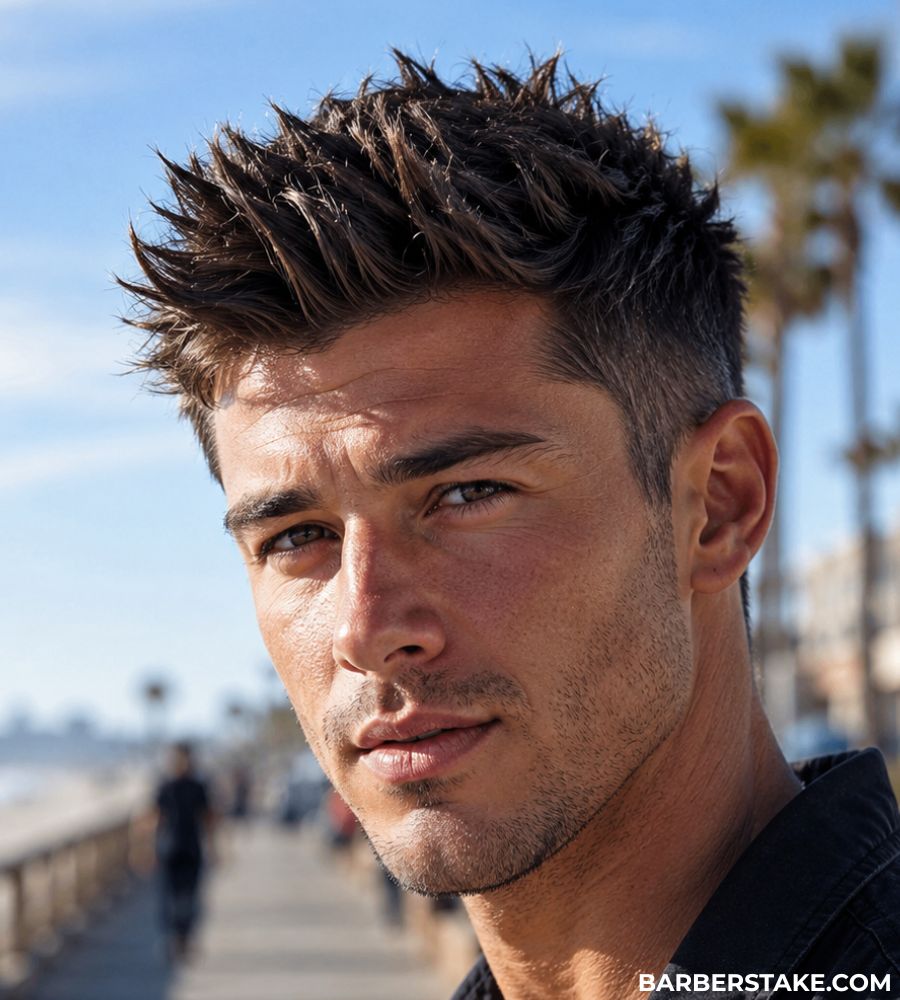
Modern textured spikes have shed the rigid, gel-shellacked uniformity of their early 2000s predecessor in favor of an irregular, finger-styled version where different sections of hair are lifted and separated at varying heights. The result is a natural-looking, multidirectional texture, tactile and casual, rather than the helmet formation that previously gave this category a complicated reputation.
The rehabilitation of this aesthetic is complete. The updated version is expressive, low-effort, and carries none of the ironic distance that surrounded it for the better part of a decade. It’s just a good shorter cut with character.


Who it suits: Works on short to medium hair with enough density to hold lift. Fine or flat hair needs a volumizing product to support the height. Oval and square faces carry it well. Not ideal for very formal environments, but handles creative and casual settings without effort.
How to ask for it: “I’d like a short textured cut that I can finger-spike, not uniform or stiff, just irregular and lifted in a natural way. Mid or high fade on the sides.”
Styling and maintenance: Matte paste or light clay worked through damp hair, finger-styled upward in sections. A quick blow-dry at the root adds extra lift. Every three to four weeks.
26. Ivy League: The Crew Cut With a Graduate Degree
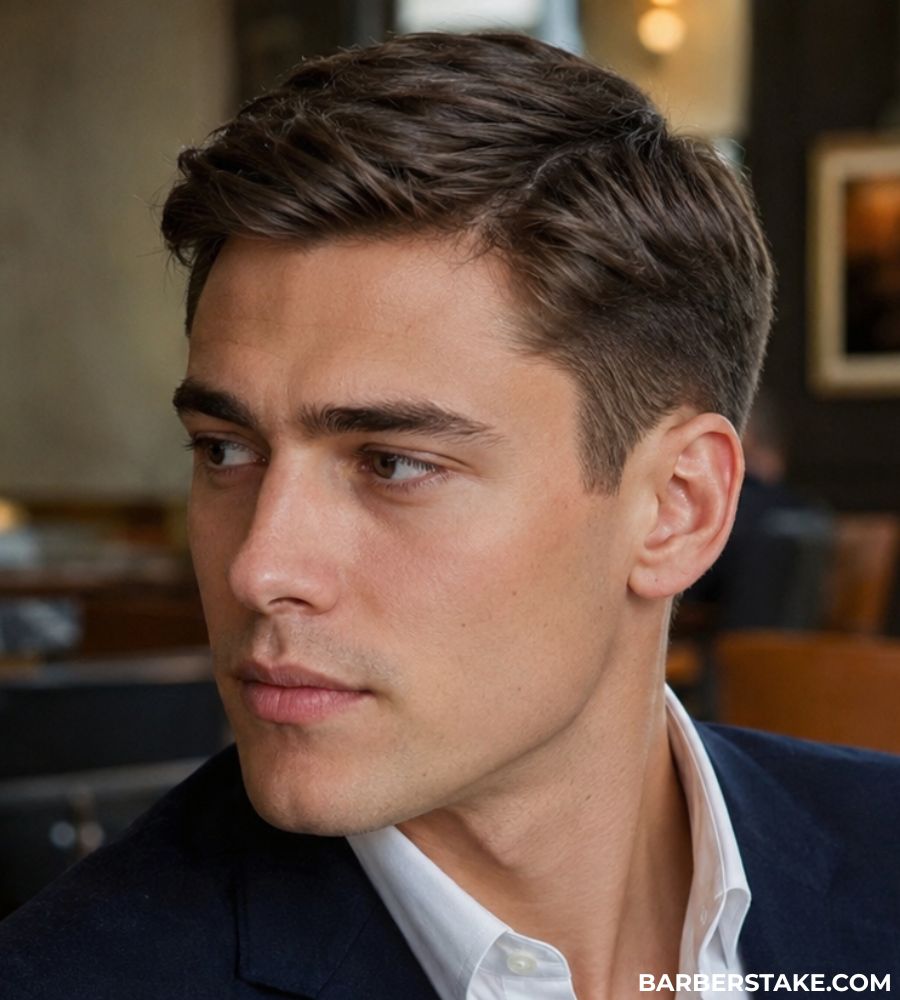
The Ivy League (also called the Princeton or Harvard clip) is a refined evolution of the crew cut, a slightly longer top that provides enough length for a side part or gentle forward comb, blended into short, tapered or faded sides. It’s the professional’s answer to “I want a haircut, not a statement,” and it delivers that answer with consistent elegance.
Distinguished, straightforward, and appropriate in virtually every setting where appearance matters. Men who wear this cut tend to be the kind of people who’ve stopped needing anyone to notice their haircut specifically; they simply need to look like someone who has their life in reasonable order. This cut accomplishes that efficiently.


Who it suits: Works on straight and wavy hair. Particularly flattering on oval, square, and oblong faces. A reliable option for men with fine or thinning hair who want a short, professional cut that still offers some styling flexibility at the top.
How to ask for it: “I’d like an Ivy League cut, similar to a crew cut but with the top left a little longer at the front so I can comb it to one side. Tapered sides, nothing aggressively faded.”
Styling and maintenance: Light pomade or styling cream combed or finger-styled. Avoid heavy products that mat the top flat. Every three to four weeks.
27. Burst Fade Mohawk: The Cut That Never Compromised
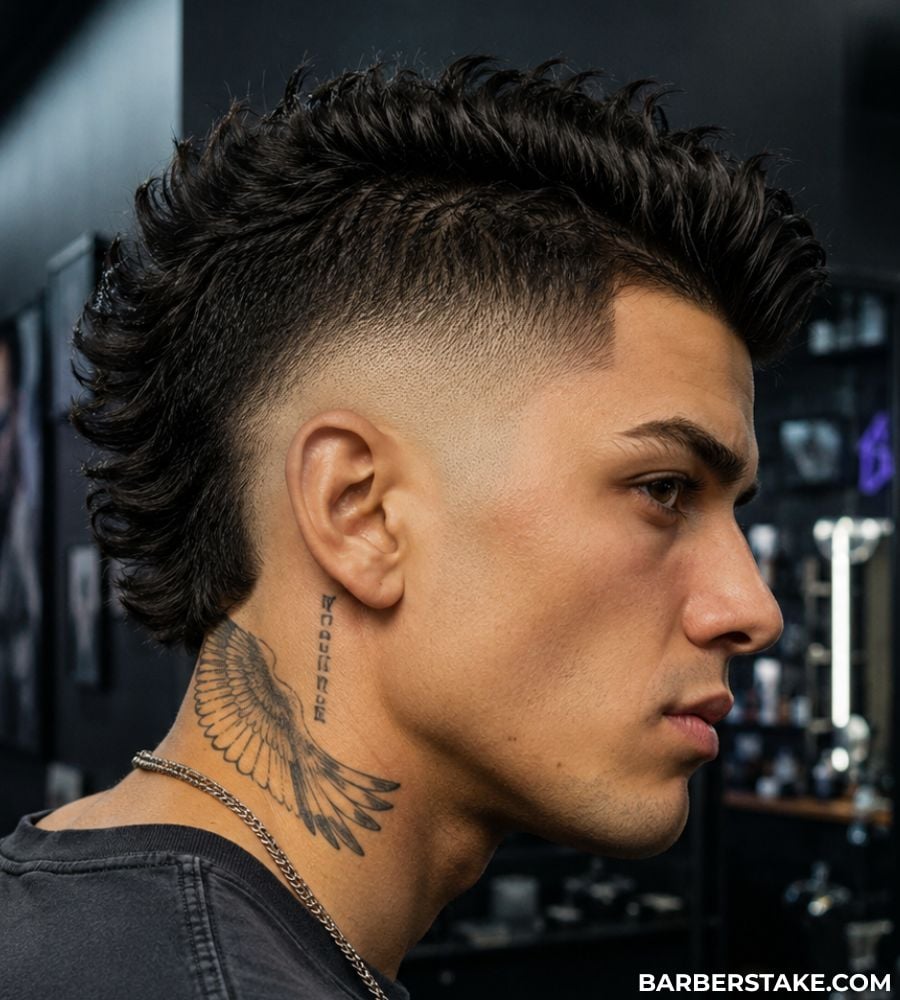
The mohawk shaves the sides down to the skin while leaving a central strip of hair from the hairline to the nape. The burst fade mohawk replaces the hard shave with a semi-circular fade curved around the ear, maintaining the unmistakable structure while moderating the edges enough to suit a wider range of contexts and tolerances. The central strip can be any length, from a close inch to a dramatic, product-lifted runway.
Enduring and bold, its presence spans from punk subculture to professional sports, offering men a cut that reflects a particular disposition. The burst fade variation has made that aspiration more accessible without diluting it.


Who it suits: Strong, angular features and a measure of self-possession. The narrow central strip can add length and definition to rounder faces when the fade is tight. Works across all hair types; thick hair holds the strip’s height without demanding excessive product.
How to ask for it: “I’d like a mohawk with a burst fade, the sides should fade in a semi-circle around the ear rather than shaving straight across. Keep the central strip at [desired length].”
Styling and maintenance: Strong-hold gel for classic spikes, matte paste for a textured, modern hawk. Blow dry at the base of the strip for added lift. Every one to two weeks.
28. Hard Part: The Detail That Signals You Thought About It
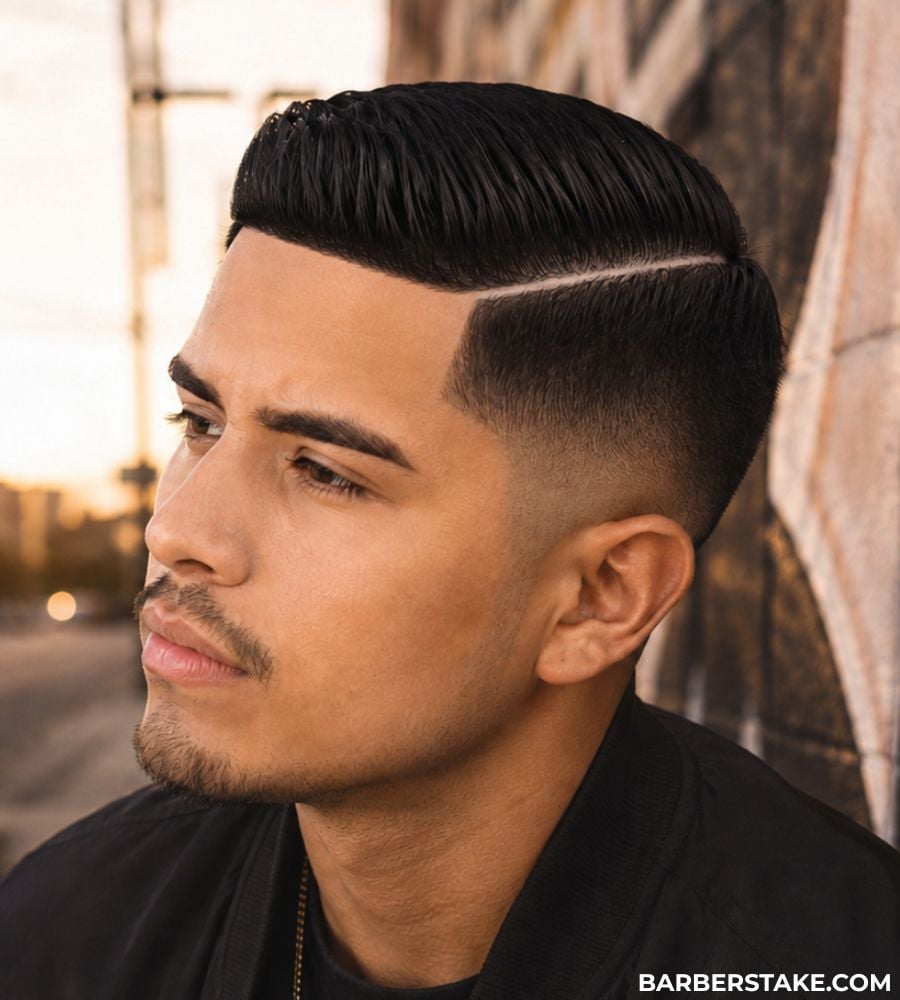
The hard part is a razor- or trimmer-shaved line running cleanly along the natural side parting, creating a precise, deliberate division between the top section and the faded side. It’s not a standalone haircut, it’s a finishing detail applied to an existing cut, but it carries enough visual impact to be worth requesting specifically. The difference between a side part and a hard part is the difference between a clean shirt and one with creases.
It tells the room that you were intentional. That you considered a small thing carefully. That’s not a trivial message to communicate with a haircut.


Who it suits: Works alongside most styles that involve a side part or comb over. Straight and wavy hair show the shaved line most cleanly. Less effective on very fine hair where the parting may not hold a crisp edge.
How to ask for it: “I’d like my side part shaved in as a hard part, use a razor or trimmer along my natural part line for a clean, defined separation. Add it to my [existing cut style].”
Styling and maintenance: Style the top normally. Keep the shaved line moisturized after washing to prevent dryness. Every two weeks to maintain the line’s sharpness.
30. Natural Wavy Hair: Your Texture Is Not a Problem to Be Solved
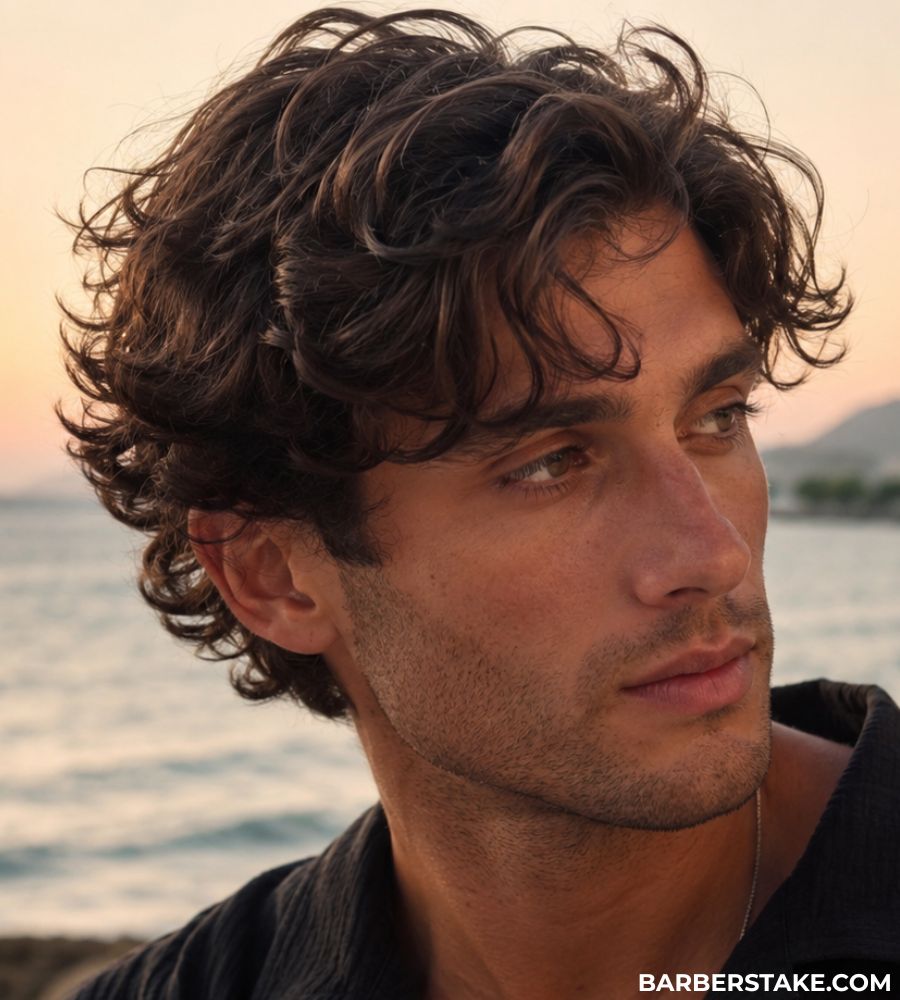
Short natural wavy or textured hair cut to emphasize rather than suppress the hair’s inherent movement, typically one and a half to two and a half inches on top, tapered or faded on the sides, shaped to let waves or soft natural texture sit without being ironed into submission or product-forced into uniformity.
The shift away from product-enforced straightness and toward embracing natural texture has been the single most significant change in men’s grooming culture over the past decade. This entry represents that shift at short length, where it’s most accessible and requires the least commitment to maintain.


Who it suits: Men with naturally wavy or softly curly hair across all face shapes. Works best when the barber understands dry cutting and natural texture. Request a consultation before clippers are introduced if you’re switching barbers.
How to ask for it: “I have natural waves, I’d like the top cut to let them show rather than removing the weight that creates them. Don’t over-thin or point-cut the top flat. Mid fade on the sides.”
Styling and maintenance: Sea salt spray or a light curl cream on damp hair, then rough-dry with fingers. Minimal manipulation is the key; the less interference, the better natural waves behave. Every three to four weeks.
31. Messy and Textured: Deliberately Undone, Properly Executed

A textured, messy men’s hairstyle keeps the hair at a short to medium-length on top with choppy, irregular layers that sit in no fixed direction. There’s no sweep, no lift toward a defined point, and no precise line at the front. The cut is built around natural movement and separation, with faded or tapered sides giving the overall look enough structure to read intentional rather than just unfinished.
The appeal is straightforward. It looks like you spent thirty seconds on it, which is only possible if the cut underneath is doing most of the work. A poorly layered top with the wrong product will look genuinely unkempt. The right cut with a small amount of matte clay looks like you woke up like that, which has been a desirable outcome in barbering for longer than social media has been taking credit for it.


Who it suits: Works across straight, wavy, and curly hair at short to medium lengths. Thick hair takes to this cut naturally, since the irregular layers manage bulk without needing precise styling. Fine hair can achieve the look with a lighter product and a bit of rough drying. Suits most face shapes and transitions cleanly between casual and smart casual environments without adjustment.
How to ask for it: “I’d like a messy textured cut on top — choppy layers with no fixed direction, nothing too structured or forward. Add a mid fade on the sides and keep the top around an inch and a half to two inches.”
Styling and maintenance: Work a small amount of matte clay or texture paste through damp hair and rough-dry with your fingers, moving in different directions to encourage separation and lift. Avoid combing through or styling in any single direction — the finish should look like the hair landed naturally rather than being placed. Trim every three to four weeks to keep the layers from losing shape.
32. Box Braids: The Timeless Protective Style
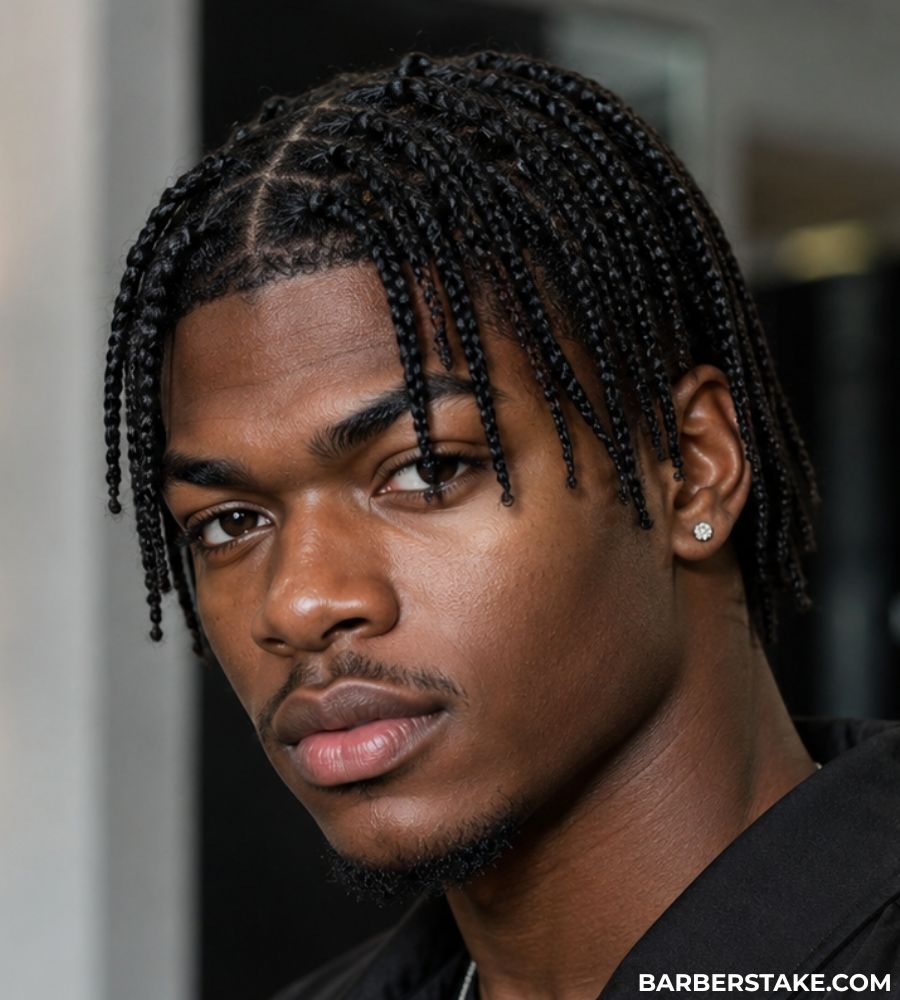
Box braids divide the hair into neat square sections at the scalp and braid each one down into a uniform plait. They can be worn at any length from ear-level to well below the shoulder, left loose, or gathered up. The result is a clean, deliberate style with deep roots in Black hair culture and a growing presence across mainstream grooming conversations. They also function as an excellent style during growth phases, protecting the hair while maintaining a sharp, considered appearance.


Who it suits: Best suited to Afro-textured, coily, and kinky hair types with the natural density and grip to hold the sections. Straight hair typically requires extensions to achieve the look effectively.
How to ask for it: “I’d like box braids, neat square sections, medium length, worn loose. I’d like to discuss braid size: I’m thinking medium or small sections.”
Styling and maintenance: Light oil (argan or jojoba) is applied to the scalp and length once installed. Keep the scalp moisturized. A satin pillowcase or bonnet at night minimizes frizz and extends the style. Reinstall every six to eight weeks.
33. Locs / Dreadlocks: The Haircut With a Cultural Legacy
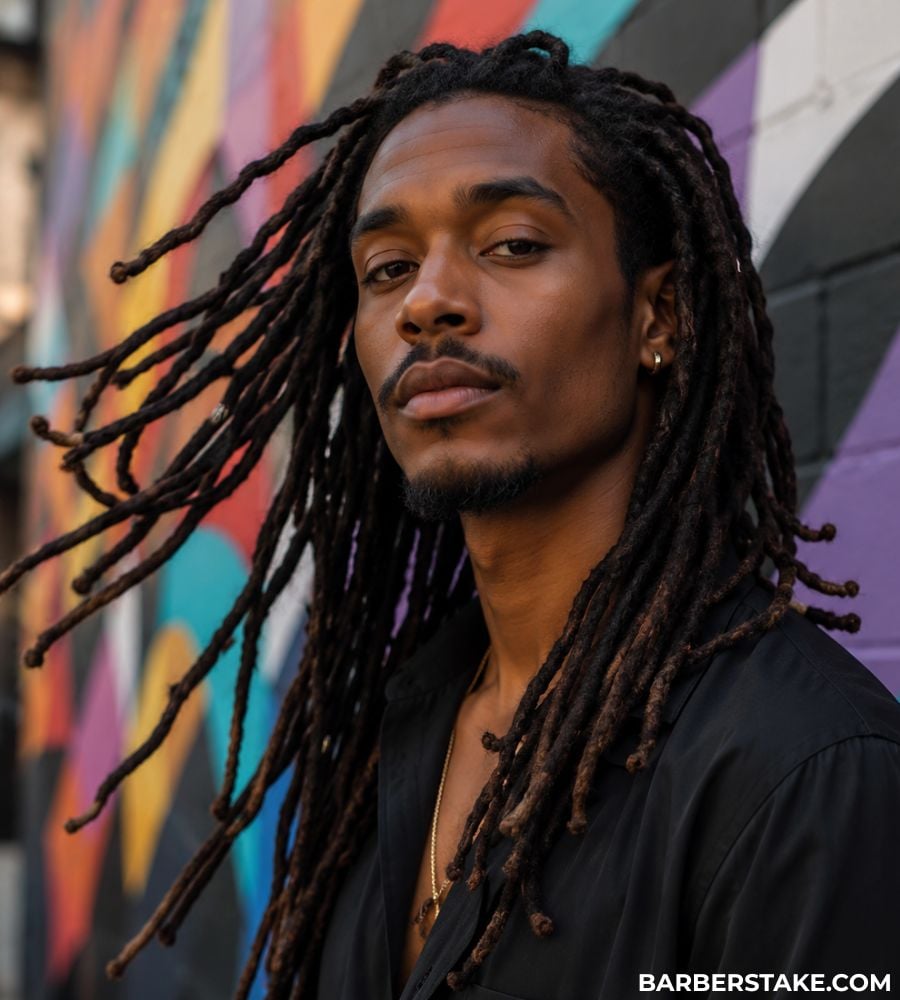
Locs form when Afro-textured or coily hair is encouraged to mat and interlock into individual rope-like strands over time, through starter methods like palm-rolling, two-strand twists, or interlocking, or allowed to develop more freely. They evolve across months and years, developing thickness, length, and distinctive texture that becomes genuinely personal. No two people’s locs look the same.
Locs are culturally rooted and increasingly visible across sports, music, creative industries, and public life. They belong here not as a trend but as a significant hairstyle in history, one that has been gaining broader mainstream visibility and respect for decades.


Who it suits: Afro-textured and coily hair types form the most defined locs most naturally. The tighter the natural curl, the more quickly locs form and the more structured they remain.
How to ask for it: “I’d like to start locs, can we discuss the best method for my hair type? I’m interested in [palm-rolling/two-strand twists/interlocking] to start.”
Styling and maintenance: Regular palm-rolling at the roots, conditioning oils (jojoba, coconut, or castor) to nourish the scalp. Monthly retwist appointments in the early stages, every six to eight weeks once established.
34. Temp Fade: The Subtlest Upgrade Available at the Barbershop
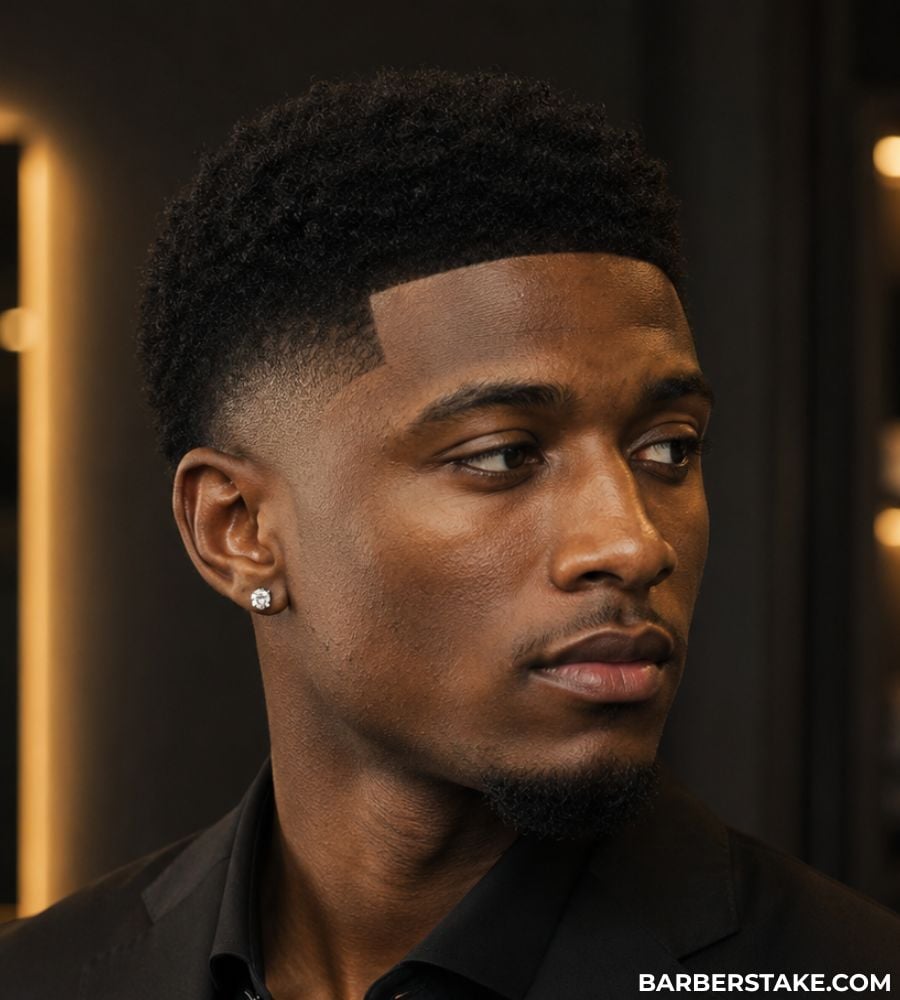
The temple fade focuses specifically on the area at the temples and front hairline, tapering tightly at the sides of the forehead and above the ears, while leaving the back of the head’s transition less dramatically reduced. It frames the face with precision without committing to the fuller impact of a high fade, making it a refined detail that sharpens any cut it accompanies.
The temp fade has gained considerable crossover appeal because of this simple truth: a well-executed temple line makes every haircut sitting above it look more considered.


Who it suits: Works with virtually all hair types and cuts. Particularly valuable for men with strong natural hairlines they want to define, or men whose haircuts sit near the temples, crops, crew cuts, afros, quiffs.
How to ask for it: “I’d like a temp fade, tight and clean at the temples and front hairline. Leave the back relatively natural. Pair it with [your top style].”
Styling and maintenance: Per the top style. Every one to two weeks to keep the temple line sharp.
35. Burst Fade: The Barbershop Flex Worth Requesting by Name
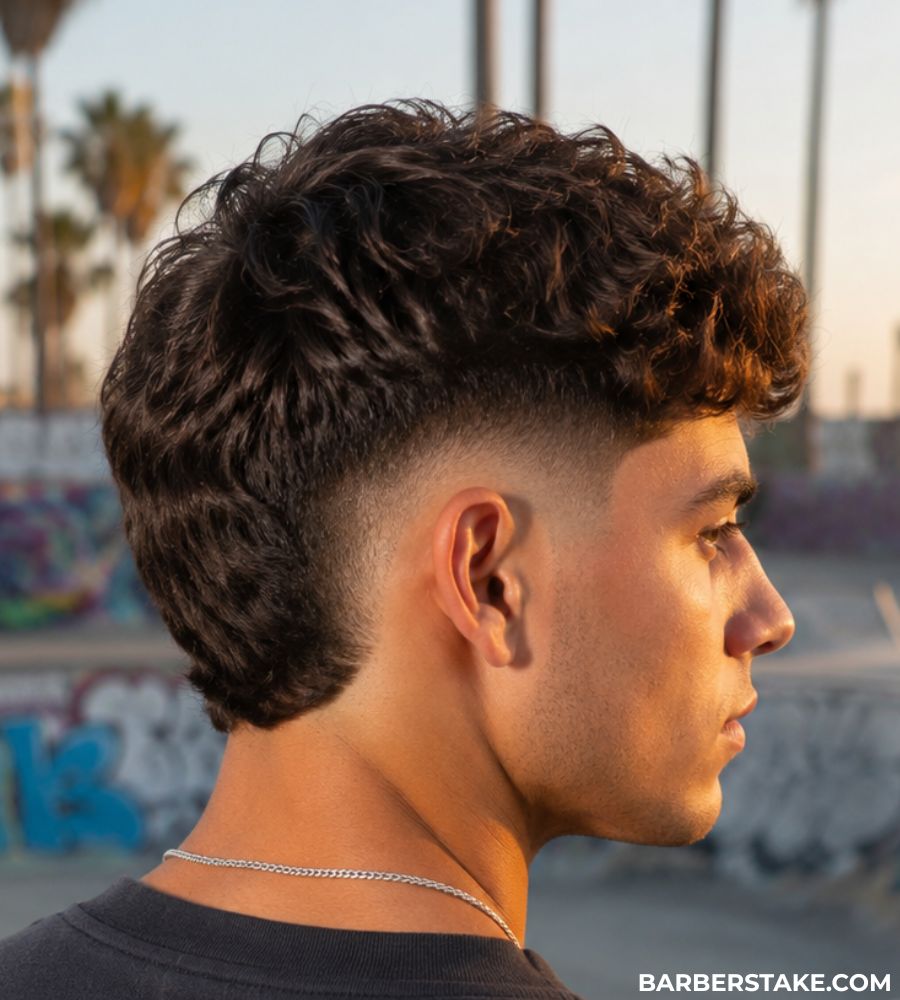
The burst fade creates a semi-circular or sunburst pattern around the ear, the hair radiating outward from behind the ear in a curved taper rather than following a standard horizontal or drop line. It’s technically distinct from other fade variations and provides a specific, decorative framing dimension that suits mohawks, natural afro textures, and voluminous curly tops especially well.
Its mainstream appeal is driven by social media exposure and a broader appetite for technically expressive cuts. When a barber executes a clean burst fade, it also tends to indicate they know what they’re doing with everything else.


Who it suits: Works across most hair types. Especially powerful alongside natural afro textures, mohawks, and curly tops where the burst pattern adds framing and visual rhythm that a standard fade wouldn’t achieve.
How to ask for it: “I’d like a burst fade, the taper should curve in a semi-circle around the ear rather than running in a straight line. Pair it with [top style].”
Styling and maintenance: Per the top style. Every two weeks to keep the arc defined.
36. Long Layered Hair: The Patient Man’s Reward
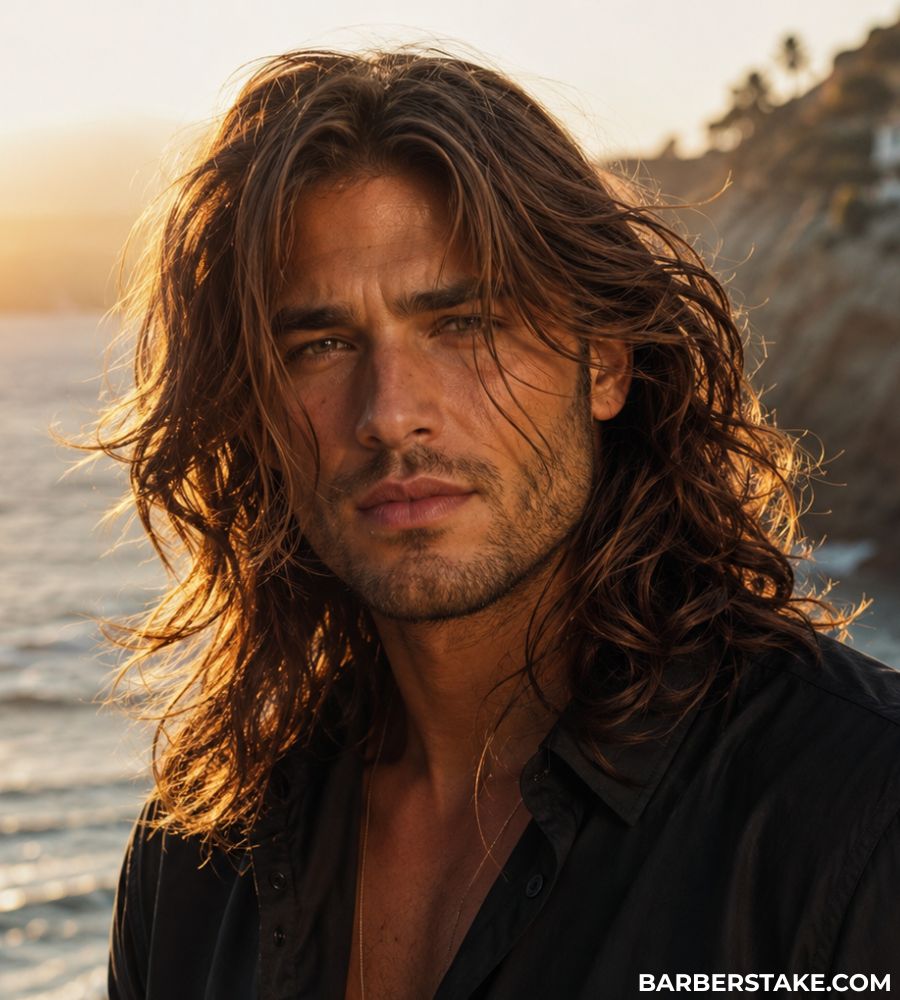
Long, layered hair is an attractive men’s style in which the hair reaches shoulder length or beyond and is shaped with soft, graduated layers to reduce bulk, add movement, and create a flattering, proportional silhouette. It can be worn loose, pulled back into a bun or ponytail, or tucked; the styling options expand significantly with the length, which is the reward for growing it through the awkward phase in the first place.
Long men’s hair has been in the longest consistent growth period (metaphorically speaking) in mainstream culture since the late 1960s. It now sits firmly in the mainstream across creative industries, sports, and everyday life, and a generation of men growing it out deserve a comprehensive entry here rather than a footnote. The man bun (#19), wolf cut (#13), and bro flow (#28) are specific expressions of this broader category.


Who it suits: Most face shapes with the right layering. Oval faces carry nearly any long style; square faces benefit from softening layers around the jaw; oblong faces do better with volume at the sides rather than flat, straight falls. Works on straight, wavy, and curly hair, texture determines the styling approach rather than the suitability of the length.
How to ask for it: “I’m growing my hair long, I’d like layers added for movement and shape without sacrificing length. Tidy the ends and add layering through the crown and mid-length sections.”
Styling and maintenance: Sulfate-free shampoo two to three times weekly, nourishing conditioner every wash, leave-in on towel-dried hair. Sea salt spray or lightweight cream for texture. Air dry where possible; diffuse on low heat for curly or wavy types. Every eight to ten weeks for end trims and shape maintenance.
37. Middle Part: The Symmetrical Style That Took Over
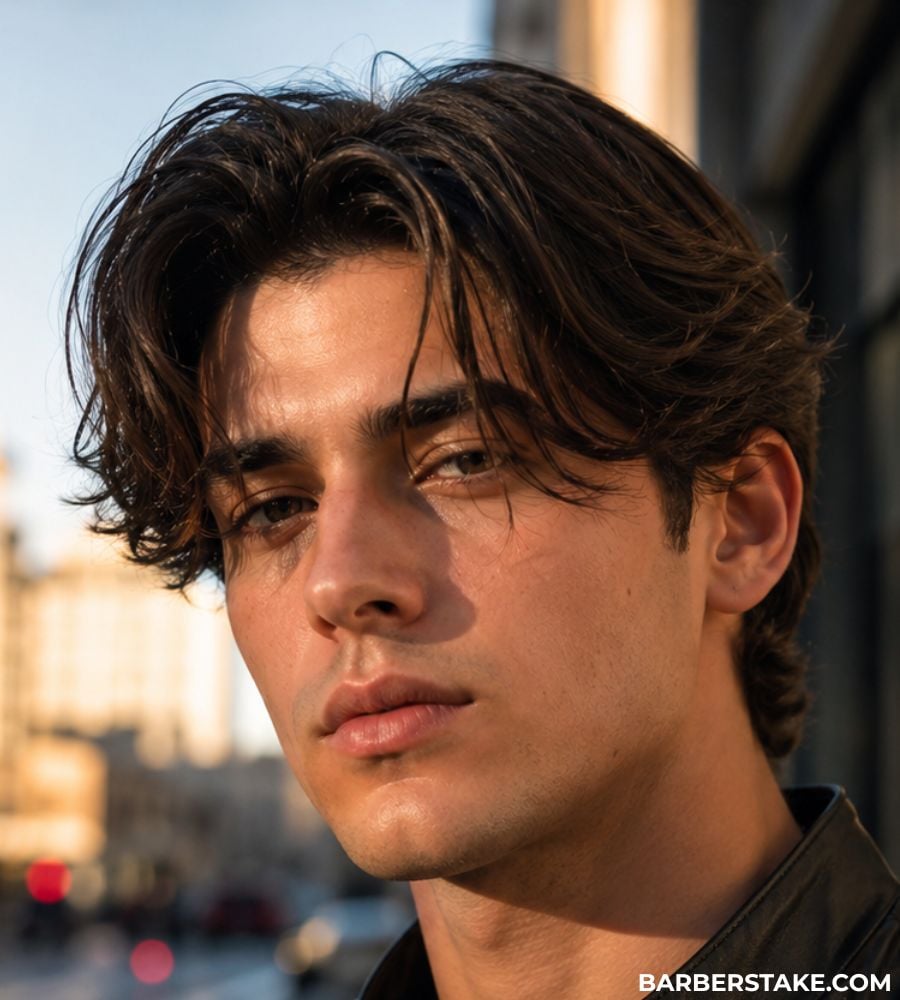
The middle part is a trendy medium-length men’s hairstyle that divides the hair evenly down the center, with the top section split into two halves that fall to either side of the face. The length sits anywhere from short, where the part is more of a styling detail than a structural choice, to medium where it begins to frame the cheekbones. It can read clean and combed rather than layered and feathered, making it work across a wider range of professional and casual contexts.
The middle part is doing significantly more work in modern men’s barbering than its understated appearance suggests. It’s been driven by a broader cultural appetite for symmetry and softness in men’s styling, and it suits a wide enough range of hair types and face shapes that almost any barber will have cut several this week. It also happens to be a useful answer for men who want some style without committing to volume or directional sweep.


Who it suits: Particularly effective on oblong and oval face shapes, where the symmetrical split adds width and softens length. Works on square faces by breaking up the angularity of the jaw and temple line. Less flattering on round faces, where the central part can emphasize width across the middle of the face. Both straight and wavy hair carry it well. Requires enough length on top to split cleanly, generally three inches or more.
How to ask for it: “I’d like a medium-length cut on top with a clean middle part, hair falling evenly to both sides. Tidy the sides with a low taper or scissor cut, and keep the part natural rather than shaved in.”
Styling and maintenance: Apply a lightweight styling cream or smoothing product to damp hair, then comb through from the center with a wide-toothed comb to set the part. Blow-dry on low heat while maintaining the split, directing each side outward. Finish with a touch of pomade or hair oil for a controlled, polished result. Trim every six to eight weeks.
38. Mod Cut: Sixties Sharpness That Still Holds Up
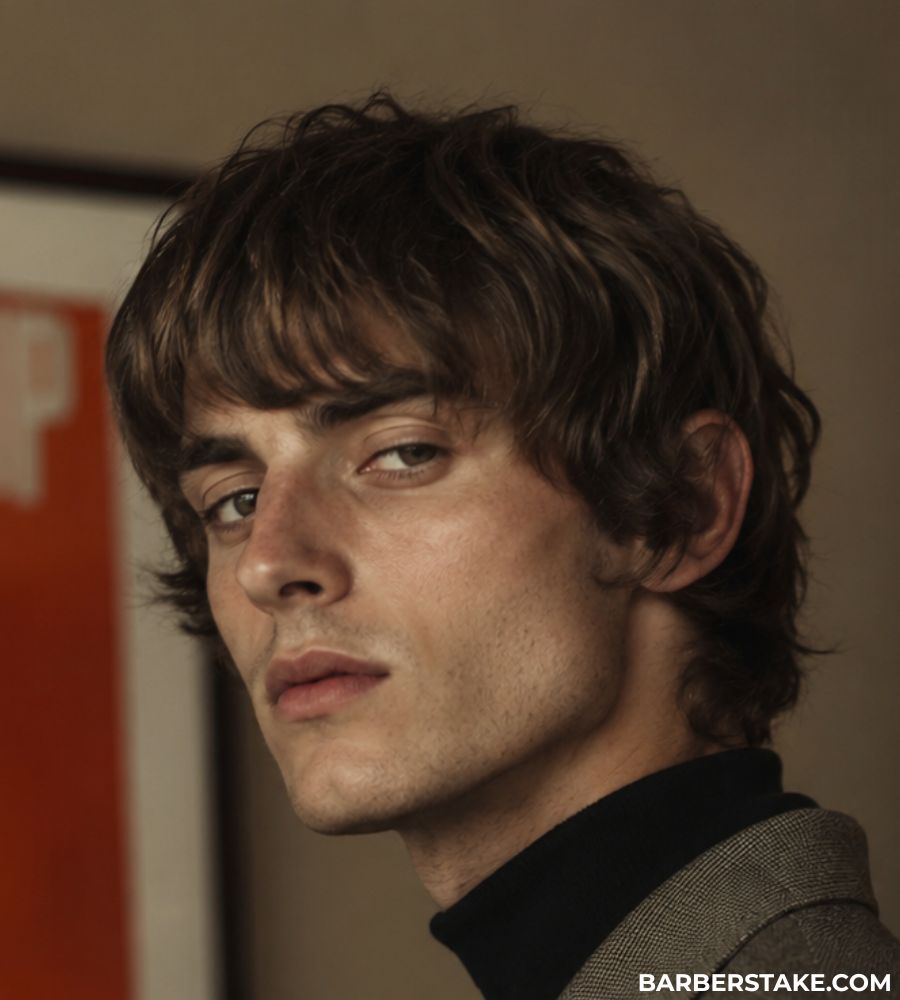
The mod cut takes its cues from 1960s British subculture, where sharp tailoring met sharp hair. The shape is clean and structured, with a medium-length top cut into a rounded, neat silhouette and a fringe swept forward or to the side across the forehead. The sides are kept tidy with scissor work or a soft taper rather than a heavy fade, which keeps the look closer to its mop-top origins than to modern barbering’s clipper-driven aesthetic.
The mod cut has cycled in and out of fashion since The Beatles first made it a global export, and it keeps returning because the underlying shape simply works. It reads as deliberate without coming across as fussy, and it carries a retro reference that feels considered rather than costume-y. Younger men are rediscovering it through a broader revival of vintage styling, while older men recognize it as the haircut they or their fathers actually wore.


Who it suits: Works best on straight and wavy hair, where the structured fringe and rounded shape hold their form. Oval and oblong face shapes carry it most naturally, and the forward fringe helps balance a high forehead. Thick hair excels here. Very curly or coily hair struggles to achieve the clean, defined silhouette the cut depends on without significant adjustments in technique.
How to ask for it: “I’d like a mod cut inspired by the 1960s style, medium length on top with a rounded shape and a fringe swept forward or to one side. Keep the sides neat with scissor work or a light taper rather than a fade.”
Styling and maintenance: Apply a lightweight cream or low-shine pomade to damp hair, then blow-dry the fringe forward and into shape with a vent brush. Comb the top into its rounded silhouette and finish with a small amount of product for control without stiffness. Trim every four to five weeks to maintain the fringe length and overall shape.
39. Modern Bowl Cut: The Punchline That Became a Request
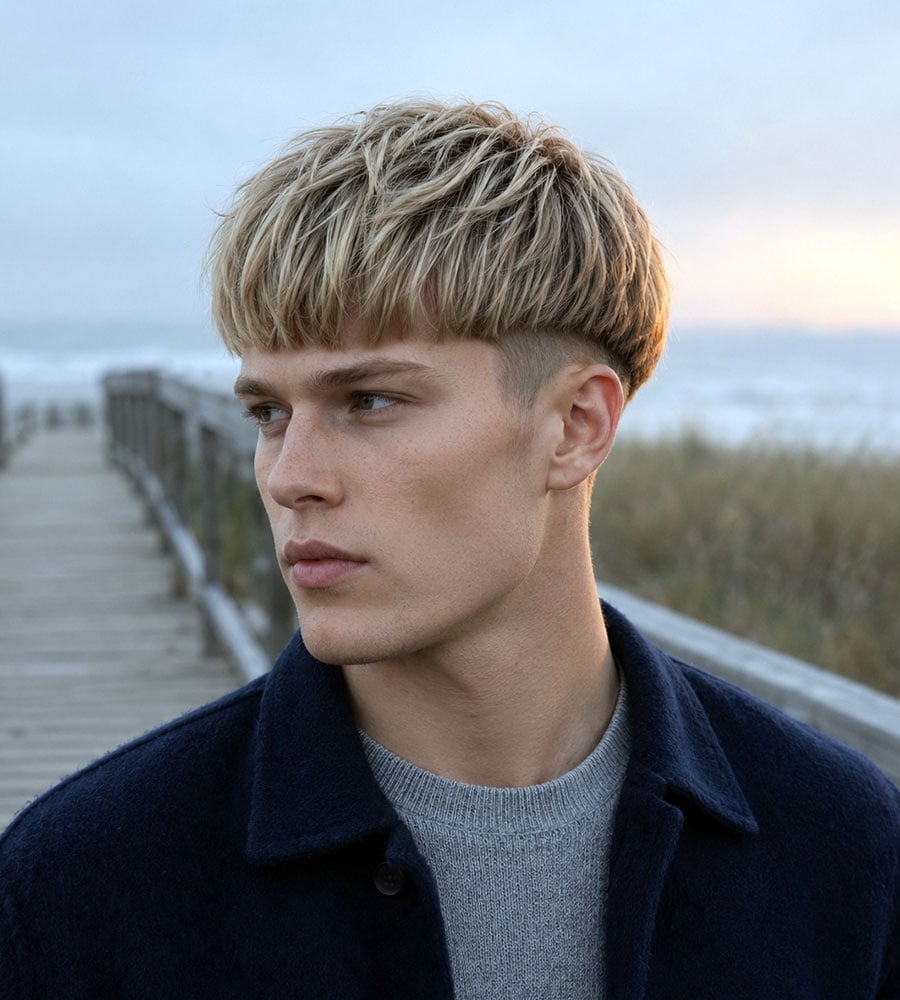
The modern bowl cut keeps a rounded, evenly weighted curve of hair falling around the head, the fringe sitting straight across the forehead and the perimeter following one continuous line above the ears, but replaces the harsh, stamped-on edge of the playground original with soft layering, internal texture, and an undercut or subtle taper beneath the curve. The silhouette still reads as a bowl. It just reads as one that was chosen on purpose, by someone who knew exactly what they were doing.
The rehabilitation of this cut is one of the more unexpected developments in recent men’s barbering, driven largely by K-pop styling, the broader 90s revival, and a generation of young men entirely unburdened by the cut’s previous reputation. It shares clear DNA with the two block above it, the same rounded top-heavy structure over reduced sides, but keeps more visible weight through the perimeter, which is what gives it that distinctive, deliberate mushroom shape. It arrives in the barbershop as a confident request now, not a dare.


Who it suits: Straight and slightly wavy hair with good density, the cut depends on the perimeter falling as one clean, continuous line, and both curl and thinness disrupt that. Diamond and oblong faces benefit most, since the horizontal fringe and rounded width balance narrow or elongated proportions. Round faces should approach with caution; the shape adds width exactly where they need it least. Requires roughly three to four inches on top to achieve the curve.
How to ask for it: “I’d like a modern bowl cut, a rounded shape with the fringe straight across the forehead and the perimeter following one continuous line, but with texture and layering through the top so it isn’t a solid block. Undercut or softly taper underneath the line.”
Styling and maintenance: A lightweight styling cream or soft matte clay on damp hair, blow dried downward and around with a vent brush to set the rounded fall, then finger-styled for separation so the finish stays soft rather than helmet-like. Avoid heavy or wet-look products, which collapse the texture and drag the cut straight back to 1994. Every three to four weeks to keep the perimeter line clean.
40. Buzz Cut: The Ultimate Low-Maintenance Style
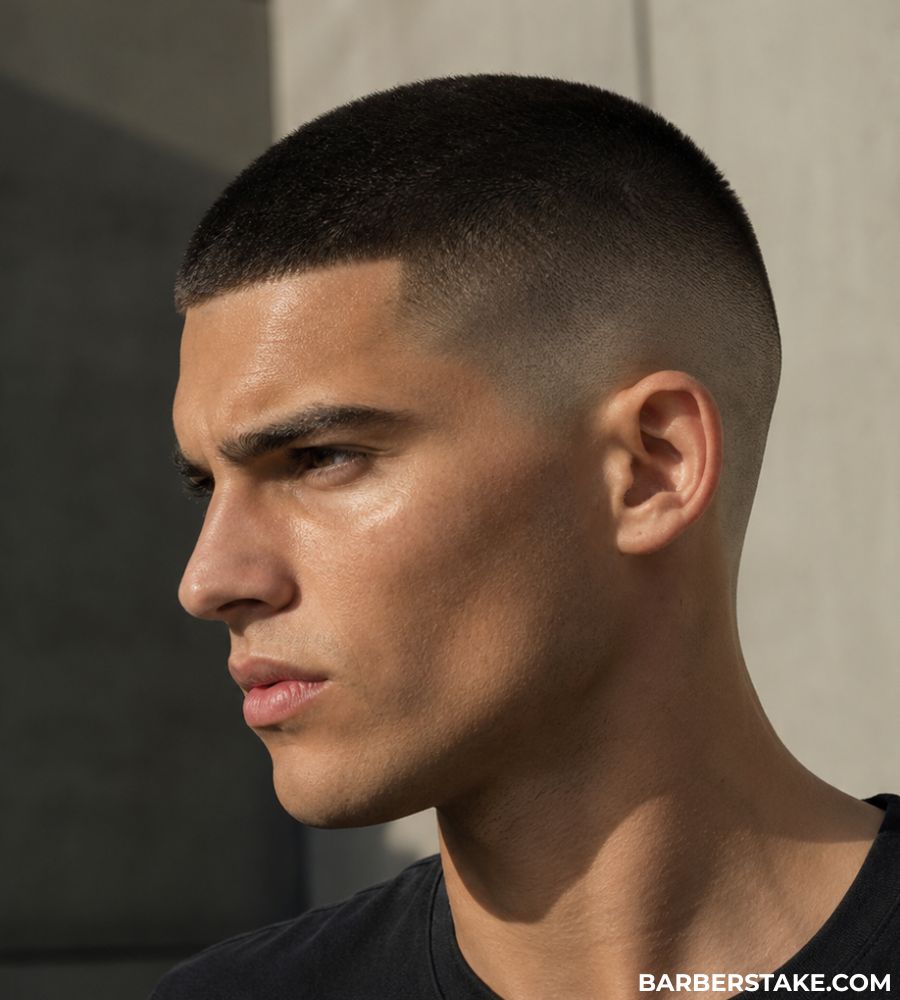
The buzz cut takes clippers at a uniform length across the entire head, typically between a grade one (3mm) and grade four (13mm), and removes any other decision from the equation. No layers, no fades unless you add them, no structural complexity. Just clean, cropped clarity.
There’s an interesting paradox at the heart of the buzz cut: it demands exactly the kind of confidence it seems to generate. Men who get it consistently report that the absence of hair as a styling tool forces them to carry themselves differently, and that it turns out to work in their favor. It’s consistently in the top three most-searched men’s haircuts globally, and its appeal is essentially the same as it’s always been: zero maintenance, maximum decisiveness.


Who it suits: Best on men with well-defined skull shapes and proportional features. Oval and square faces carry it most naturally. Very narrow or elongated face shapes can find that the uniform length emphasizes length in an unflattering way, a low skin fade around the edges helps in those cases.
How to ask for it: “I’d like a buzz cut at a grade two or three all over, faded down to a skin finish around the edges and neckline.” If you’re going very close for the first time, start at a grade three, you can always go shorter.
Styling and maintenance: No product required. A light moisturizer on the scalp prevents dryness at shorter lengths. Maintain the definition every ten to fourteen days; at longer lengths (grade four and above), you can push to three weeks.
Quick Picks: Best Men’s Haircuts By Goal
- Short hair: Textured Crew Cut or French Crop
- Medium hair: Flow, Curtains, Slick Back, Modern Bowl Cut
- Long hair: Long Layered Hair, Man Bun, Wavy Shoulder Length
- Low-maintenance: Buzz Cut
- Professional: Side Part, Comb Over, Brush Back or Ivy League
- Trending: Modern Mullet, Wolf Cut, Flow, Middle Part Curtains, Burst Fade Mohawk, Quiff, Brush Back
- Curly hair: Broccoli Cut or Thick, Bouncy Crop
- Thinning hair: Caesar Cut or Textured French Crop
- Mature: Short and Spiky, Crew Cut, Messy
How To Choose The Right Haircut For Your Face Shape
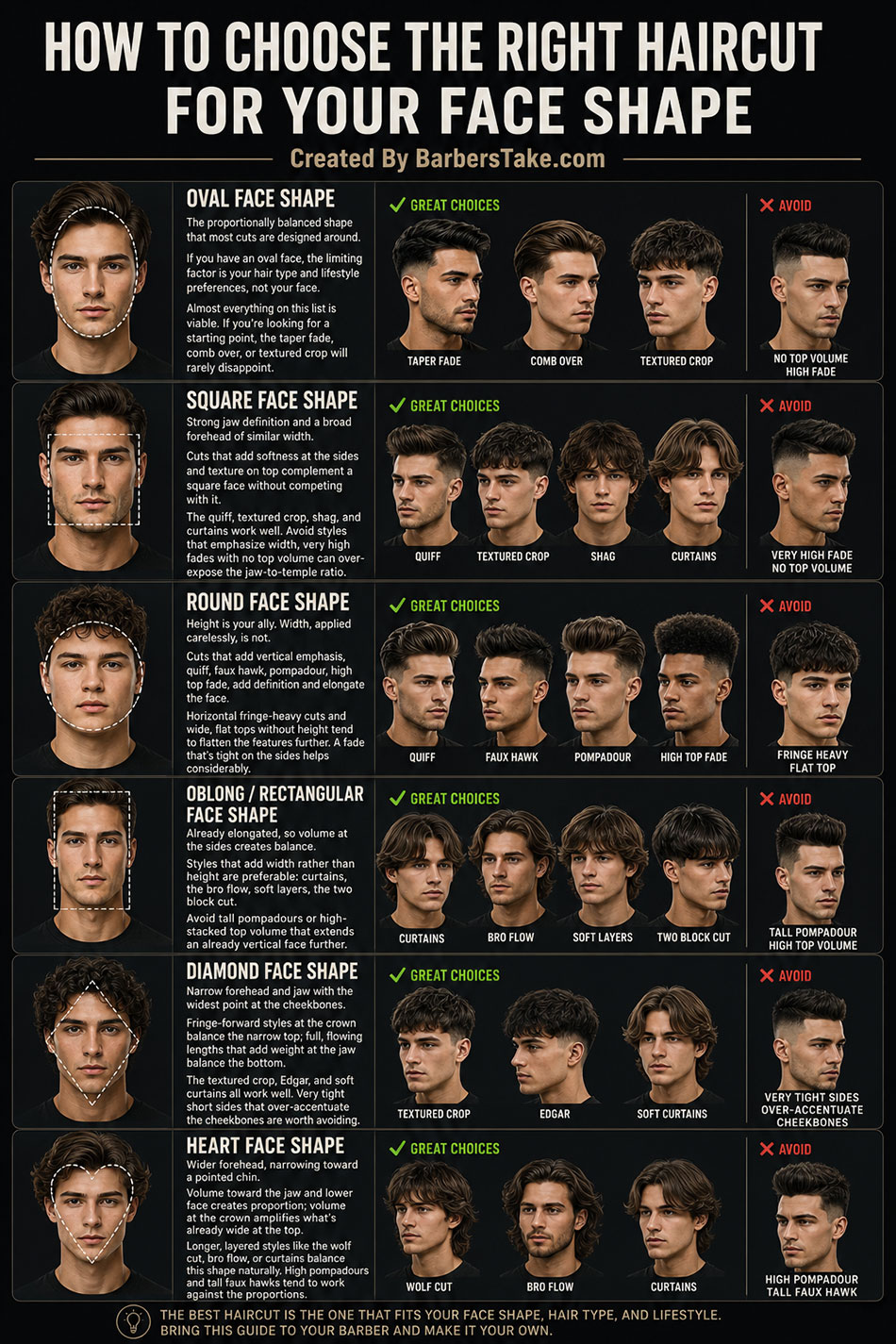
Oval Face Shape
The proportionally balanced shape that most cuts are designed around. If you have an oval face, the limiting factor is your hair type and lifestyle preferences, not your face. Almost everything on this list is viable. If you’re looking for a starting point, the taper fade, comb over, or textured crop will rarely disappoint.
Square Face Shape
Strong jaw definition and a broad forehead of similar width. Cuts that add softness at the sides and texture on top complement a square face without competing with it. The quiff, textured crop, shag, and curtains work well. Avoid styles that emphasize width, very high fades with no top volume can over-expose the jaw-to-temple ratio.
Round Face Shape
Height is your ally. Width, applied carelessly, is not. Cuts that add vertical emphasis, quiff, faux hawk, pompadour, high top fade, add definition and elongate the face. Horizontal fringe-heavy cuts and wide, flat tops without height tend to flatten the features further. A fade that’s tight on the sides helps considerably.
Oblong / Rectangular Face Shape
Already elongated, so volume at the sides creates balance. Styles that add width rather than height are preferable: curtains, the bro flow, soft layers, the two block cut. Avoid tall pompadours or high-stacked top volume that extends an already vertical face further.
Diamond Face Shape
Narrow forehead and jaw with the widest point at the cheekbones. Fringe-forward styles at the crown balance the narrow top; full, flowing lengths that add weight at the jaw balance the bottom. The textured crop, Edgar, and soft curtains all work well. Very tight short sides that over-accentuate the cheekbones are worth avoiding.
Heart Face Shape
Wider forehead, narrowing toward a pointed chin. Volume toward the jaw and lower face creates proportion; volume at the crown amplifies what’s already wide at the top. Longer, layered styles like the wolf cut, bro flow, or curtains balance this shape naturally. High pompadours and tall faux hawks tend to work against the proportions.
How To Pick A Haircut Based on Your Hair Type
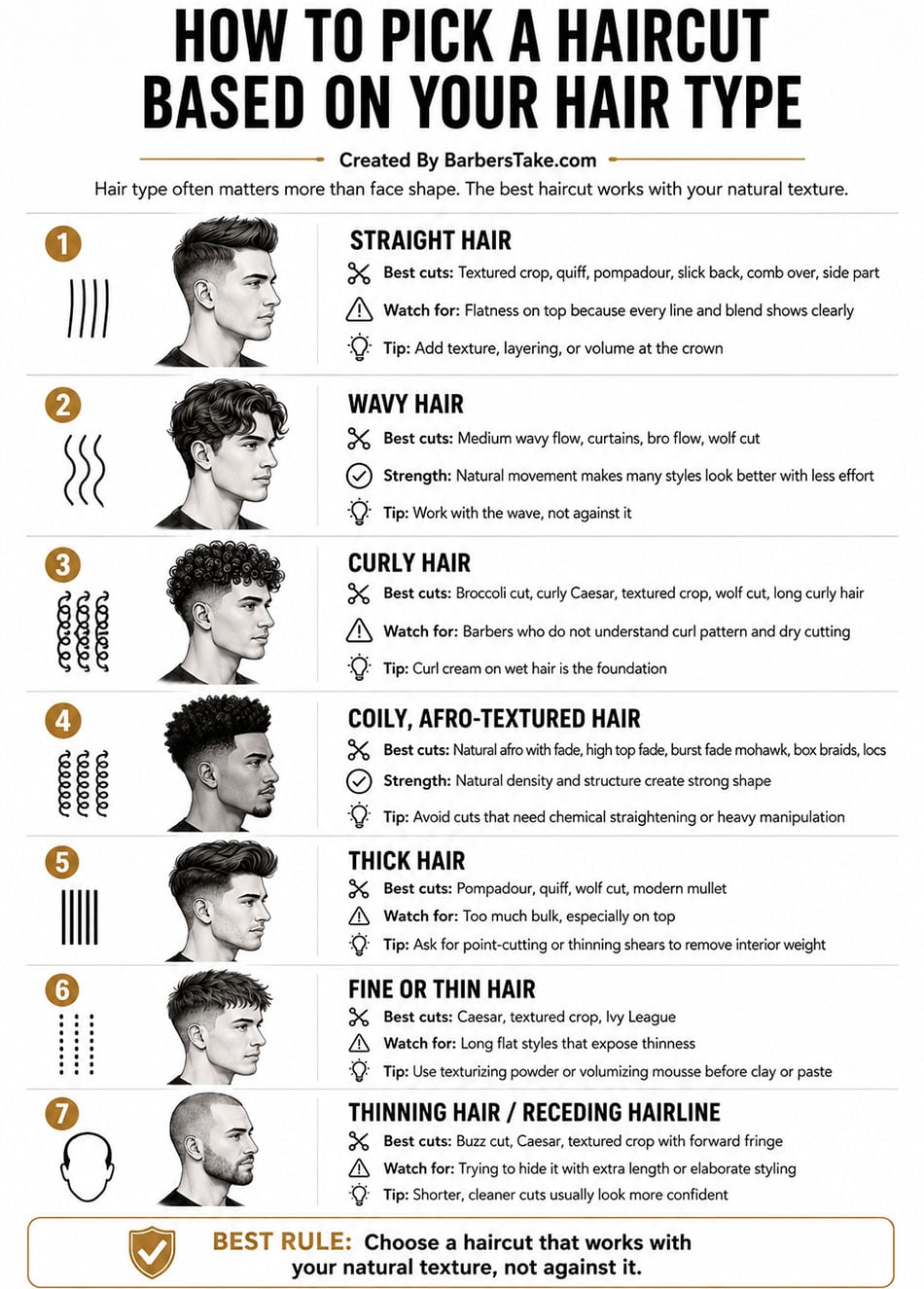
Straight Hair
Showcases the precision of a cut clearly, which is both an advantage and a demand, every line and blend reads sharply. Works with almost every cut on this list. The main challenge is flatness on top; choose cuts that add texture, layering, or volume at the crown (textured crop, quiff, pompadour) or embrace the sleekness (slick back, comb over, side part).
Wavy Hair
Arguably the most forgiving hair type for men’s haircuts. Natural movement enhances most styles without extra work, and the texture adds interest without demanding management. The medium wavy flow, curtains, bro flow, and wolf cut all lean into wave patterns effectively. Work with the movement, products that suppress it are doing you no favors.
Curly Hair
Requires a barber who understands natural curl patterns and dry cutting technique. Cuts with faded sides and textured tops that let the curl pattern define the shape are consistent winners: the broccoli cut, curly caesar, textured crop for shorter lengths, and wolf cut or long curly hair for medium-to-long styles. Curl cream applied to wet hair is the foundation of any styling routine here.
Coily, Afro-Textured Hair
Structural cuts that use the hair’s natural density and architecture as a feature rather than a challenge produce the strongest results. The natural afro with fade, high top fade, burst fade mohawk, box braids, and locs all work with the hair’s inherent qualities. Avoid cuts designed for other textures that require chemical straightening or excessive manipulation to maintain.
Thick Hair
Carries almost any cut with authority, but managing the bulk is the recurring consideration. Ask your barber to use point-cutting or thinning shears to remove interior weight without altering the surface line. Pompadours, quiffs, wolf cuts, and modern mullets all benefit from thickness. If the top feels like a solid block regardless of product, weight removal is the solution, not more product.
Fine or Thin Hair
Shorter cuts with built-in texture (Caesar, textured crop, Ivy League) tend to create the most convincing fullness. Texturizing powder or volumizing mousse before clay or paste adds lift at the roots. Longer flat styles that expose thinness are less kind than shorter cuts that work with what’s there. The worst thing fine hair can do is nothing, even a small amount of the right product changes the impression significantly.
Thinning Hair / Receding Hairline
Work with the progression rather than against it. Shorter, cleaner cuts, buzz cut, Caesar, textured crop with forward fringe, look more deliberate than attempts to compensate with length or elaborate styling over thin areas. A forward fringe (as in the textured crop or Caesar) handles early temple recession discreetly without announcing itself. The buzz cut is, for many men, the most confident decision they make, and the response is almost universally positive once they commit.
How To Ask Your Barber For A Haircut
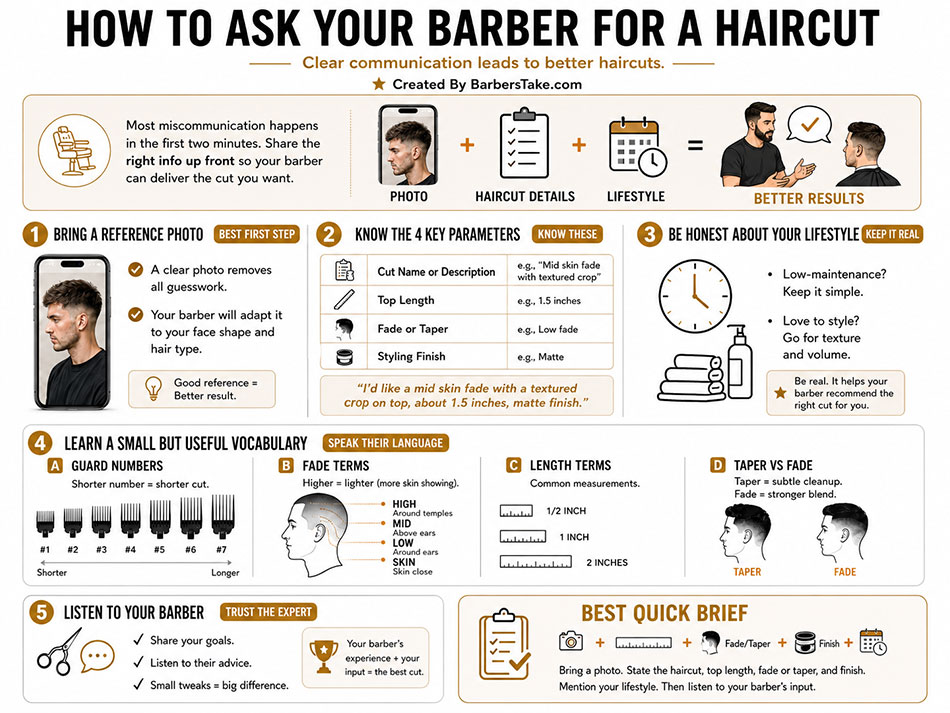
Most miscommunication in a barbershop happens in the first two minutes. Not because either party is being unclear, but because the vocabulary between a man who cuts hair professionally every day and a man who gets a haircut every few weeks doesn’t always overlap. A few practical adjustments close that gap entirely.
Bring a reference photo. This is the single most effective step you can take. One clear image on your phone removes most of the ambiguity before any scissors are introduced. Acknowledge upfront that your result will look like the photo adapted to your face and hair type, not a replica. A good barber will tell you honestly if the adaptation is likely to be significant.
Know the four key parameters before you sit down: the cut name or a brief description, the length you want on top (in inches or guard numbers), the fade or taper style and height (low, mid, or high; taper or skin finish), and your preferred styling finish (matte, natural, or shine). “I’d like a mid skin fade with a textured crop on top, about an inch and a half, matte finish” is a complete, actionable brief. “Just tidy it up” is not.
Be honest about your lifestyle. A five-minute morning routine should come with a genuinely low-maintenance cut recommendation. If you’re not going to blow dry or use product, tell your barber, they’ll steer you toward something that looks good without it rather than cutting something that relies on daily styling you’re never going to do.
Learn a small but useful vocabulary: Guard numbers (1 through 8, each approximately 3mm per step), fade terms (low, mid, high, skin, drop, burst, temp), length terms (half inch, inch, two inches), and the difference between a taper and a fade (see the FAQ below). Five minutes of reading here pays off every time you sit in the chair.
When your barber suggests something different, listen. They are looking at your head from angles you have never seen. A suggestion to adjust the fade height, modify the fringe length, or approach the cut slightly differently is almost always grounded in something they’re observing that you can’t from where you’re sitting. Take the input, it’s included in the price.
How To Find The Right Local, Professional Barber
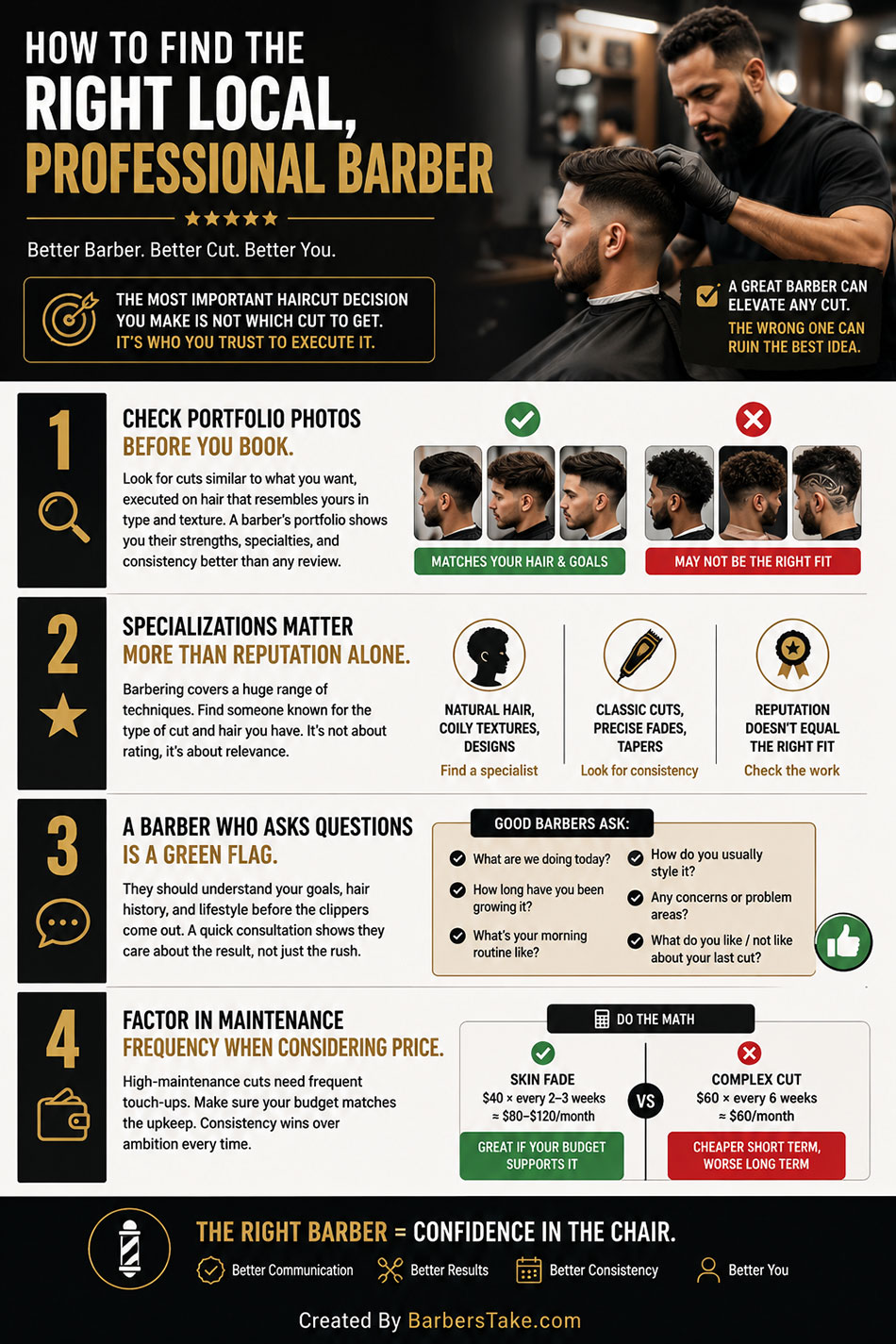
The most important haircut decision you make is not which cut to get. It’s who you trust to execute it. A technically capable barber who understands your hair type and communicates well will improve any cut you bring in; the reverse is also true. Here’s how to find the right person.
Check portfolio photos before you book. Most working barbers maintain an Instagram or post work on their barbershop’s website. Look for cuts similar to what you want, executed on hair that resembles yours in type and texture. A barber whose feed is predominantly geometric designs on Afro-textured hair may not be the right choice for a soft curtains cut on fine wavy hair, not a quality judgment, just a specialization one.
Specializations matter more than reputation alone. Barbering covers an enormous range of techniques, and not every barber is equally skilled across all of them. For natural Black hair, coily textures, or intricate designs, specifically seek out barbers known for those skills. For classic men’s cuts with precise fades, look for someone whose portfolio shows consistent technical execution across a range of fade types.
A barber who asks questions is a green flag. The ones who pick up clippers before they’ve asked you anything are the ones to be cautious about. A quick consultation, “what are we doing today?”, “how long have you been growing it?”, “what’s your morning routine like?”, indicates someone who’s building a picture before making a decision. That’s a good sign every time.
Factor in maintenance frequency when considering price. A skin fade that looks sharp on day one needs to be back in the chair in two to three weeks to stay that way. Multiply the cut price by the required frequency before committing to a high-maintenance style on a budget that doesn’t support it. A slightly simpler cut you can actually maintain consistently will look better across the year than an ambitious one you can only afford every six weeks.
The Most Common Mistakes Men Make With Their Haircuts
After years behind the chair, I’ve noticed certain patterns. The same mistakes appear with reliable consistency, across different clients, different cuts, and different barbershops. These are the ones worth knowing about before they happen to you.
Getting a haircut based on how it looks on someone with completely different features
A pompadour on a man with thick, wavy hair and a defined jaw is a genuinely different haircut to the same name on a man with fine, straight hair and a narrow face. Reference photos are essential, just use them as a starting point for a conversation rather than a target to match exactly. The adaptation is where the barber earns their money.
Waiting too long between cuts, then blaming the cut
A skin fade looks purposeful on day seven and like a growing-out accident on day thirty-five. The maintenance schedule is part of the style. If the frequency required to keep a cut sharp doesn’t fit your life or budget, choose a cut with a more forgiving grow-out, a taper rather than a skin fade, a longer top rather than a cropped one. Many men make the mistake of getting a great cut and then extending the gap until it looks nothing like it did, then concluding that the cut “doesn’t suit them.”
Not styling at all and attributing the result to the cut
A textured crop without clay looks like a slightly short, directionless result. The same cut with thirty seconds of matte paste and finger styling looks like a deliberate, well-executed haircut. Some cuts genuinely require nothing, the buzz cut, the natural bro flow, but most do better with some product. Ask your barber to show you how they styled it before you leave the chair, and replicate that process.
Using the wrong product for the desired outcome
Gel on a textured crop kills the movement. Matte clay on a slick back undermines the shine. Heavy pomade on fine hair flattens it against the scalp. Product type matters as much as the amount. Matte clay for texture and separation; pomade or cream for shine and control; sea salt spray for lightweight texture on natural hair; volumizing mousse for fine hair that needs lift. If you’re not sure, ask the barber what they used and why.
Going too dramatic on the first visit to a new barber
A new barber hasn’t cut your hair before. They’re working from your brief, a reference photo, and their assessment of your head in the first two minutes. Going for a significant style change on that first appointment is a gamble. Start with something relatively contained, see how they work, then escalate the ambition on the second visit once trust is established on both sides.
Letting the sides grow out but not the top: the unintentional mullet
This is more common than it should be. Men who want to grow their hair out sometimes let everything grow equally and end up with a shape that wasn’t the goal. If you’re growing from a faded cut, keep trimming and shaping the sides while the top gains length, otherwise the transition period looks far longer than it needs to.
Asking for a cut before the hair is long enough to achieve it
Some cuts require grow-out before they can even begin. A wolf cut, man bun, or curtains haircut can’t be achieved with shorter locks. The length needs to exist first. Talk to your barber about a grow-out strategy, not an attempt to approximate the final look from insufficient material.
Frequently Asked Questions
What is the most popular men’s haircut?
The most popular haircuts for men trending right now include the texture crew cut, modern mullet, burst fade mohawk, French crop fade, Broccoli, comb over fade, Edgar, brush back and mod cut. In the barbershop, mid fades are the most common request for the sides and back, while taper fades are strong for older, professional men.
What haircut should I get?
The honest framework: identify your face shape, understand your hair type, and be realistic about how much time you’ll spend styling in the morning. If you’re genuinely uncertain, the textured crop, crew cut, and comb over fade are the most broadly flattering, lowest-risk options across the widest range of people. Start with one of those and refine from there.
What is the difference between a fade and a taper?
A taper gradually blends the hair shorter toward the neckline and temples without necessarily reaching bare skin. A fade transitions all the way down to the skin (or very close to it) at the base. Tapers are softer, more conservative, and more forgiving as they grow out. Fades are sharper, more defined, and require more frequent maintenance to stay intentional. All skin fades involve tapering technique; not all tapers end at the skin.
How often should men get a haircut?
Depends entirely on the cut. Skin fades and precise shapes: every two to three weeks. Standard fades and most professional cuts: every three to four weeks. Longer styles and grow-outs: every six to eight weeks for trims to maintain shape. A practical rule of thumb: when you start avoiding mirrors, it’s probably time.
How do I ask for a fade?
Specify three things: the height/level (low, mid, or high), the finish (skin fade to the bare scalp, or a taper that stops before the skin), and the top style. “I’d like a mid skin fade with a textured crop on top” is a complete and clear request. If you’re unsure of the height, ask your barber what they’d recommend for your face shape, they’ll have an opinion.
What are the best haircuts for men with thinning hair?
Short, clean, textured cuts are consistently more flattering than longer styles that expose thinning areas or attempts to cover recession with length. The Caesar cut, textured crop (which uses the forward fringe to cover temple recession discreetly), and buzz cut are the most practical choices. The buzz cut is, for many men dealing with significant thinning, the most confident and attractive decision available, and the response from others is almost universally more positive than the man expected.
What are the best haircuts for men with round faces?
Cuts that add height at the crown (quiff, pompadour, faux hawk, high top fade) create length and definition. Avoid horizontal fringe-heavy cuts that add width, and full fringes that emphasize the horizontal profile of the face. A tight fade on the sides creates visual narrowing that helps the overall proportions.
What haircuts work well with a beard?
Almost all of them, a beard adjusts the visual weight of a haircut rather than limiting which cuts work. Particularly effective pairings: the textured crop or Caesar with a short beard adds structure; the buzz cut with a full beard creates dramatic contrast; the slick back with a beard balances the polished top with rugged texture; the man bun with a beard is reliably attractive.
What is the difference between a wolf cut and a shag?
The shag is the origin, a 1970s-rooted, heavily layered cut with choppy ends and a textured fringe. The wolf cut is a social media-era evolution that combines the shag’s layering with a mullet’s longer back and typically includes a curtain fringe at the front. They share DNA; the wolf cut adds more intentional drama, a defined back-length component, and a modern cultural identity that the classic shag predates by about forty years.
How long does hair need to be for a curtains haircut?
A minimum of about three to four inches on top to split and fall to either side. The classic curtains length that reaches the cheekbones typically requires four to six inches. Most men can achieve a workable curtains style within four to six months of growing from a short cut, depending on individual growth rate.
What are the best haircuts for men with curly hair?
The consistent principle is letting the natural curl pattern lead rather than forcing it into shapes designed for straight hair. For shorter lengths: the textured crop (with modified fringe technique) and Caesar. For medium volume and contrast: the broccoli cut and curly burst fade. For medium-to-long styles: the curly wolf cut and long layered curls. Ask specifically for a barber experienced with curly hair, dry cutting technique produces significantly better results on natural curl patterns than wet cutting.
Is the mullet back in style?
Yes, and genuinely so, not just ironically. The modern mullet is structurally more sophisticated and texturally richer than the original, and has appeared consistently across fashion, sports, and mainstream culture long enough to confirm that this isn’t a trend fluke. Whether it stays depends partly on how broadly it spreads, historically, a trend peaks somewhere around the time it appears on a chain restaurant menu. Keep an eye on that.
How do I maintain a fade at home between barber appointments?
A detail trimmer can clean up the neckline and ear outline between appointments, which makes a real difference to how intentional the overall cut reads. The internal blend, however, requires barber-level skill and should not be attempted at home, a self-inflicted fade is a special kind of problem. Focus on styling the top consistently, keeping the neck clean, and scheduling appointments at the frequency the cut actually requires.
What is the Edgar cut?
The Edgar cut, also called the Takuache cut, is defined by a blunt, straight horizontal line across the forehead, the fringe cut square rather than textured or swept, paired with a high skin fade on the sides. It has deep roots in Mexican-American youth culture and has grown into broader mainstream popularity through social media. It’s a deliberate, graphic cut that is most effective on strong, angular facial features with a defined forehead.
What is the best low-maintenance haircut for men?
The buzz cut is the simplest, most low-maintenance men’s haircut that requires no styling or product. The textured crop is a timeless style that’s more visually interesting and versatile and still only takes about thirty seconds with matte clay. The crew cut is equally efficient and the natural bro flow, once the grow-out is complete, essentially styles itself. The best, easy longer men’s hairstyles are the ones that work with your natural texture rather than against it.
My Final Words
If you’ve made it this far and you’re still not sure which one to request, here’s the most practical piece of advice I can offer from years of being a professional barber: pick the cut that you’d be comfortable maintaining, not the one that looks most impressive in a photo.
The best haircut you can get is the one that suits your head shape and facial features, works with your hair type, and fits into the amount of time you’re realistically going to spend on it every morning. A well-executed, properly maintained crew cut will always outperform an ambitious pompadour that gets touched up every seven weeks. Simplicity that’s kept sharp beats complexity that’s allowed to grow out shapeless every single time.
That said, this list exists partly to push against the reflex of always getting the same thing. If something here caught your attention and you’ve been dismissing it as “not for me,” it’s worth having a conversation with your barber about it. They can tell you in thirty seconds whether your face and hair will support it. The worst outcome is that you discover it won’t. The best outcome is that you walk out of the chair with a haircut you’ve never had before and immediately wonder why it took you this long.
That’s usually what makes the best visits to the barbershop memorable, not the ones where you got exactly what you expected, but the ones where you trusted someone who knows what they’re looking at.