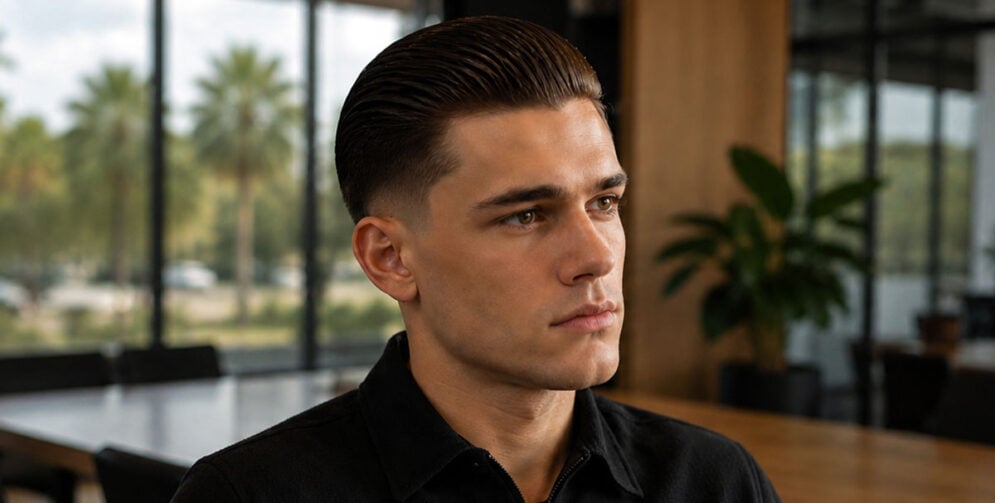
The slick back is a timeless men’s hairstyle where the hair is directed away from the forehead and toward the crown, creating a clean profile that can look polished, relaxed or deliberately bold. The defining feature is the backward direction on top. The sides can remain full, taper gradually, fade into the skin or sit beneath a disconnected undercut, which allows the same basic style to work in conservative offices, creative settings and formal events.
The most popular slick back haircuts for men now have more volume, separation and natural movement than the rigid, glossy versions associated with earlier decades. “These variations often highlight stylish movement and subtle definition instead of being combed flat and fixed rigidly in place,” says professional hairstylist James Goodman. A change in side treatment, product finish or styling tool can make the same haircut feel classic, contemporary or casual.
In this guide, I’ll show you 37 slick back hairstyles, organized by the feature that makes each version distinctive. You’ll also learn how to choose a style for your hair type and hairline, what to ask your barber for, which products create different finishes and how to correct the problems that make slicked-back hair fall forward, separate or look greasy.
What Is A Slick Back Hairstyle?
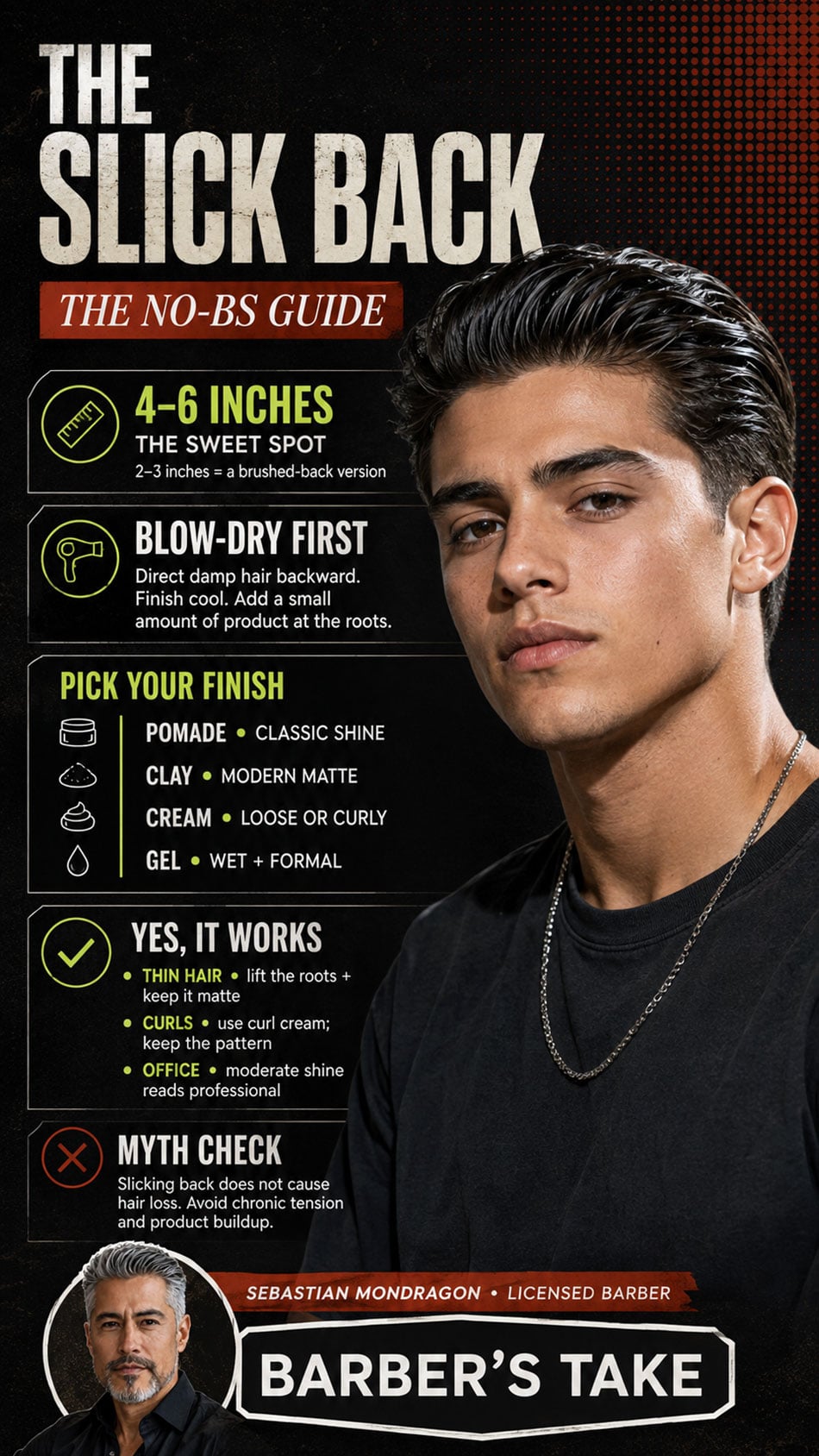
A slick back is a men’s hairstyle in which the hair on top is combed or brushed away from the face toward the crown and nape. A traditional version has a smooth, uninterrupted direction, but the wider slick-back family also includes side-parted, textured, faded and undercut variations. Most men need approximately three to five inches at the front for a full slick back, although straight hair may cooperate at a shorter length and curly or strongly forward-growing hair may need more.
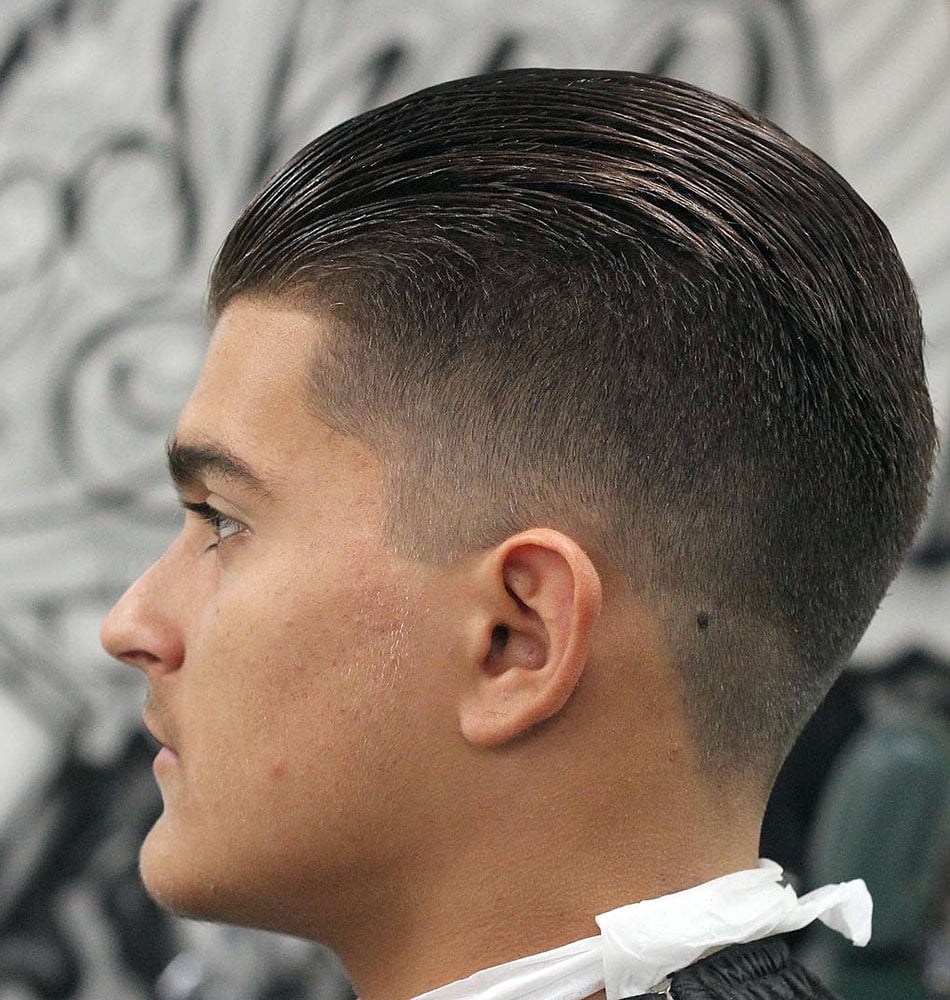
The slick back can describe both a haircut and a styling technique. Almost any hair with enough length can be pushed backward temporarily, but a haircut intended to be worn back is shaped around that direction. The front is left long enough to reach backward, the crown is blended so it does not form a shelf and excess weight is removed only where it interferes with the flow. When those elements are handled correctly, the style requires less heat and product to hold.
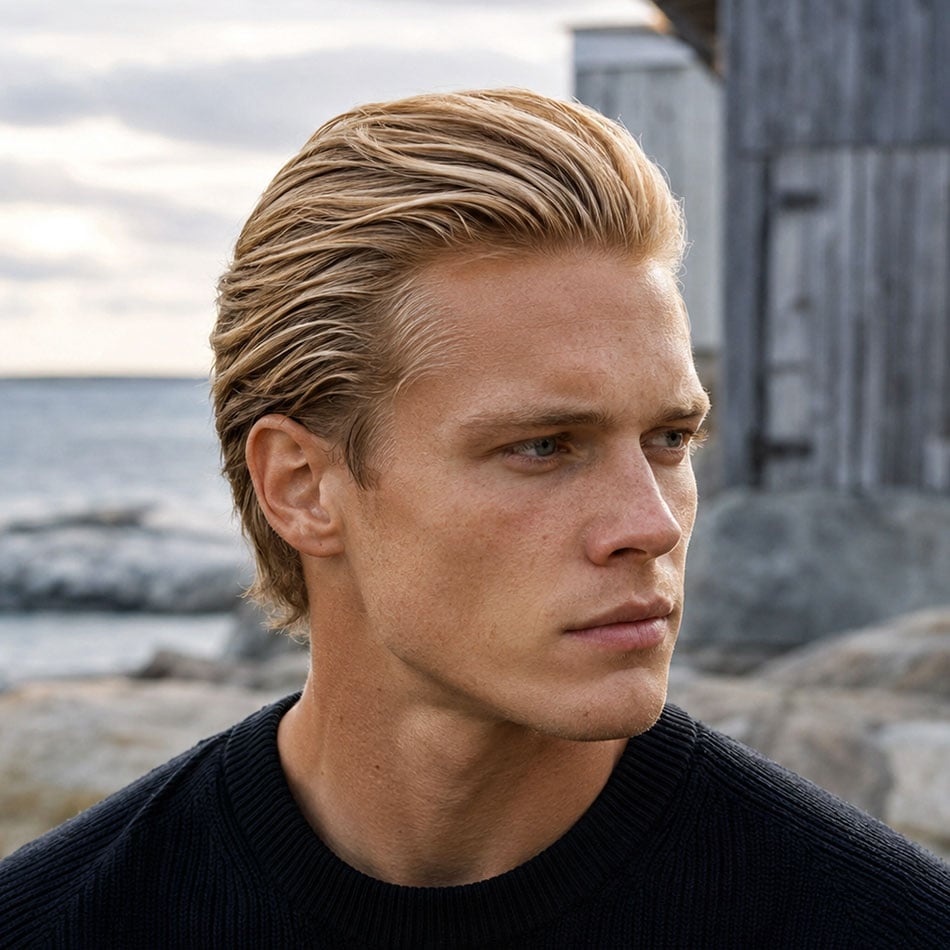
“A good slick back starts with the haircut, not the pomade. You need enough length through the front, a clean connection through the crown and the right amount of weight removed so the hair naturally wants to travel backward,” explains Eric Garibay, professional barber at BLVD Barbershop.
The Modern Slick Back Haircut: The Most Popular Variation
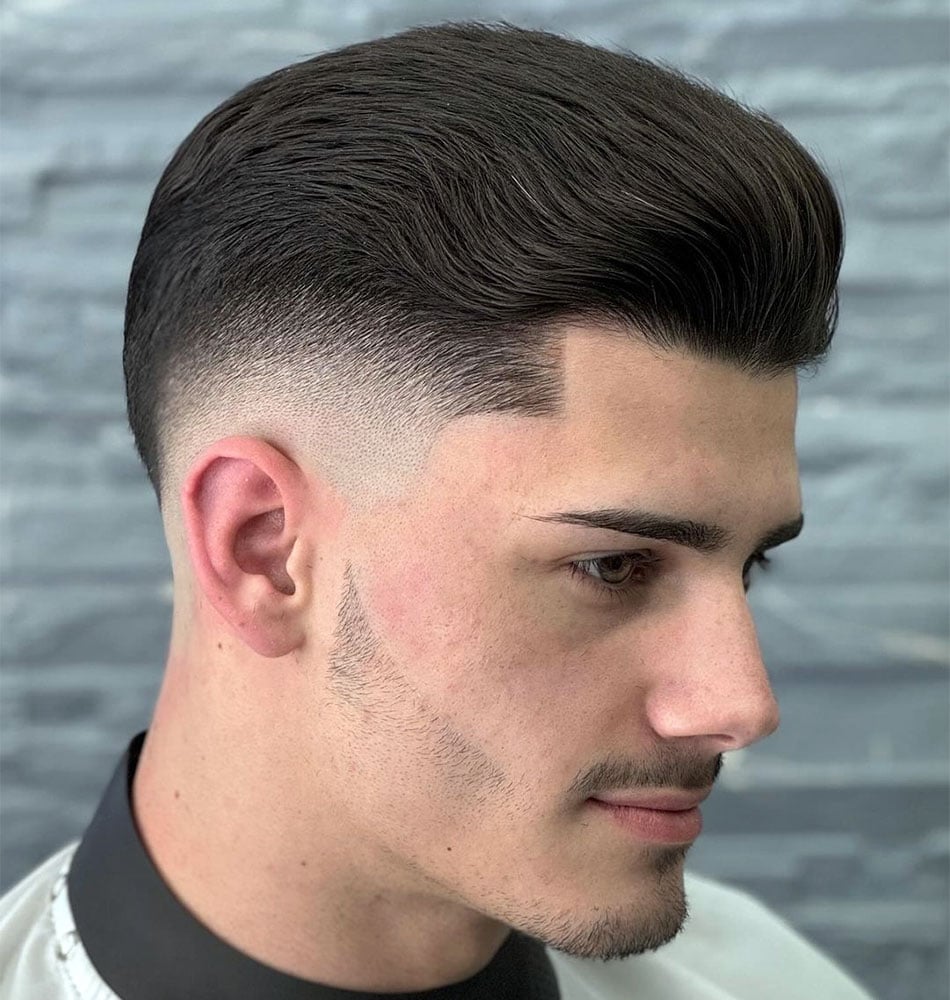
The modern slick back pairs the traditional swept-back top with a clean fade that removes bulk around the temples, ears and neckline. This sharper contrast makes the top appear fuller while giving the haircut a fresher, more youthful finish. Modern versions are often styled with natural volume, visible separation and low-to-medium shine rather than the flat, high-gloss finish associated with older slick backs. A low fade keeps the look subtle and professional, while a mid or high fade creates a bolder distinction between the long top and short sides.
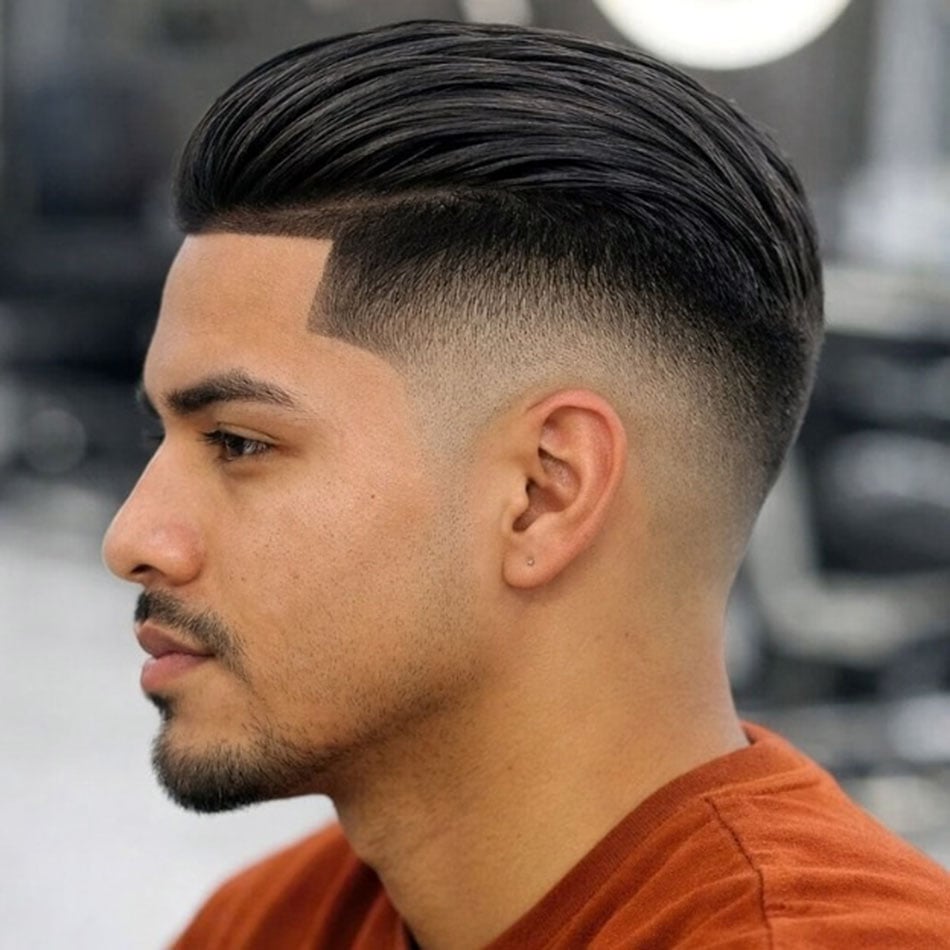
Which Slick Back Should You Choose?
The best version for you depends less on what is currently trending and more on your hairline, density, growth pattern and willingness to style it. Use these recommendations as a starting point:
- For a conservative or professional look: choose the classic, tapered, executive, old money or side-parted slick back.
- For a modern everyday haircut: start with a low or mid fade slick back with a natural or matte finish.
- For fine or thinning hair: keep moderate length, add lift at the roots and use a small amount of matte paste or lightweight cream.
- For thick or coarse hair: preserve enough length for control and ask your barber to manage weight strategically through the interior.
- For wavy or curly hair: choose a loose slick back or brush back that follows the natural pattern instead of forcing it flat.
- For a receding or uneven hairline: pick a looser, slightly diagonal direction with low shine rather than a tight, wet comb-through.
- For strong contrast: get a high fade, undercut or disconnected slick back.
- For the least daily styling: a short brush back or medium slick back with a taper is usually the most forgiving.
Traditional Slick Back Hairstyles
These polished variations preserve more fullness around the sides and rely on controlled shape rather than extreme contrast. They are the easiest slick backs to adapt for business, formal and everyday settings.
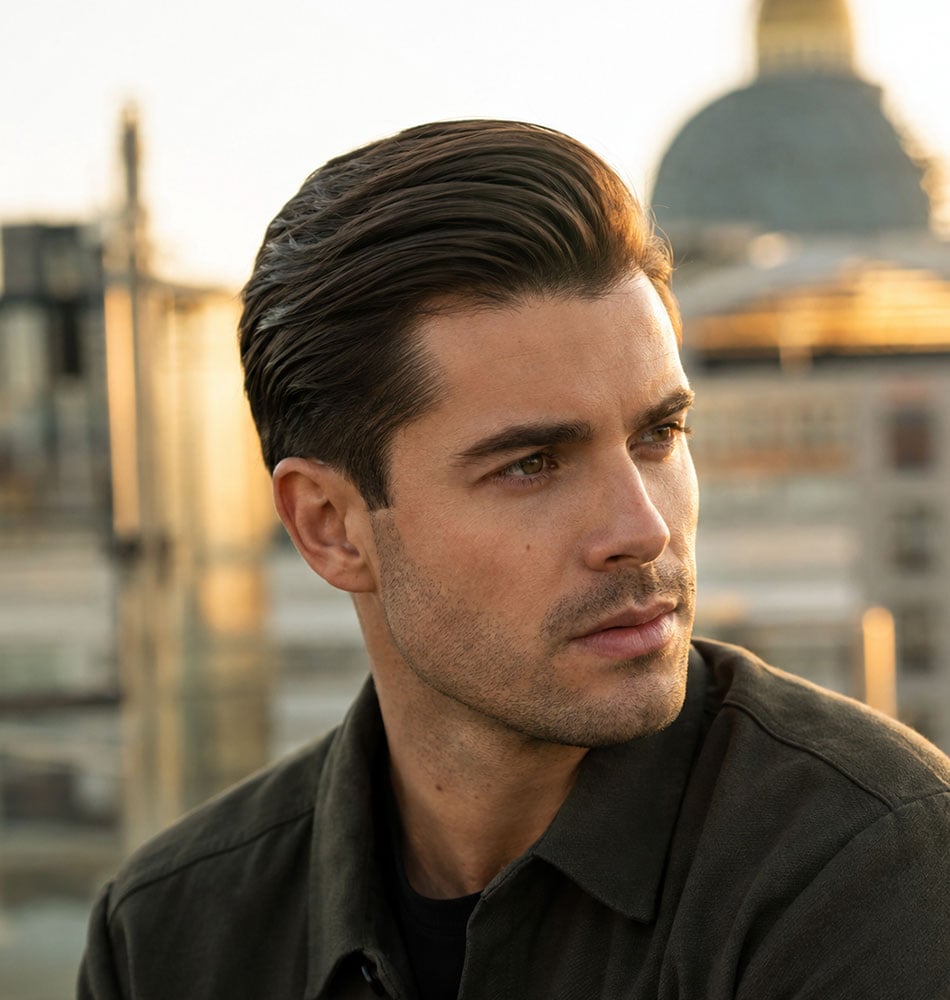
Classic Slick Back
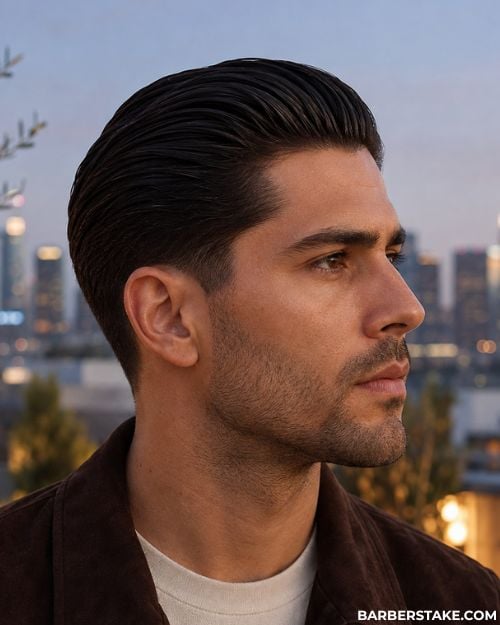
The classic slick back features medium-length hair combed directly away from the forehead with fuller, naturally blended sides. A light or medium sheen emphasizes the comb lines without making the surface appear wet. The look has moved through polished 1920s grooming, greaser culture and later subcultures such as mods, but the underlying construction has remained consistent. Ask for enough length at the front to reach the crown and a soft connection into the sides. Apply a medium-hold pomade to towel-dried hair, comb from the hairline toward the crown and avoid pressing the front completely flat if your face benefits from a little height.
Slick Back with Taper
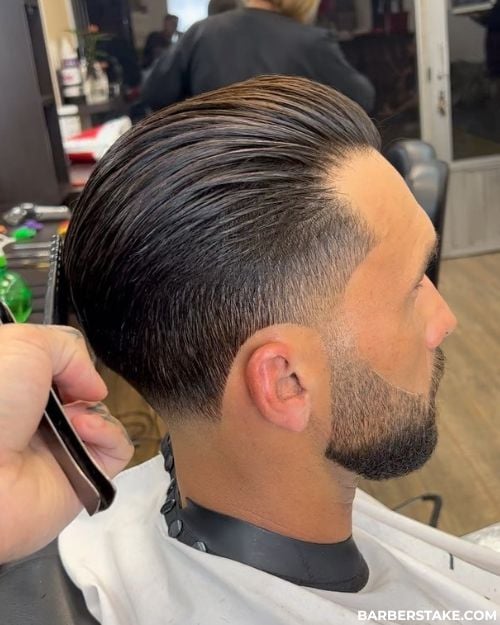
The slick back with a taper keeps the upper sides full and shortens the hair gradually only around the temples, ears and neckline. The restrained perimeter looks professional without creating the exposed scalp or frequent upkeep of a skin fade. It is also forgiving as it grows because there is no sharp band of short hair moving down the head. This is the version I recommend most often to men who want one haircut for the office, dinner and weekends. Ask for a natural connection from the top into the sides, then use a lightweight pomade or styling cream for flexible control and understated shine.
Medium Slick Back
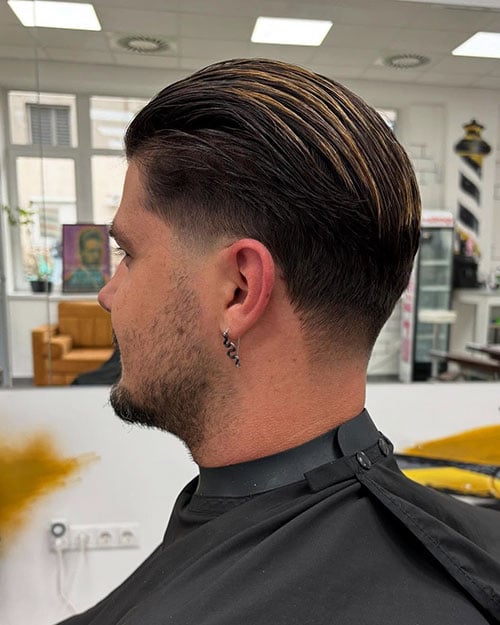
The medium slick back sits in the practical middle of the style, with enough length to create a complete backward flow without the conditioning and drying time associated with long hair. This medium-length cut works especially well when the front reaches back comfortably but the crown remains compact and controlled. Ask your barber to leave the front slightly longer than the crown and preserve enough weight through the sides to prevent them from sticking outward. Blow-dry with a vent brush, add modest lift at the roots and finish with a medium-hold cream, paste or pomade based on how much shine you prefer.
Hard Side Part Slick Back
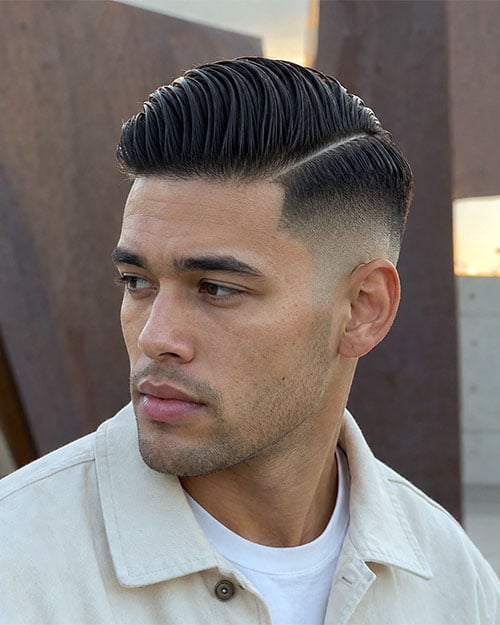
The hard side part slick back introduces a narrow shaved line and sends the top backward at a slight diagonal. The part adds structure and makes the style easier to reproduce, but it also requires more frequent touch-ups because the shaved line softens quickly as it grows. This variation suits straight or lightly wavy hair that naturally separates to one side. Ask your barber to place the part along your actual growth pattern rather than forcing a line where the hair does not want to divide. Set the part while the hair is damp, blow-dry back and across, then use a low-to-medium shine pomade for a deliberate finish.
Comb Over Slick Back
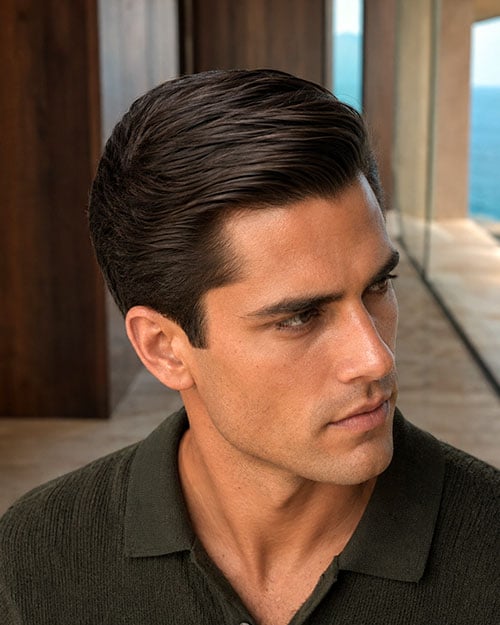
The comb over slick back directs the hair diagonally backward instead of moving it straight toward the crown. That angle can complement an uneven hairline, follow a natural sideward growth pattern and create more visual coverage through the front. Unlike a conventional comb over, the hair still travels predominantly backward and retains the open-forehead character of a slick back. Establish the direction with a vent brush and blow-dryer before applying product. Follow the same diagonal from the front hairline to the opposite rear corner with a medium-hold pomade, using a wide-tooth comb if you want softer lines.
Old Money Slick Back
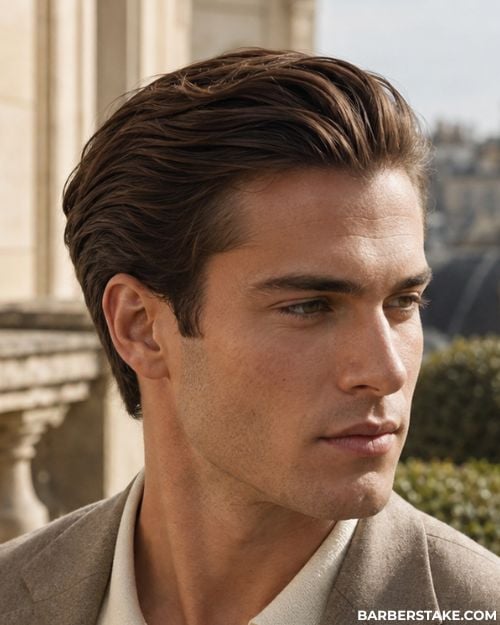
The old money slick back is a restrained version with a medium-length top, natural or softly tapered sides and a controlled finish with modest shine. It avoids high skin fades, aggressive lineups and exaggerated height, allowing the quality of the cut and the condition of the hair to carry the look. Ask for a scissor-cut shape that follows the head and keeps enough fullness above the ears to support the top. Apply a small amount of natural-finish pomade or styling cream to towel-dried hair and comb it back evenly. The result should look composed and expensive without appearing heavily styled.
Executive Slick Back
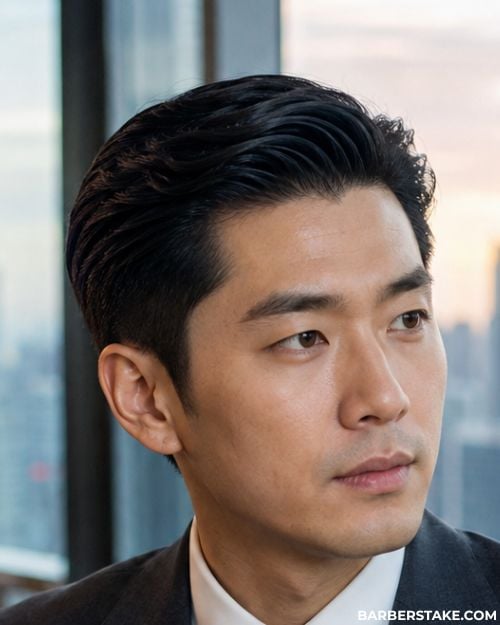
The executive slick back combines a neatly tapered perimeter with a smooth, low-volume top suited to conservative offices and client-facing work. The distinction from the old money version is precision: the temples, neckline and sideburns are kept slightly sharper, while the top remains controlled without a glossy wet finish. Ask your barber to preserve enough length through the crown for a seamless transition and avoid taking the sides so short that the cut becomes aggressive. Blow-dry the hair backward with limited lift and finish with a lightweight, natural-shine pomade. A trim every three to five weeks will usually maintain the shape.
Slick Back Fade Haircuts
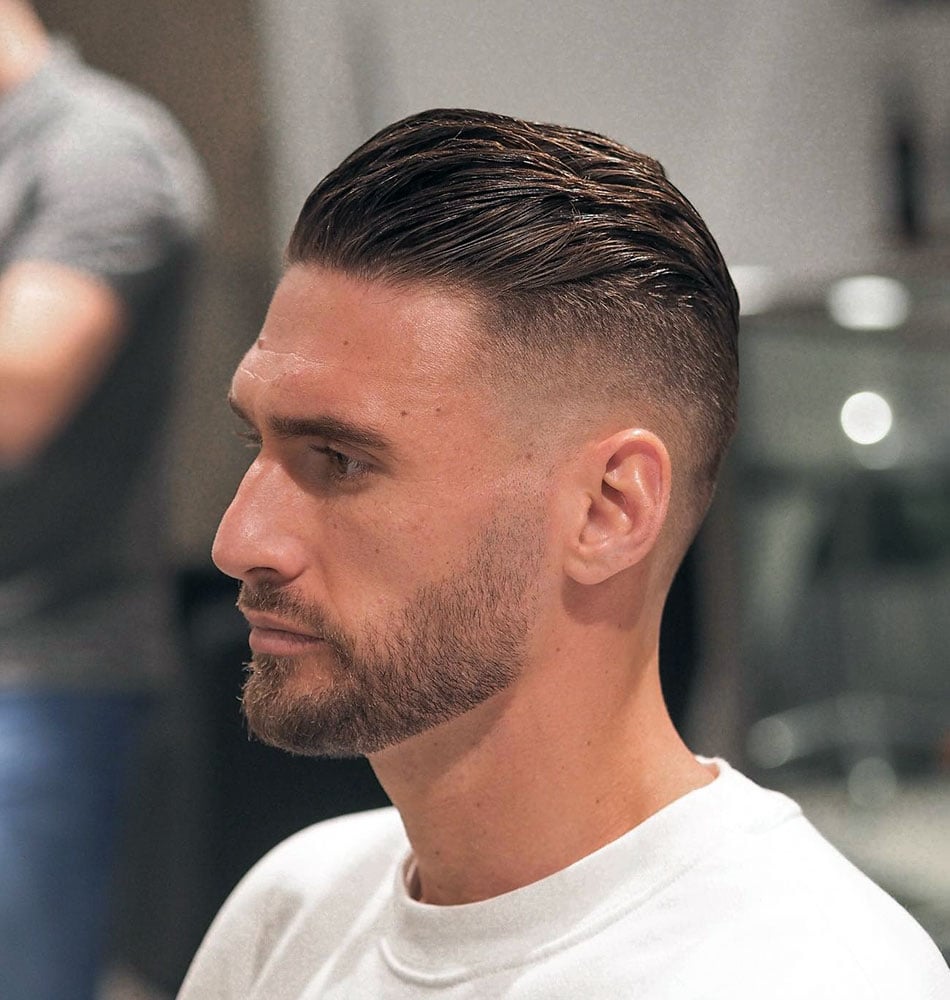
Slick Back Fade
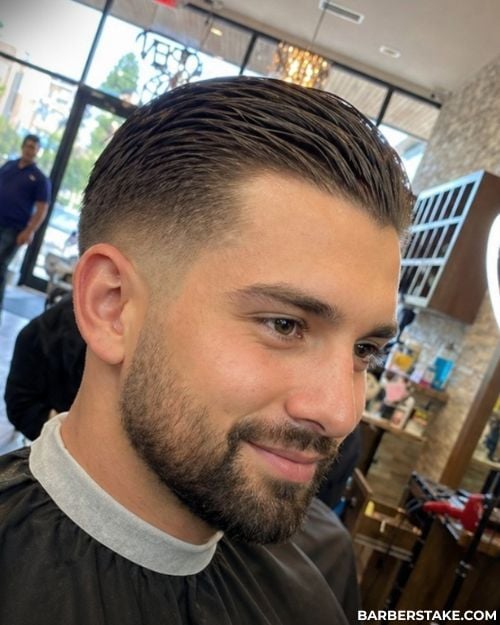
The slick back fade places a smoothly graduated back and sides beneath the longer, backward-directed top. Unlike an undercut, the lengths transition rather than meeting at a hard disconnected line. The result is cleaner and more contemporary than a classic slick back, but the amount of contrast depends on where the fade begins and whether it ends in skin. Ask your barber to blend the crown carefully so the longer top does not hang over a bulky ridge. Blow-dry the hair back first, then use a medium-hold product matched to your density. Fine hair usually benefits from low shine, while dense hair can support a more defined finish.
Slick Back with Low Fade
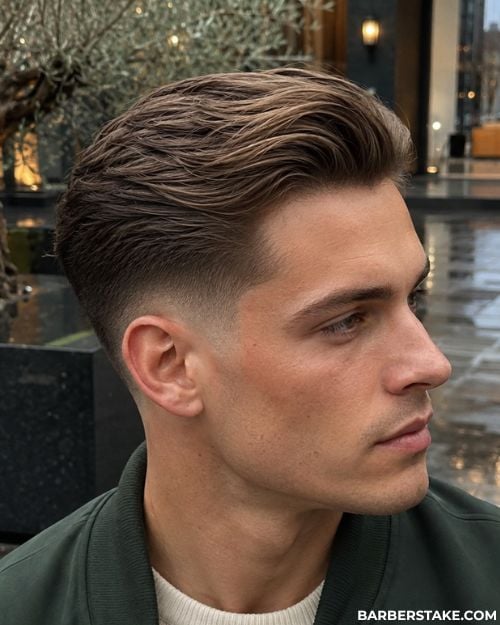
The slick back with a low fade begins just above the ears and stays close to the lower perimeter, preserving fullness through the upper sides. This produces subtle contrast and makes the haircut easier to wear in professional settings. It is also a strong choice for longer or wavier tops because the remaining side weight supports the flow instead of making the top look detached. Ask for approximately three to five inches through the front, depending on texture, with enough crown length to connect cleanly. Blow-dry backward and finish with a styling cream or medium-hold pomade. Choose matte for a modern result or light shine for a more traditional appearance.
Slick Back with Mid Fade
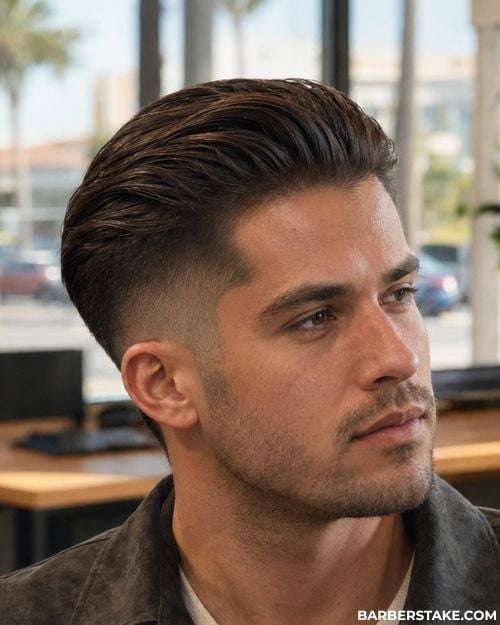
The slick back with mid fade begins around the temples, creating more visible separation than a low fade without removing as much side weight as a high fade. It is the most balanced faded version for many men because it frames the face, cleans up the profile and still leaves enough structure near the crown. Ask your barber whether the fade should travel level around the head or drop slightly behind the ears to follow your skull shape. Style the top with a brush and blow-dryer, then choose a pomade for a defined finish or a paste for softer texture and lower shine.
Slick Back with High Fade
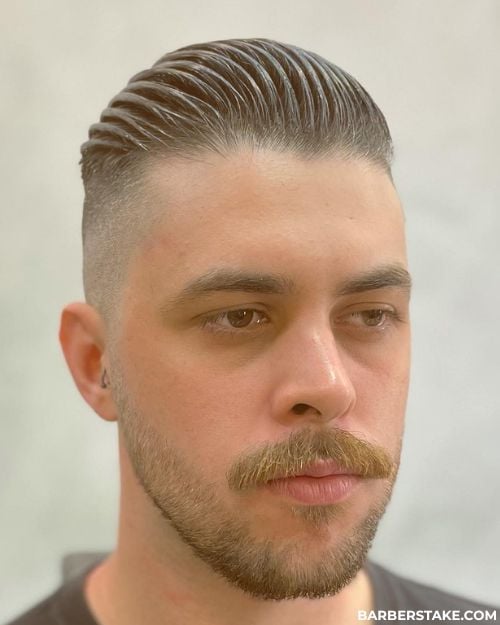
The slick back with a high fade starts near or above the temples and removes most of the visual weight from the sides. This creates dramatic contrast and directs immediate attention to the longer top. It works best when the crown is blended carefully and the top has enough density to stand on its own. On very fine hair or pronounced temple recession, the exposed sides can make sparse areas more noticeable, so the highest fade is not automatically the most flattering choice. Ask for three to five inches on top, blow-dry backward with controlled lift and use a firm pomade or paste that holds without saturating the hair.
Slick Back Taper Fade
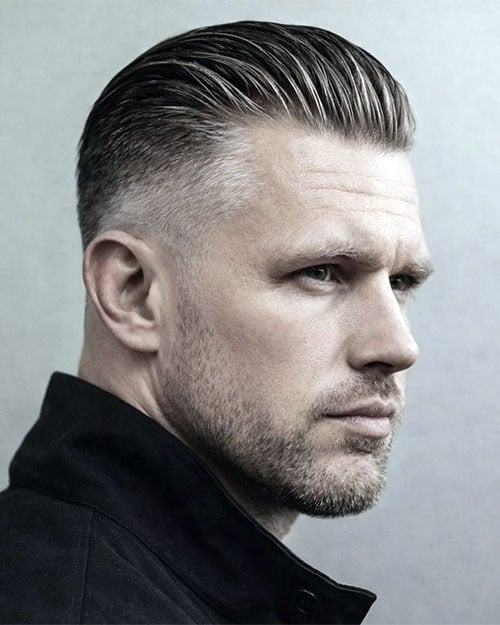
The slick back taper fade concentrates the shortest blending around the temples, sideburns and neckline while keeping more fullness through the sides than a conventional fade. This creates a crisp outline without disconnecting the top from the rest of the haircut. It is particularly useful for men who want visible barbering detail but do not want bare skin extending high around the head. Ask for a smooth connection through the crown and enough side weight to prevent the top from looking oversized. Apply a medium-hold cream or pomade to damp hair, blow-dry backward and use either a comb for polish or your fingers for separation.
Messy Slick Back with Burst Fade
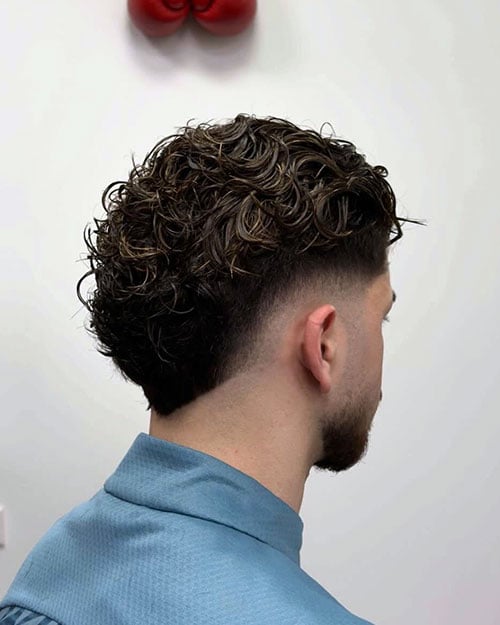
The messy slick back with a burst fade combines loose backward texture with a curved fade that wraps around the ear. Because the fade is concentrated at the sides and leaves additional length toward the back, the overall profile can take on a subtle mohawk influence. The top should look separated and intentional rather than simply uncombed. Apply sea salt spray or lightweight mousse to damp hair, blow-dry backward with your fingers and finish with a small amount of matte clay. Pinch a few sections into definition, but keep the crown connected to the extra length behind it so the shape flows rather than breaking into separate zones.
Slick Back with Line Up
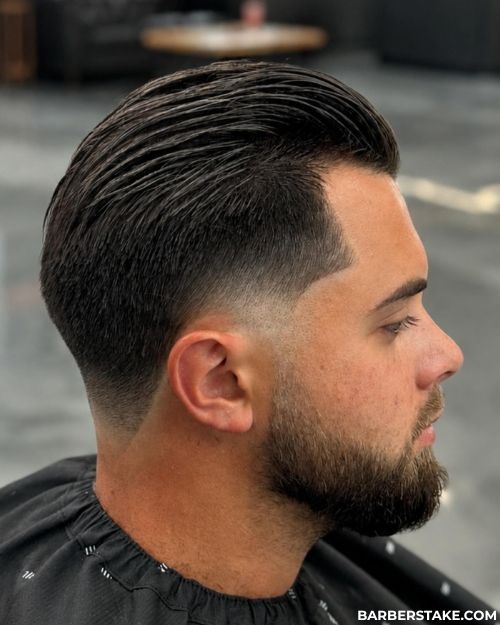
The slick back with line up adds squared temples and a sharply defined front edge to the open, backward-directed top. This pairing creates a precise frame around the face and works especially well with a fade and dense hairline. The main tradeoff is maintenance because the crisp corners begin to soften as soon as the hair grows. Ask your barber to follow your natural hairline rather than pushing it backward to create an unnaturally straight edge. Keep the top smooth or lightly textured based on your preferred finish, and schedule touch-ups only as frequently as your hairline and fade require.
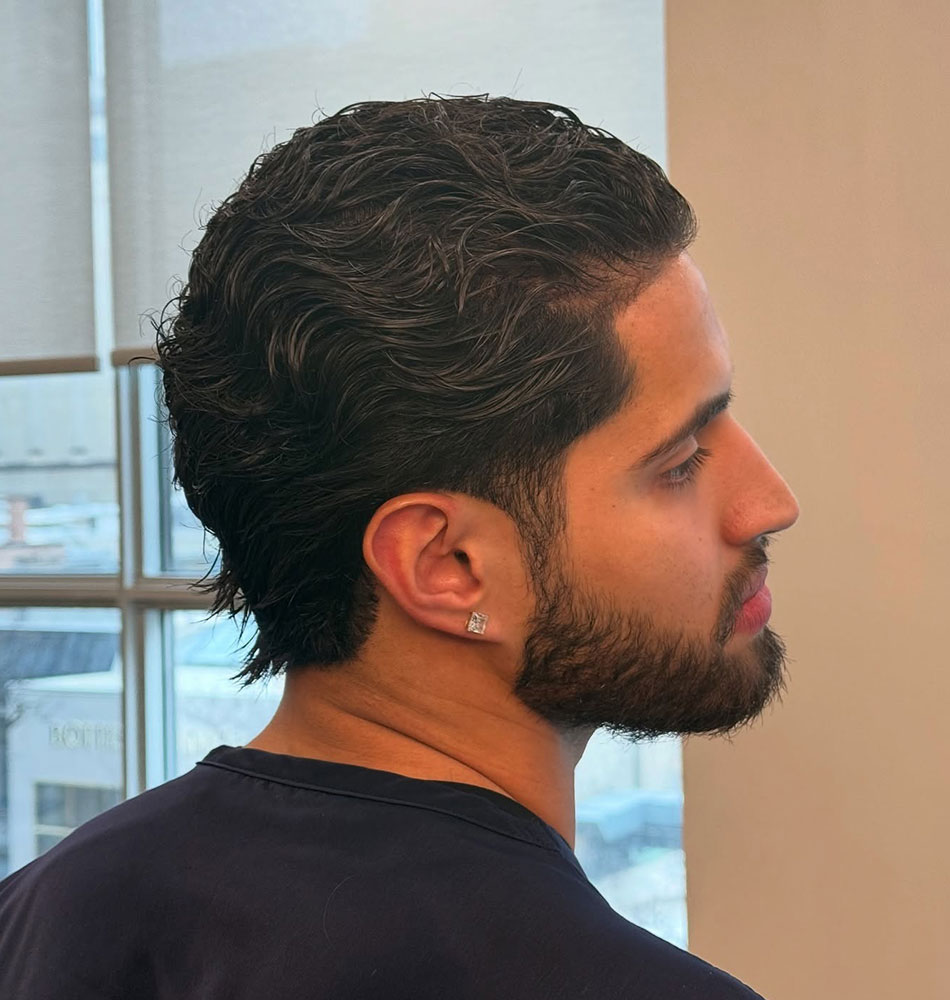
Slick Back with Beard
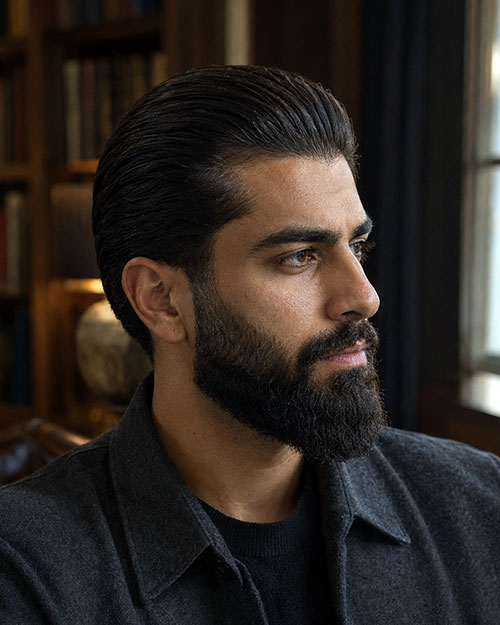
The slick back with a beard balances controlled hair on top with denser texture around the jaw. The combination can add visual weight to the lower face and soften the polished character of the hairstyle, but it looks most cohesive when the sideburns transition intentionally into the beard. A fade can create a clean break, while a taper can blend the two more naturally. Ask your barber to shape the haircut and beard as one composition rather than treating them separately. Style the hair with your preferred pomade or paste, define the cheek and neckline and use beard oil or balm only in the amount needed to control dryness.
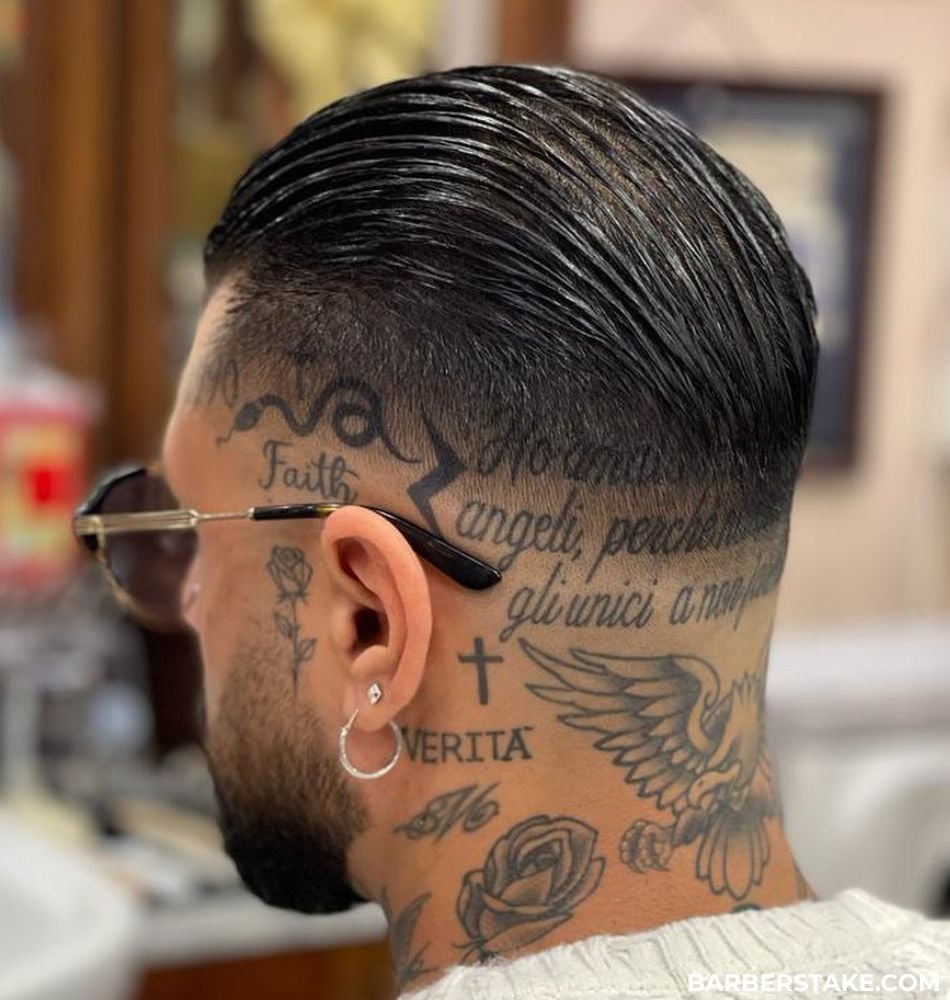
Back View of a Slick Back
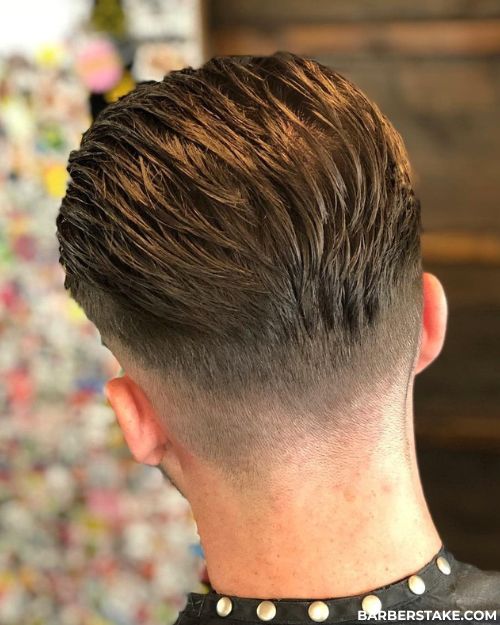
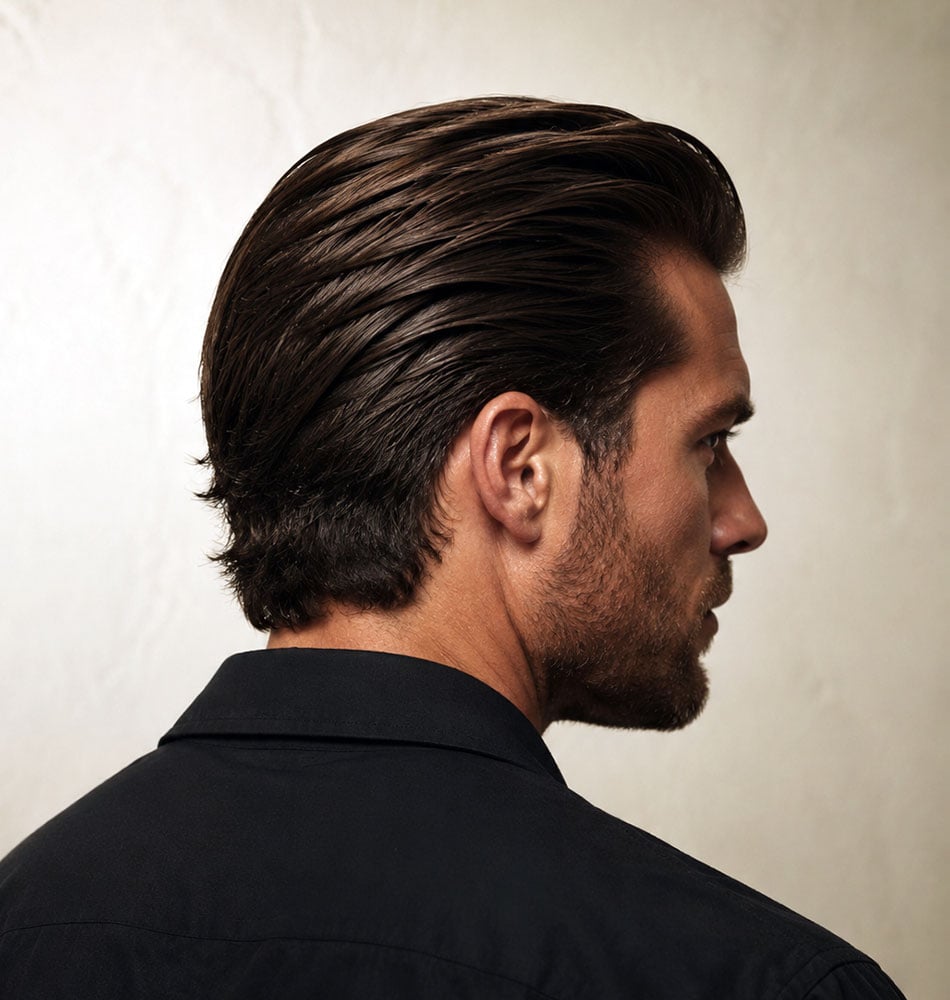
The back view reveals whether a slick back has been cut and styled as a complete shape. The layers should travel smoothly over the crown toward the nape without forming a shelf, separating into thin gaps or ending in an abrupt block of weight. A classic version can taper softly into a natural neckline, while a modern version may finish with a fade and sharper outline. Apply product through the crown and rear sections, not only at the front, and brush everything in the same general direction. A clean crown connection and deliberate neckline make the style look finished from every angle.
Slick Back Undercuts and High-Contrast Styles
These styles rely on disconnection, unconventional shaping or a dramatic difference between the long top and short sides. They make a stronger statement and usually require more deliberate grow-out planning.
Slick Back Undercut
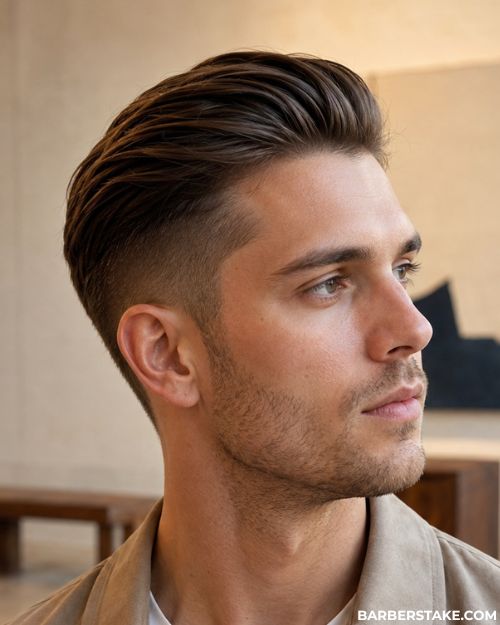
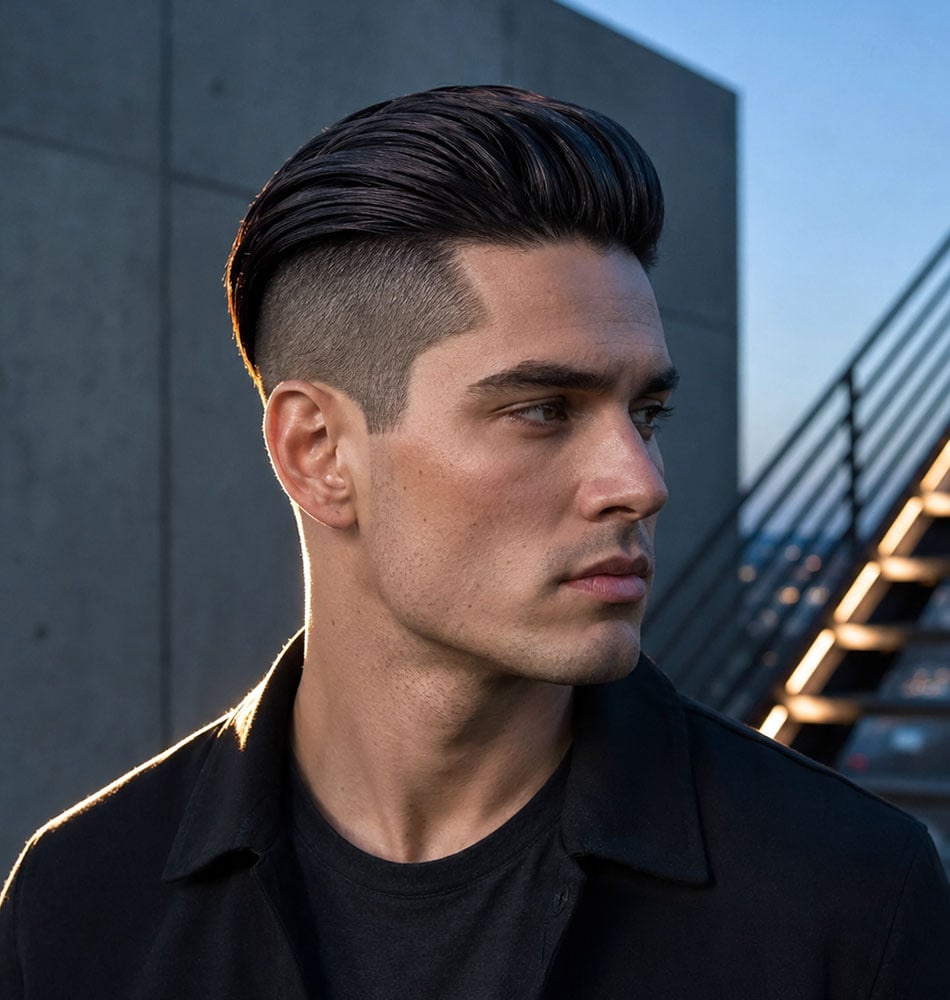
The slick back undercut pairs a long top with sides clipped to one short length and little or no gradual blend between them. The hard separation gives the backward flow a bold, architectural profile and distinguishes the cut from a slick back fade. Ask your barber where the disconnect will sit and how the top should fall over it, since placing the line too high can narrow the head while leaving the sides too bulky can create a shelf. Blow-dry the top back before applying product. Use matte clay for a modern, textured result or pomade for the cleaner vintage finish associated with the classic undercut.
Loose Slick Back Undercut
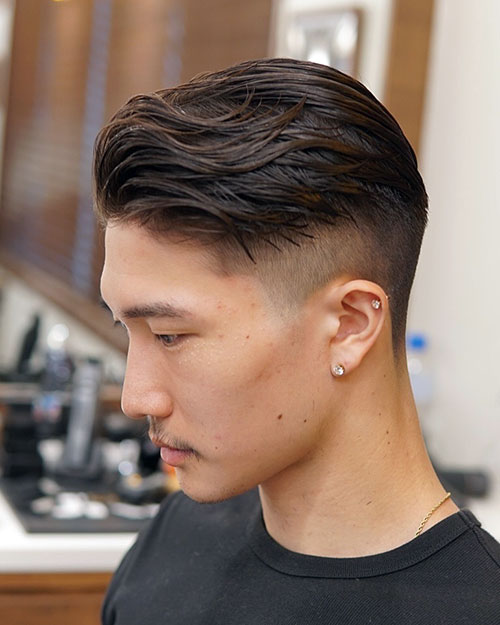
The loose slick back undercut keeps the short, disconnected sides but styles the longer top with volume, separation and natural movement. It feels less rigid than a glossy undercut because the hair is pushed backward rather than pressed flat. Ask for approximately four to six inches on top, adjusted for your texture, and enough internal structure to prevent the length from collapsing around the parting or crown. Apply a lightweight cream or pliable paste to damp hair and blow-dry backward while lifting the roots with your fingers. The finished style should move when touched but still maintain a recognizable rearward shape.
Disconnected Slick Back
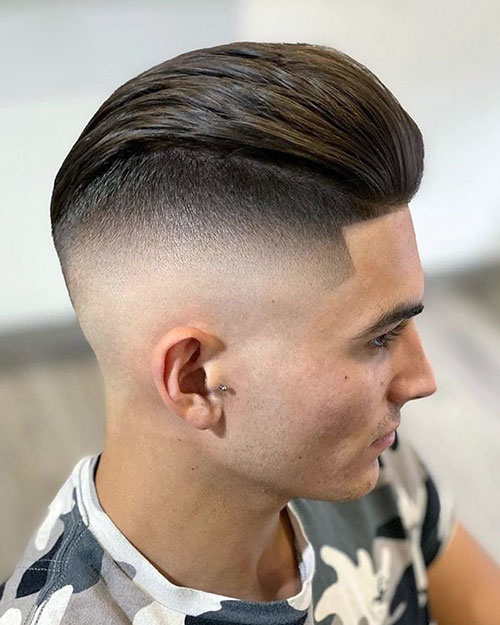
The disconnected slick back exaggerates the visible boundary between the long top and uniformly short sides. It is related to the undercut but usually places greater emphasis on the hard line and height of the separation. The shape is most successful when the top is dense enough to cover the transition cleanly and the crown does not flare outward. Bring a side-profile reference photo so your barber can match the position of the disconnect, not just the top length. Blow-dry the top backward with firm direction and finish with a strong but pliable matte or low-shine product that keeps the longer section controlled.
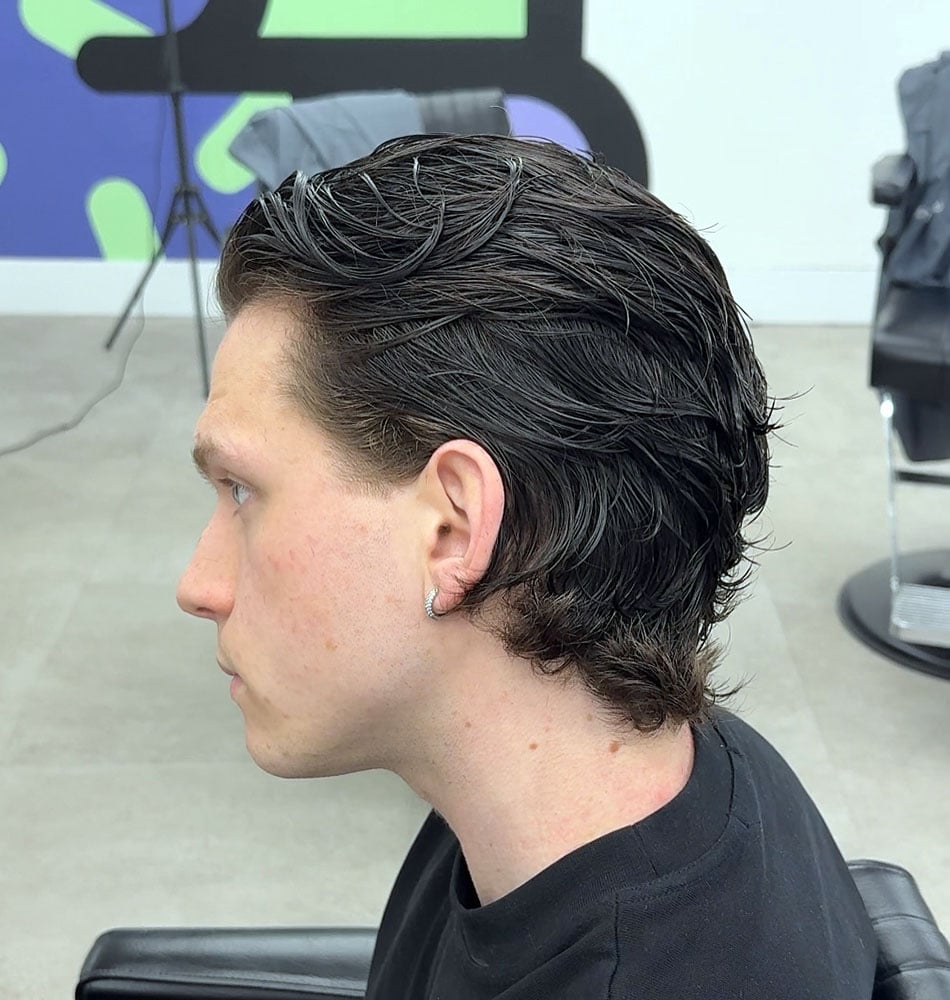
Slick Back Mullet
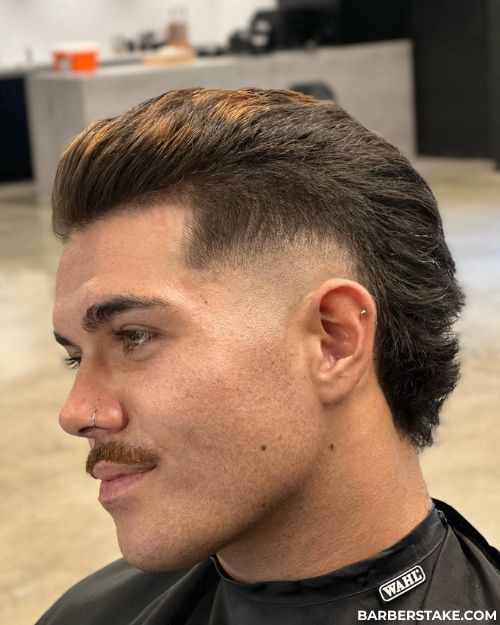
The slick back mullet directs the top and sides backward into intentional extra length at the nape. The polished front creates contrast with the rebellious rear shape, giving the modern mullet a cleaner and more styled character. The crown connection is critical: too much bulk creates a step, while too little makes the back look detached. Ask your barber to preserve the rear length, taper or fade around the ears and blend the top through the crown. Comb the front back with a medium-hold pomade or cream and allow the rear section to follow its natural texture instead of coating the entire haircut in heavy product.
Textured, Natural and Different-Finish Slick Backs
These styles change the texture, movement or surface finish. Several can be created from the same haircut by changing the product and styling tool.
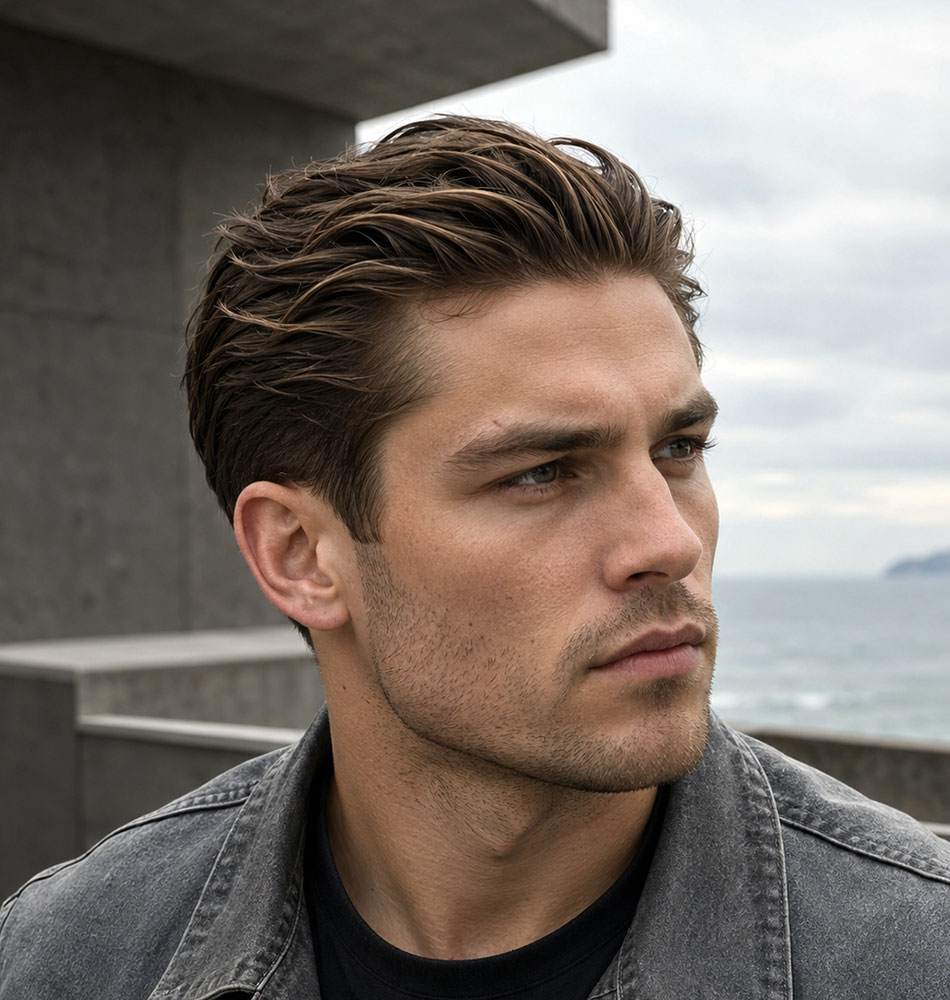
Textured Slick Back
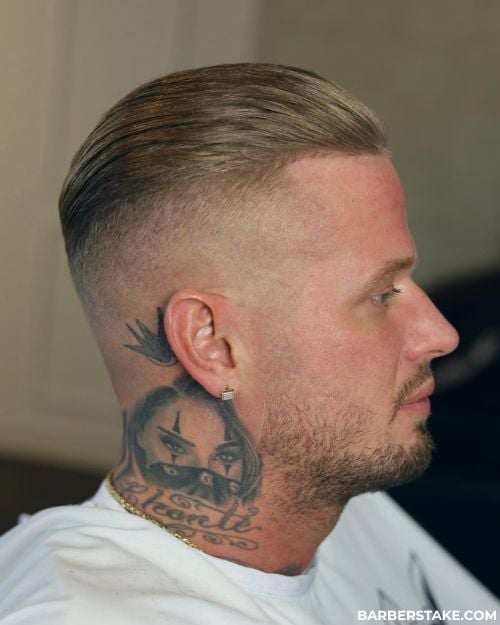
The textured slick back keeps the hair moving backward while separating it into visible sections instead of smoothing the surface into uniform comb lines. This creates a more casual shape and can make fine-to-medium density look fuller because the strands are not compressed together. Ask for point-cut texture only where it supports movement, since excessive thinning can make wavy or fine hair look sparse. Apply a light pre-styler, blow-dry backward with your fingers and work a small amount of matte paste through the mid-lengths and roots. Finish by pinching a few sections rather than combing the entire surface flat.
Wavy Slick Back
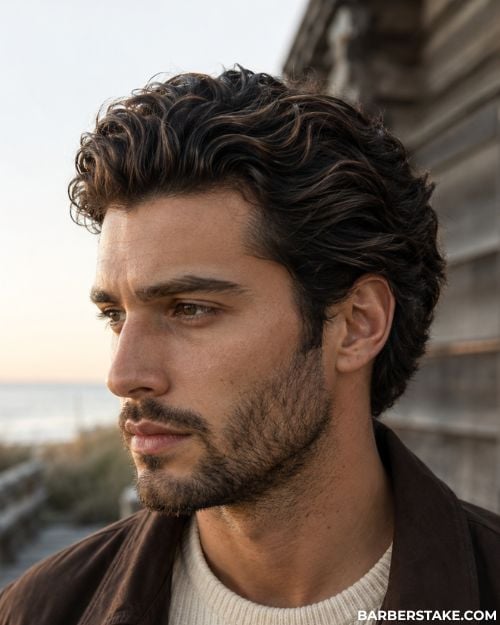
The wavy slick back follows the natural bends in the hair while directing the overall shape away from the face. The wave adds dimension and volume, so the goal is control rather than complete smoothing. Heavy pomade and repeated fine-tooth combing can stretch the pattern, collapse the lift and make the top appear greasy. Ask for long, connected layers that allow the waves to settle backward without creating a bulky crown. Apply a light styling cream or mousse to damp hair, blow-dry on moderate heat with a wide-tooth comb or fingers and stop before the surface becomes too uniform.
Curly Slick Back
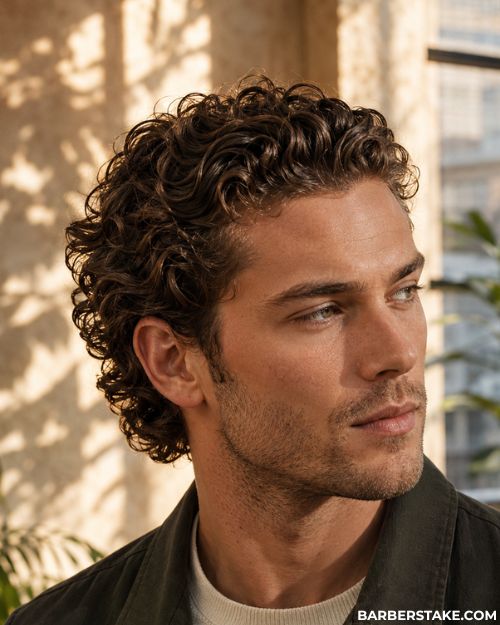
The curly slick back moves the curls away from the forehead while preserving visible coils and bends through the top. It should look controlled but not straightened. The barber needs to account for shrinkage, density and the way the curl sits when dry before removing interior weight. Aggressive thinning can create frizz and an uneven silhouette, so ask for strategic layering rather than a blanket request for thinning shears. Rake curl cream or a flexible gel through damp hair from front to back, arrange the shape with a wide-tooth comb or fingers and air-dry or diffuse on low without repeatedly touching the curls.
Loose Slick Back
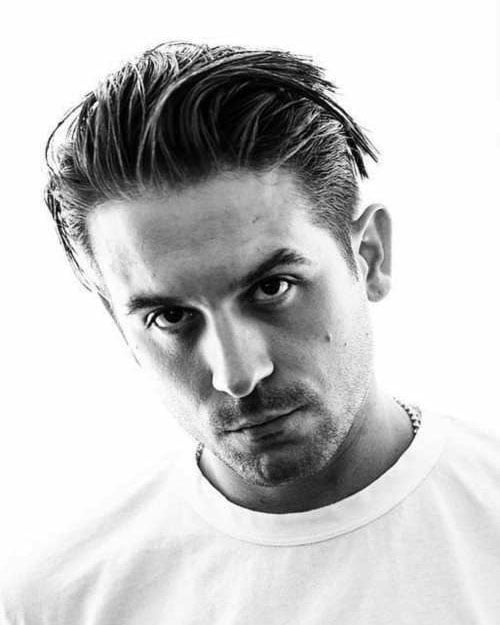
The loose slick back creates a swept-back outline with soft volume, visible separation and a few imperfect strands around the front. Medium-length layers provide enough weight to remain directed backward while still allowing movement. This is one of the most forgiving choices for men who dislike the severity of a traditional slick back or whose hairline benefits from less tension and definition. Apply sea salt spray, mousse or lightweight cream to damp hair, blow-dry backward with your fingers and lift the front slightly at the roots. Finish with a flexible paste concentrated through the mid-lengths instead of coating the entire surface.
Full Brush Back
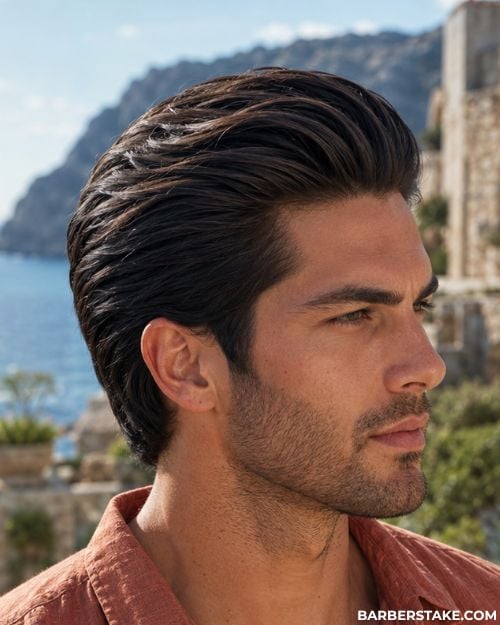
The full brush back retains generous length through the top, sides and crown to create a broad, balanced silhouette with natural flow. It differs from a traditional slick back because it relies on lift and movement rather than a tight, combed surface. Thick, straight and wavy hair usually provide the strongest foundation, although strategic layering can help medium density hold the shape. Ask for a scissor-cut perimeter with a subtle taper around the ears and neckline. Blow-dry backward with a vent brush while lifting at the roots, then use a lightweight cream or matte pomade and finish with your fingers to preserve separation.
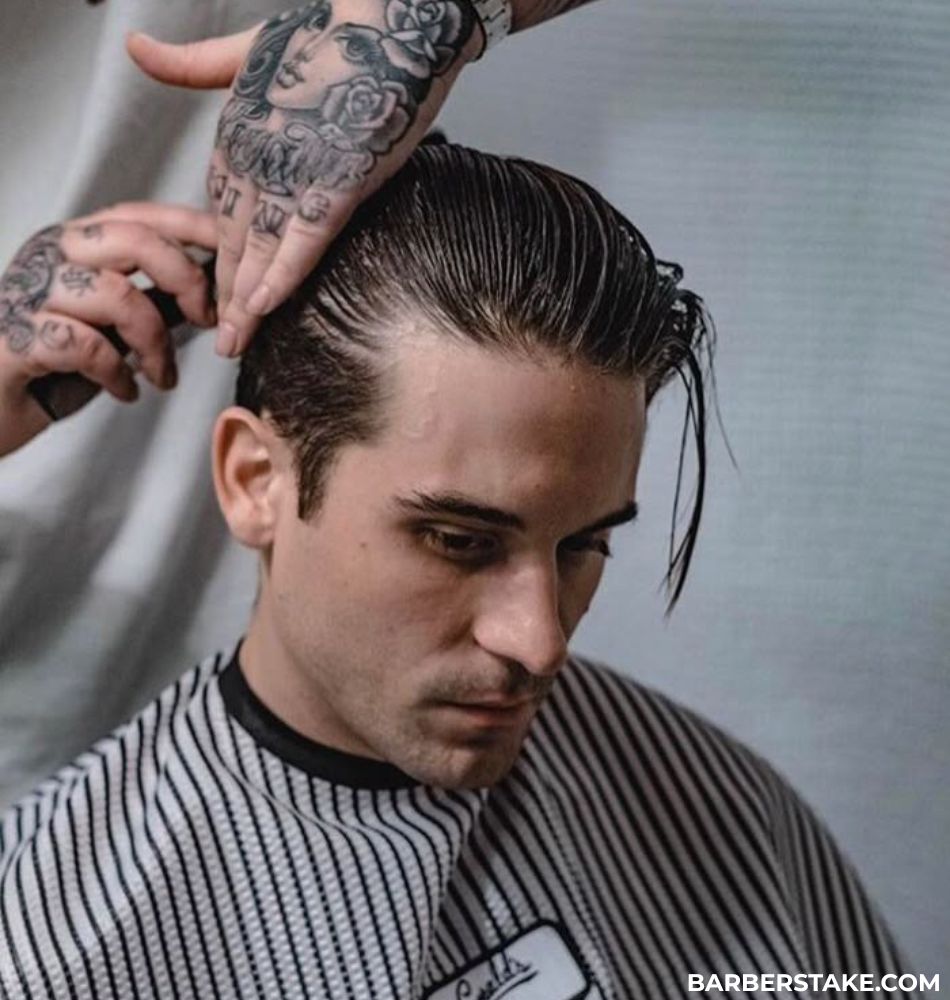
Wet Look Slick Back
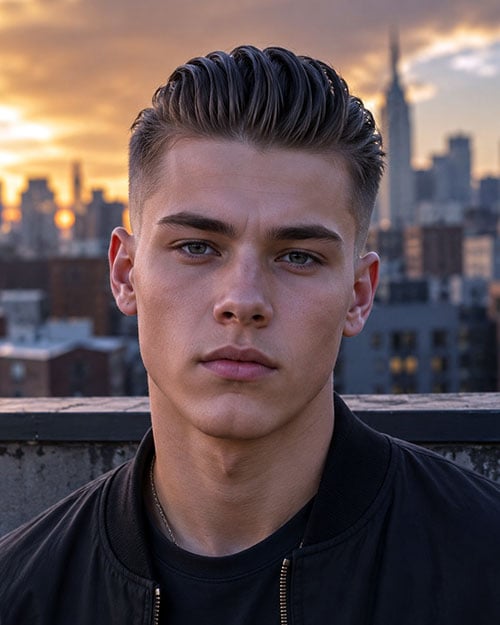
The wet-look slick back is the most deliberate, high-shine version, with the hair combed close to the head in smooth, defined lines. It works best for formal events, evening styling and dense hair that can support the separation created by gloss. On fine or thinning hair, a reflective product may expose more scalp than expected. Start with damp rather than dripping hair, distribute a high-shine pomade or wet-look gel evenly from roots to ends and use a fine-tooth comb for consistent lines. Allow the product to set before touching the surface, and wash it out according to the formula you used.
Matte Slick Back
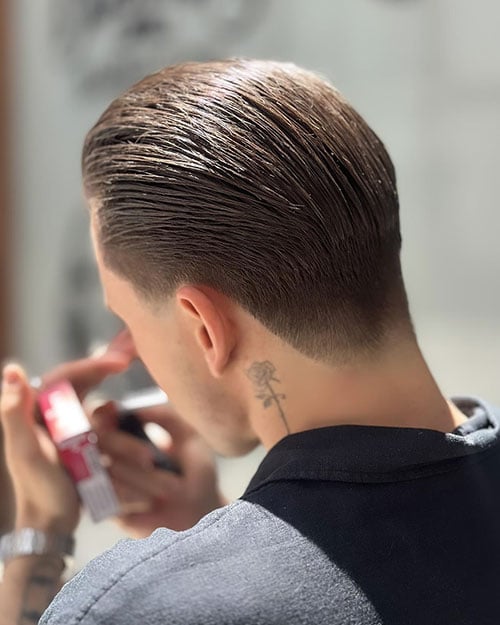
The matte slick back keeps the controlled rearward direction while removing the sheen associated with traditional pomade. The dry finish looks contemporary and works particularly well with fades, textured tops and fine hair that would show more scalp under a glossy product. Matte clay can become heavy or brittle on dry, coarse or grey hair, so choose a softer paste if the strands lack moisture. Establish the shape with the blow-dryer before applying product, warm a small amount thoroughly between your palms and distribute it beyond the surface layer. Smooth with your palms or separate with your fingers based on the finish you want.
Short, Long and Tied-Back Slick Backs
These styles are defined primarily by length. The amount of hair determines whether the shape behaves like a compact brush back, a flowing slick back or a tied style.
Short Slick Back
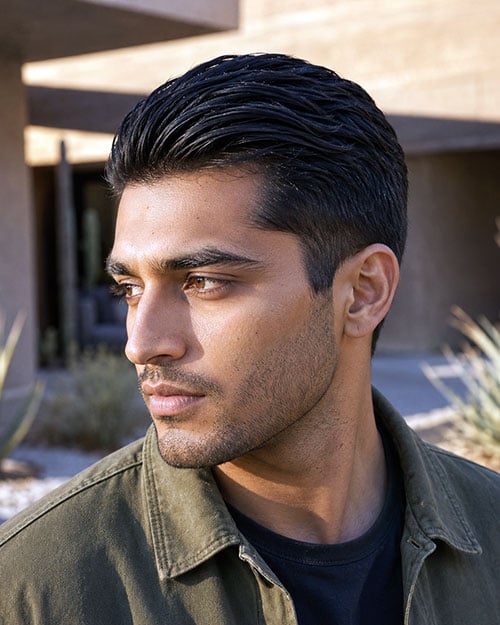
The short slick back uses approximately two to three inches on top to create rearward direction without the full drape of a traditional medium-length version. It is technically closer to a brush back, but it provides the same open-forehead shape with less drying time and product. Straight or slightly wavy hair tends to cooperate most easily at this length, while strong curls or forward growth may need additional length. Ask for a connected top and tidy taper or fade, then blow-dry backward and use a small amount of light pomade or cream. The style should reset easily with damp hands.
Long Slick Back
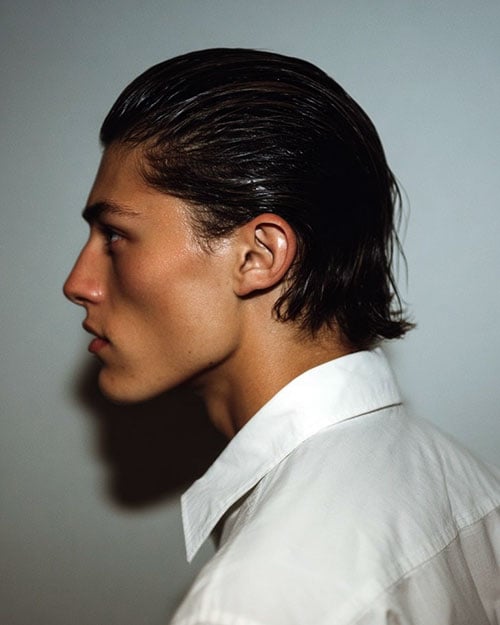
The long slick back controls extended length by directing it into one continuous sweep away from the face. The weight of the hair can help it stay back, but it also exposes dryness, split ends and a bulky crown more readily than shorter versions. Ask for long layers that preserve the perimeter while preventing the top and sides from collapsing into a single heavy mass. Condition regularly, detangle from the ends upward and apply a light cream or oil-enriched pomade through the lengths rather than concentrating everything at the roots. Comb or brush backward gently and tuck behind the ears when you want a cleaner profile.
Slicked Back Bun
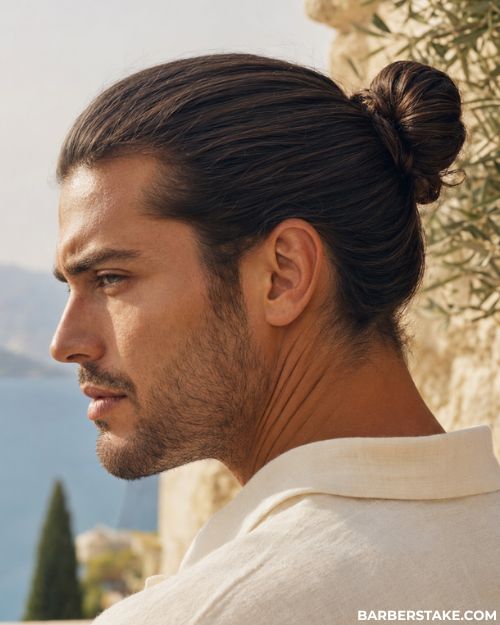
The slicked-back bun carries the hair away from the forehead and secures the length at the crown or nape. It creates a clean frontal profile and keeps long hair contained, but the tie should not feel painful or pull continuously at the temples. Repeated tension in the same area is more important to hair health than whether the surface looks sleek. Apply a light cream or flexible pomade, brush the hair backward without forcing every strand flat and secure it with a soft band. Change the tie position occasionally and loosen the style if you feel persistent tension around the hairline.
Different Types of Slick Backs
These variations adapt the slick back to the features a man already has. Hairline, density and texture usually matter more than age alone, while color changes the products and level of shine that look most flattering.
Older Men’s Slick Back
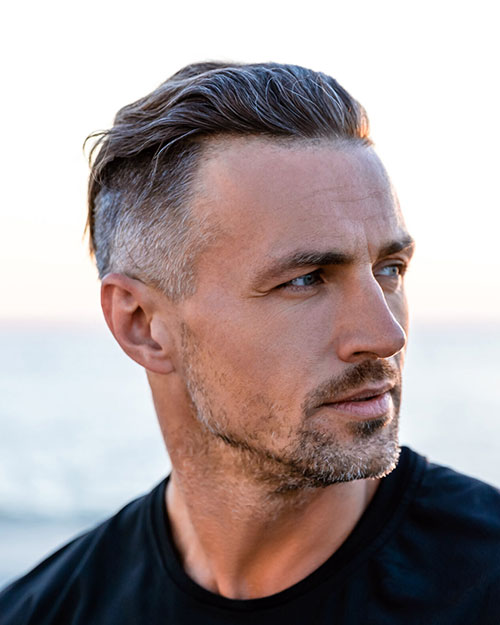
The older men’s slick back looks distinguished when the haircut respects changes in density, texture and hairline rather than copying an overly severe youthful version. A soft taper and moderate length preserve fullness around the sides, while a little lift at the front can keep the top from appearing flat. Grey hair is often drier or more resistant, so a cream pomade usually creates better movement than a dense, dry clay. Ask for connected layers and a natural neckline, then brush the hair back while blow-drying on moderate heat. Leave some separation through the top so the result feels current rather than rigid.
Widow’s Peak Slick Back
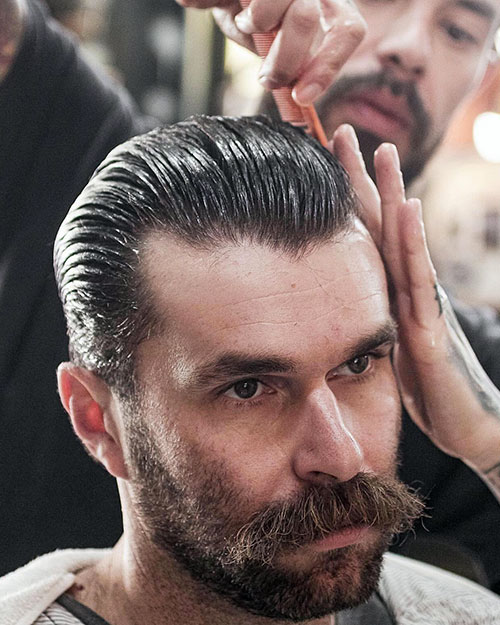
The widow’s peak slick back makes the pointed center of the hairline an intentional feature. A straight-back direction emphasizes the natural V, while a slight diagonal can soften asymmetry if one temple sits farther back than the other. The most flattering finish depends on density. Dense hair can support stronger shine and comb lines, while finer hair generally looks fuller with lift and lower shine. Ask your barber to preserve enough length around the front corners so the hairline does not appear unnecessarily narrow. Blow-dry from the peak backward and choose a flexible product that does not separate the strands too aggressively.
Slick Back for Thin Hair
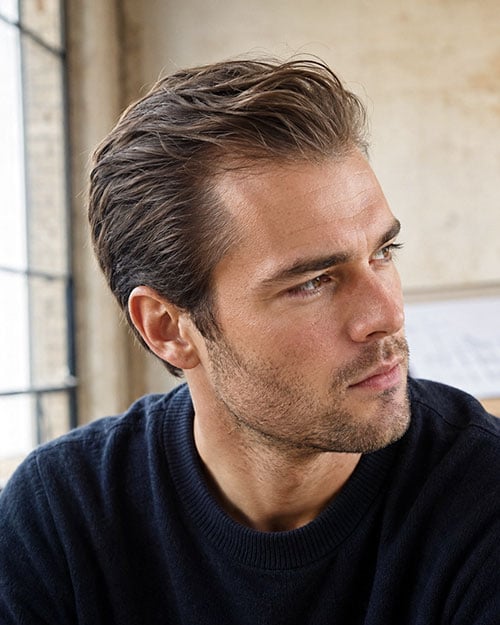
The slick back for thin hair uses root lift, moderate length and restrained product to reduce scalp exposure. Tight comb lines and glossy gel separate fine strands into narrow sections, allowing light to reflect off the scalp. A softer brush back is often more flattering than a completely flat classic slick back. Keep enough length to create coverage but avoid growing the top so long that it collapses under its own weight. Blow-dry backward while lifting at the roots, then apply a small amount of matte paste or lightweight cream with your fingers. Stop adding product as soon as the shape holds.
Slick Back for Thick Hair
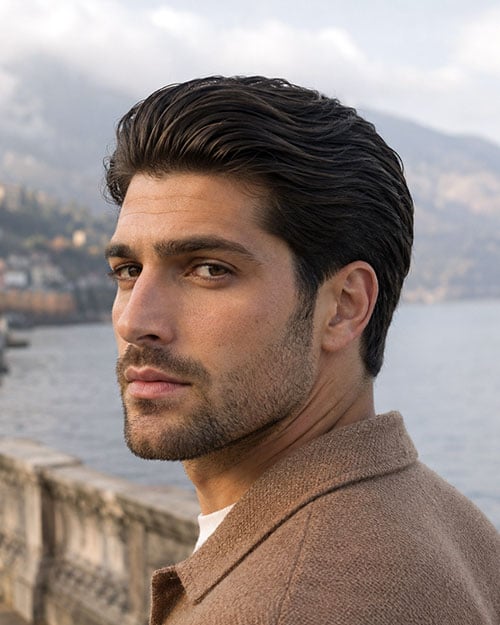
The slick back for thick hair turns natural density into a full, sculptural flow, but only after the bulk has been managed in the right places. Removing too much weight can make coarse or wavy hair expand and frizz, while leaving everything one length can create a shelf at the crown and puffing above the ears. “With thick hair, I want to remove weight underneath without making the surface look thin or wispy. The outside should still look dense and polished even though the interior has been opened up enough to move,” Garibay notes.
Ask your barber to assess the growth pattern and remove weight strategically through the interior without weakening the perimeter. Blow-dry section by section until the direction is established, then work a medium-hold pomade or pliable paste beneath the surface so the product reaches the dense inner layers.
Slick Back with Receding Hairline
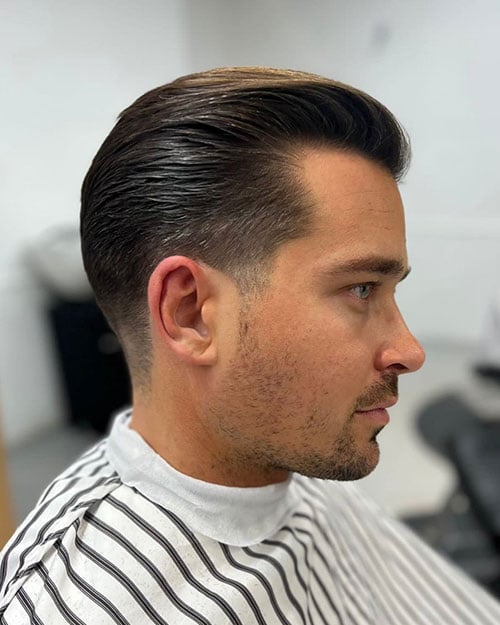
The slick back with a receding hairline can look confident and intentional, but it does not flatter every pattern of recession in the same way. A balanced widow’s peak may suit a straight-back direction, while uneven temples often look softer with a diagonal sweep, additional front lift or a loose brush back. Keep the sides tapered rather than extremely high if removing them would make the temple recession appear more pronounced. Use a matte or low-shine product sparingly and avoid pressing the front flat. The goal is not to hide the hairline, but to choose a direction and finish that frame it well.
Grey Slick Back
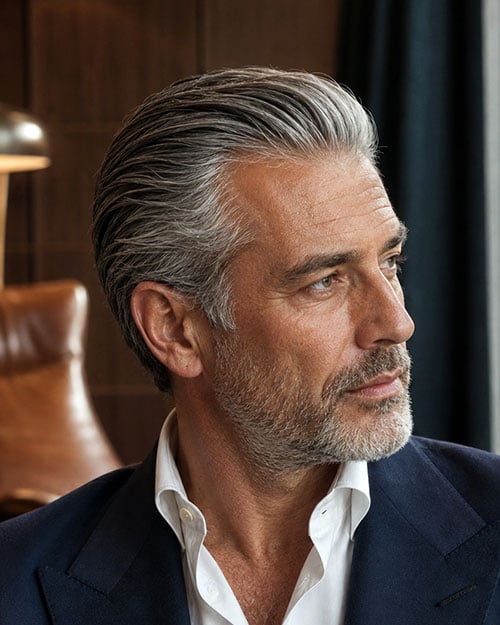
The grey slick back highlights the natural contrast and dimension in silver hair, giving the style a mature, deliberate character. Grey strands can feel drier, coarser or more resistant, which makes conditioning and product texture especially important. A heavy clay may catch on the hair and produce a brittle surface, while a cream-based pomade provides control with more pliability. Ask for soft layering and a connected taper that complement the movement rather than creating excessive contrast. Blow-dry on moderate heat with protection, then use a light sheen to enhance the silver tones without making the hair appear wet.
Blonde Slick Back
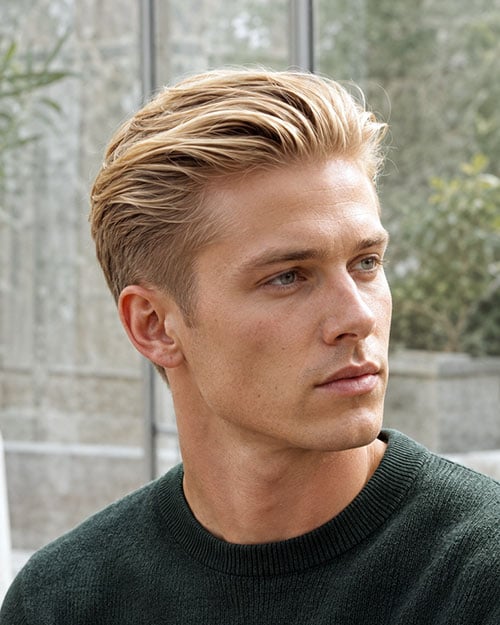
The blonde slick back makes the direction and separation of the hairstyle more visible because lighter strands catch highlights across the backward flow. Natural blonde hair can look soft and refined, while bleached versions create a bolder editorial effect. Processed hair requires additional moisture and gentler heat because damage becomes obvious when the surface is combed cleanly away from the face. Use color-appropriate shampoo as needed rather than automatically overusing purple formulas, condition regularly and apply a lightweight cream or low-shine pomade. The product should preserve luminosity and movement without turning the lighter hair dark or greasy.
How to Ask Your Barber for a Slick Back
Say You Want the Haircut Built to Be Worn Back
Lead with the direction: “I want this cut to be worn slicked back.” That tells your barber that the front needs enough length to reach backward, the crown must connect smoothly and the internal weight should support rearward movement. Do not rely on the name alone because one barber may picture a classic scissor-cut style while another imagines an undercut or skin fade.
Choose The Cut On The Sides
Specify whether you want natural scissor-cut sides, a taper, a full fade or a disconnected undercut. These are structural decisions, not small finishing details. A taper provides the most forgiving professional option, a low or mid fade adds modern contrast, a high fade exposes more scalp and an undercut creates a hard boundary beneath the top.
“Choose the sides based on how you want the haircut to look three or four weeks later, not only on day one. A soft taper grows in quietly, while a skin fade makes every bit of regrowth much more noticeable,” Garibay says.
Specify a Useful Top Length
Instead of asking vaguely for “long on top,” describe where you want the front to reach and how much daily styling you will accept. Approximately three to five inches works for many full slick backs, but texture and growth direction change the requirement. Shorter hair creates a compact brush back, while longer hair creates flow and may eventually support a bun.
Discuss the Crown and Transition
Ask how the top will connect through the crown and into the sides. A bulky shelf at the back is one of the most visible failures in this haircut. Men with a strong crown swirl may need additional length or carefully placed weight so the area does not split after drying.
Mention the Finish You Plan to Wear
Tell your barber whether you prefer a glossy classic finish, natural movement or matte texture. The intended finish affects how much separation and internal texture the top needs. A barber should also consider density and condition before recommending heavy point cutting or thinning.
Flag Your Growth Pattern
Point out cowlicks, forward-growing sections and any temple that behaves differently from the other. Styling can redirect the exposed hair shaft, but it does not permanently change the direction created by the follicle. Keeping strategic length around a difficult area is often more effective than trying to overpower it with more product.
“If the crown keeps splitting when you brush everything straight back, don’t immediately reach for more product. Shifting the direction slightly off-center can let you work with the growth pattern instead of fighting it every morning,” explains Garibay.
Use This Barber Request as a Starting Point
“I want the top cut to be worn back with enough length at the front to reach the crown. Keep the crown connected so it does not form a shelf. I want a [taper, low fade, mid fade or undercut] on the sides and a [matte, natural or glossy] finish. Please work with my cowlick and hairline rather than cutting through them.”
Bring a front and side reference photo whenever possible, since the height of the side treatment and the position of the crown connection are easier to show than describe.
How to Choose the Right Slick Back Haircut
Start with Your Hairline and Density
The slick back exposes the forehead and hairline. A balanced or peaked hairline can become a strong feature, while temple recession and diffuse thinning become more visible when the hair is pressed flat. Men with fine density usually benefit from moderate length, root lift, finger separation and low shine. Dense hair can support stronger definition but often needs thoughtful weight management.
Work with Your Natural Texture
Straight hair creates the smoothest classic shape and usually needs the least length. Wavy hair adds movement and works well in loose or textured versions. Curly hair should be directed backward without being forced flat, while coarse hair often needs moisture and a pliable product. The goal is to control the texture you have, not make every hair type imitate straight hair.
Respect the Growth Pattern
Hair that grows strongly forward or swirls at the crown needs more length, heat and daily direction than hair that naturally travels backward. Push your damp hair back without product and watch what happens as it dries. If the front separates or the crown opens, show those areas to your barber before the cut so the weight can be adjusted around them.
Consider Face and Head Shape
A rounder face can often support a little front height and cleaner sides, while a long face usually looks more balanced with less lift and fuller side weight. Strong square features suit both classic and faded versions. Head shape matters just as much as face shape because a very high fade can expose flat spots or pronounced curves that a taper would soften. Treat these as balancing principles rather than rigid rules.
Be Honest About the Daily Routine
Most versions are relatively low-maintenance, but the haircut is not completely self-styling. A medium slick back usually needs dampening, a short directional blow-dry and a small amount of product. Wet looks and resistant growth patterns require more work, while a short brush back or loose taper can be reset quickly with damp hands.
Make Sure You Have Enough Length
A short brushed-back shape may work at two to three inches, while many traditional slick backs need roughly three to five inches at the front. Curly, very thick or strongly forward-growing hair may require more. Starting from a short crop, the grow-out can take several months depending on the target length and individual growth rate.
Plan for Product Buildup
Daily pomade, clay or gel can leave residue even when the style looks clean. Water-based products usually rinse more easily, while traditional oil-based pomades may require a dedicated cleansing routine. Choose shampoo frequency based on your scalp, activity level and product rather than following one schedule for everyone. Men prone to irritation or acne along the hairline should avoid letting heavy product sit against the skin unnecessarily.
How To Style A Slick Back
Start with Damp, Detangled Hair
Begin with clean or refreshed hair that is damp rather than dripping. Detangle gently from the ends toward the roots before forcing the hair backward. This is especially important for long, curly, bleached or dry hair, which can break when a fine-tooth comb is dragged through knots.
Set the Direction with Heat
Point the blow-dryer from the forehead toward the crown while guiding the hair with your fingers, a vent brush or a wide-tooth comb. Lift slightly at the roots if you want fullness, or keep the brush closer to the head for a flatter classic shape. The blow-dry creates the foundation, while product reinforces the direction and finish.
Select the Product by Finish and Hair Type
Match the formula to both the look and the hair carrying it:
- Classic shine: Use a water-based or traditional pomade with medium-to-firm hold.
- Matte texture: Use clay or paste, but choose a softer formula for dry, coarse or grey hair.
- Loose movement: Use styling cream, mousse or sea salt spray with a small amount of flexible paste.
- Fine or thinning hair: Use a lightweight matte paste or cream sparingly after creating root lift.
- Thick hair: Use a pliable medium-to-strong product and distribute it beneath the surface in sections.
- Curly hair: Use curl cream or flexible gel that controls frizz without flattening the pattern.
- Wet look: Use a high-shine pomade or wet-look gel on dense, damp hair.
“Most guys put the most product where they can see it, which means the hairline gets overloaded. Start farther back, distribute the product evenly and give the front the lightest final pass so you keep some lift instead of making it flat and greasy,” Garibay suggests.
Match the Finish to Your Hairline and Density
Product finish changes how clearly the slick back displays the scalp and hairline. Glossy pomades create darker, more separated sections that can look exceptional on dense hair. On fine or thinning hair, that same separation may reflect light off the scalp and make sparse areas more noticeable.
For a maturing hairline, I generally recommend a matte or low-shine product with modest height and finger separation. The goal is not to conceal the temples. It is to avoid a flat, wet surface that makes every change in density more obvious. A widow’s peak can suit a straight-back direction, while uneven recession may look more balanced with a slight diagonal or looser brush back.
“I choose the finish after I look at the hairline, density and condition of the hair. Not simply because a client says he wants a slick back,” explains licensed barber James Goodman. “If the front is thinning, a dry, flexible finish with some lift will almost always be more flattering than a tight, glossy comb-through.”
Coarse, grey or naturally dry hair may need a cream pomade rather than a heavy clay. The hair should stay back because it was cut and dried in the right direction, not because it has been saturated or pulled tight.
Apply Product in Small Layers
Warm a modest amount thoroughly between your palms. Apply from the back and sides of the top before finishing at the front so the hairline does not receive the heaviest concentration. Work through the inner layers on dense hair instead of coating only the surface. If the style needs more control, add a second small amount rather than beginning with a large scoop.
Choose the Right Tool
A fine-tooth comb creates tight, formal lines. A wide-tooth comb gives softer definition and reduces pulling. A vent brush adds lift while maintaining a clean direction, and fingers create the loosest, most textured result. Tool choice can take the same haircut from formal to casual without changing the cut.
Reset with Water Before Adding More Product
If the style falls during the day, dampen your palms and press the hair back before reaching for more product. Many water-based formulas reactivate with moisture. Adding repeated layers without resetting the shape is more likely to create grease and weight than additional hold.
Common Slick Back Problems and How to Fix Them
The Hair Falls Forward Within an Hour
The front may be too short, the hair may have been styled from dry without setting the direction or the product may not match the density. Dampen the hair, blow-dry from front to crown and use the brush or fingers to maintain tension until the section cools. If the hair still springs forward, grow additional length or ask your barber to preserve more weight at the front.
The Crown Splits or Sticks Up
A crown swirl cannot be erased with product. Cutting it too short or removing the wrong weight often makes the split more obvious. Allow the crown to dry in its natural direction first, then guide it into the backward flow. Your barber may need to leave the swirl longer, change the connection or adjust the direction slightly rather than forcing everything straight back.
The Style Looks Greasy Instead of Polished
Common causes include applying too much product, choosing more shine than the hair can support or adding pomade before the hair has been shaped. Start with less, distribute it below the surface and apply the lightest amount at the hairline. Switch from glossy pomade to a natural-finish cream or paste if the scalp and strands appear overly reflective.
Fine Hair Separates and Shows the Scalp
Avoid a tight fine-tooth comb, heavy gel and flat drying. Use a volumizing pre-styler if needed, lift the roots while drying and finish with fingers or a wide-tooth comb. A loose diagonal direction can provide more visual coverage than perfectly straight comb lines.
The Sides Puff Out
The sides may be sitting at an awkward transitional length, carrying excess bulk or drying outward from the head. Ask your barber whether they should be tapered shorter, layered to lie flatter or left longer so their weight controls them. Direct the sides backward and slightly downward during the blow-dry rather than applying more product after they have already expanded.
Humidity Brings Back Frizz and Movement
Use a smoothing cream or flexible anti-humidity product before drying, make sure the hair is fully dry and finish with a light setting spray if the environment demands it. Wavy and curly hair should retain some natural movement. Trying to eliminate every bend often requires so much product that the finished style becomes stiff or greasy.
Barber-Approved Style Tips for a Sharper Slick Back
Practice the Direction Without Claiming to Change the Follicles
Repeatedly blow-drying and arranging the hair backward can make the routine easier because you become more consistent and the styled shaft settles into a familiar shape. It does not permanently retrain the follicle or remove a cowlick. Continue working with the natural growth pattern and use the haircut to reduce resistance where possible.
Use the Cool Shot to Set the Shape
After directing the hair backward with warm air, continue brushing while using the dryer’s cool setting for several seconds. Cooling helps the styled hair retain the shape established during drying. It is most useful at the front and around resistant sections of the crown.
Use Less Product and Place It More Deliberately
Many failed slick backs are product-distribution problems rather than hold problems. A heavy surface coat weighs the hair down and makes the finish look oily. A smaller amount worked through the roots and inner layers holds more effectively, especially on thick hair. Add product in stages and stop as soon as the shape stays in place.
Ask for Strategic Weight Management
Do not automatically request thinning shears or aggressive point cutting at every appointment. Thick straight hair may benefit from internal weight removal, while wavy, curly, fine or dry hair can become frizzy and weak if too much is removed. Ask your barber to reduce only the bulk that prevents the hair from traveling backward and to preserve the perimeter needed for control.
Keep the Crown and Neckline Clean
The backward direction draws attention toward the crown and nape, so a bulky transition or overgrown neckline becomes noticeable quickly. A taper generally grows out more gracefully than a skin fade, but both should remain connected to the top. Clean the neckline carefully between visits only if you can follow its natural shape without pushing it higher.
Maintenance
Choose a Trim Schedule Based on the Sides
A skin fade may look its sharpest for approximately two to three weeks, while a taper or scissor-cut perimeter can often remain presentable for three to five weeks. Longer tops may only need shaping and weight management at each visit. Let your tolerance for grow-out determine the schedule instead of treating every slick back as equally demanding.
Build a Wash and Scalp Routine Around the Product
Rinse or cleanse as needed to prevent residue from accumulating around the scalp and hairline. Water-based products usually remove more easily, while oil-based pomades may require a stronger shampoo or more than one wash. Conditioner helps offset frequent heat and cleansing, especially on long, curly, processed or grey hair. There is no single shampoo interval that fits every scalp and formula.
Protect the Hair from Repeated Heat
Frequent blow-drying can worsen dryness and damage, particularly on bleached, long or already fragile hair. Use moderate heat, keep the nozzle moving and apply a light heat protectant when drying regularly. The goal is directional control, not maximum temperature.
Use the Grow-Out to Your Advantage
The slick back has a flexible progression. A short brush back can grow into a medium slick back, a medium version can become a loose flow and a long slick back can eventually be tied. Continue shaping the crown and perimeter during the process so the additional length feels intentional instead of simply overgrown.
Frequently Asked Questions
What is a slick back hairstyle?
A slick back is a men’s hairstyle in which the hair on top is directed away from the forehead toward the crown and nape. Traditional versions are smooth and straight back, while modern variations can be textured, side-parted, faded, tapered or undercut. The unifying feature is the rearward direction.
How long does hair need to be to slick back?
Approximately three to five inches at the front works for many full slick backs. Straight hair may cooperate at a shorter length, while curly, thick or strongly forward-growing hair may need more. A two-to-three-inch top can usually create a shorter brush-back version.
Is a slick back professional?
Yes. Classic, tapered, executive and side-parted versions are appropriate for most professional settings when the perimeter is clean and the finish is controlled. Low and mid fades fit many business-casual environments, while high skin fades, wet looks and disconnected undercuts make a stronger statement.
Does a slick back work with thin hair?
It can, but a loose brush back is often more flattering than a flat, glossy comb-through. Create lift at the roots, keep the length moderate, use a lightweight matte product and avoid tight comb lines that separate the strands and expose the scalp.
Can curly hair be slicked back?
Yes. Direct the curls away from the face while preserving their pattern instead of trying to make them completely smooth. Ask for layering based on the dry curl shape, use curl cream or flexible gel and style with fingers or a wide-tooth comb.
What product is best for a slick back?
Use pomade for classic shine, clay or paste for matte texture, cream for natural movement, flexible gel or curl cream for curls and wet-look gel for maximum gloss. Hair density, dryness and desired finish matter more than the product category alone.
How do I get my hair to stay slicked back?
Start with sufficient length, set the direction on damp hair with a blow-dryer and apply a modest amount of product through the inner layers rather than only on the surface. Cool the hair in position and reset with damp hands before adding more product during the day.
Does a slick back cause hair loss?
Combing the hair backward with reasonable tension is not considered a cause of male pattern hair loss. The concern is repeated pulling from very tight buns, ponytails or other styles that place chronic tension on the hairline. Product buildup is more likely to contribute to irritation or acne than androgenetic hair loss. Avoid painful tension, cleanse according to the product and consult a dermatologist if you notice persistent shedding, recession or scalp inflammation.
Final Thoughts
The slick back remains relevant because one direction can support many different haircuts. A taper makes it conservative, a fade makes it modern, an undercut makes it bold and a change from pomade to paste can move the same top from formal to relaxed.
The best result begins with a cut built around your actual length, density, hairline and growth pattern. Choose the side treatment and finish deliberately, establish the direction with heat before adding product and keep the crown connected as the style grows. When those fundamentals are right, slicked-back hair looks controlled without appearing forced.